
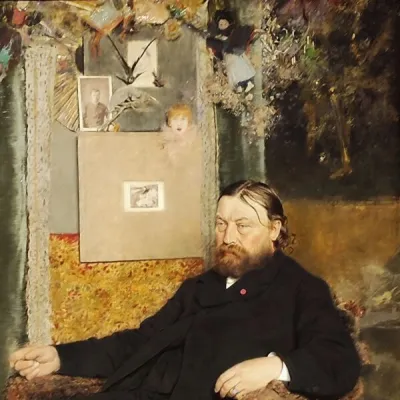
Peter Benoit
Human Design Chart
Biography
Benoit's most important compositions include the Flemish oratorios De Schelde (The river Scheldt) and Lucifer (which met complete failure when it was staged in London in 1888), the operas Het Dorp in 't Gebergte (The village in the mountains) and Isa, and the Drama Christi, a huge body of songs, choruses, small cantatas and motets. Benoit also wrote a great number of essays on musical matters.
He died 8 March 1901.
The Human Design of Peter Benoit: Reflector 6/2
Reflector 6/2 — Design at a Glance
Peter Benoit lived as a Reflector, a type without defined centers. This meant that he did not have constant, personal energies of his own. Instead, his design acted as a mirror for the environment and natural cycles. He perceived the energy of his surroundings and the natural world—such as seasons or planetary constellations—especially intensely and reflected it back.
This openness required a specific strategy: before important decisions, Peter Benoit waited at least one month, that is, a complete lunar cycle. This waiting allowed him to clearly recognize changing influences rather than impulsively reacting to fleeting stimuli.
By living in harmony with these natural rhythms and following his strategy, he automatically found people and environments that suited him. He could observe the world without attachment. As a reward for living according to his design, Peter Benoit experienced a feeling of joyful surprise. If he lived against this mechanism, such as through hasty actions or ignoring cycles, it led to deep, lasting disappointment about himself and the state of the world. His path was to consciously use reflection rather than forcing rigid energies that his chart did not foresee.
No Inner Authority
Peter Benoit lacked an inner, physical authority. This configuration is rare and means that his decision-making did not stem from a defined internal compass but occurred externally through resonance and exchange. As a mental projector, he had no center activation below the throat center. His strategy was to exchange with different people. In dialogue, dormant potentials in his open centers were activated by energetic interactions, providing him specific information. This allowed him to view issues from many perspectives and express them differently. His high resonance ability helped him find the right environment and suitable people for this exchange.
The evaluation of these collected data was a complex process that required time. Peter Benoit should withdraw alone for this purpose. Over time, he recognized the red thread, distinguished what made sense and belonged to him. This developed his specific intelligence: filtering out the essential from a mass of information, meaningfully organizing and structuring it. This formed his capital as a projector. A key in his life was being in an environment where he felt comfortable. There he met the right people for a trusting exchange about decision-making processes, which over time deepened his sense of what was right for him.
The 6/2 Profile — Role Model / Hermit
Peter Benoit's design followed the pattern of Profile 6/2, which foresaw a clear two-phase development. In the first three decades of life, Line 3 energy dominated: Peter Benoit gathered knowledge through intense experimentation and diverse life experiences. This period was marked by trial and error; mistakes served not as failure but as necessary corrective mechanisms for self-control and patience.
Around his thirtieth year, the mechanics of Line 6 kicked in. This marked the transition from external action to internal process. Peter Benoit metaphorically withdrew into a 'cave' to reflect on the previously gathered experiences from a great distance. This phase served healing and acquiring deeper self-knowledge. Line 6 transformed earlier excesses or rule-breaking into conscious wisdom.
Emerging from this withdrawal, Peter Benoit developed into an example role model. His task was to share the introspectively gained integrity and natural talent for contribution with others. Line 2 emphasized selflessness in service to the collective; his individual contribution should serve as a model for others. Although this service could end in crises if not recognized, the goal was to preserve personal integrity through the exchange of life wisdoms. Peter Benoit lived this path from an experimental seeker to a wise teacher who helped others recognize their own depth.
No Definition — Defined & Open Centers
Peter Benoit lived without any defined inner energy source for identity, willpower, or mental clarity. His design mirrored his environment completely: He lacked a constant internal authority in the Head, Ajna, G, Heart, Sacral, Solar Plexus, Spleen, and Root centers. Instead, he absorbed inspiration, concepts, love, emotions, and stress from his surroundings.
This open configuration fundamentally shaped his lifestyle. Without defined Head or Ajna centers, he tended to get caught up in other people's mental monologues rather than generating his own answers. His open G center meant that he did not carry a fixed identity but adapted himself to the people and places around him to discover who he was. He did not actively seek direction but waited to be initiated.
His undefined Heart center meant that he was not designed to make promises or prove willpower; trying to prove himself would only exhaust him. His open Sacral center received vital energy from outside, making him vulnerable to overexertion as he lacked his own boundaries for regulating work rhythms. Emotional waves of the Solar Plexus were amplified without recognizing them as his own.
The open Spleen and Root centers made him sensitive to intuition and stress from the environment. He tended to avoid spontaneous decisions since his Spleen center reflected conditioning rather than true instincts. The absorbed stress in his Root center could manifest as pressure he did not generate himself. Peter Benoit relied on reflecting external influences rather than controlling or accepting them as his own truth. His wisdom lay in perceiving and mirroring the field of others without identifying with it.
Channels & Gates
Peter Benoit's design inclined him towards logical formulation and strategic power accumulation. His energy was significantly influenced by Gate 4, the Gate of Formulation. This gate responds to doubt through the development of formulas that clarify suspicious patterns, thereby creating future security. This process allowed him to act successfully despite uncertainty and feel free from revenge or punishment by understanding causal relationships.
This analytical foundation was supported by further energetic influences. Gate 49 brought emotional principle loyalty into play. It acted on transformation at tribal levels and obedience towards deep values in family and community. The emotional wave determined his discernment, while the Gate of Sacrifice redistributed resources when it aligned with principles.
Parallel to this, the Gate 8 of Contribution was active. It drove him to stand individually for group goals and bring attention through the vitality of his uniqueness. His expression of identity served as a creative role model that needed reinforcement to mutate and flourish.
The adept handling of power and resources stemmed from Gate 14. This gate provided direction and self-control in amassing greatness, dealing not with raw violence but graceful control and wealth management. The pulsating nature of this gate guided directional finding, which required external impulses to fully manifest. Together, these gates formed a profile that combined logical clarity with emotional depth and strategic influence, always focusing on creating security through understandable formulas.
Circuit Signature
Peter Benoit's design was characterized by the complete absence of defined circuits and streams. This meant he did not have any specific archetypal role or function in collective consciousness prescribed by one of the forty-six circuits. His Human Design showed a 'No Definition' type, which manifested as empty groups and missing channel connections.
This configuration granted him absolute freedom from collective expectations and patterns. Peter Benoit was not bound to a particular task for the collective. Instead, he could develop spontaneously and authentically without feeling pressured to fulfill a specific energy or function. Since no circuits were defined, there was no set energetic flow guiding his actions or framing them. He acted independently of typical role models created by active circuits. This undefined state allowed development based purely on his individual nature, uninfluenced by external archetypal prescriptions. His design offered a space without pre-scripted narratives in which he could move freely without growing into collective patterns or fulfilling them.
Left Angle Cross of Revolution 2
Peter Benoit's Human Design profile featured the Left Cross of Revolution, a configuration that deeply influenced his inner drive towards change and renewal. This was not superficial restlessness but rather a fundamental dynamic to question existing structures and develop revolutionary impulses from within. This energy served as a driving force for personal and potentially external upheavals aimed at breaking through old, unsustainable frameworks.
The cross often linked the need for spiritual or intellectual renewal with the practical implementation of new paths. Peter Benoit was marked by this revolutionary potential: He did not merely seek answers but rather sought to reframe questions themselves in order to prepare the ground for entirely new realities. The internal tension of this design lay in the constant movement between destroying the old and creating the new. It was about a transformative power that propelled him to transcend boundaries and break established patterns to come closer to a deeper truth or more authentic expression. This revolutionary energy was not coincidental but a central component of his energetic signature, characterizing his life through continuous change and the search for liberation from old constraints.
Saturn Return · Uranus Opposition · Chiron Return · 2nd Saturn Return — Life Cycles
Peter Benoit's design showed a clear cyclical structure with two prominent return phases serving as turning points for professional legitimization and academic recognition. These phases formed the framework of his public effectiveness.
The first Saturn Return occurred at age 27, marking often the transition from a search phase to structural anchoring where years of groundwork condenses into a solid result. For Peter Benoit, this became concrete in 1861: He was appointed conductor at the Théâtre des Bouffes-Parisiens. This appointment signaled external confirmation of his professional competence and created the necessary platform for further development.
Later came the Chiron Return, a fulfillment cycle around age 49 to 51. During this phase, one's incarnation cross unfolds increasingly; meaning and purpose become experiential if lived according to their strategy. This is not about healing old wounds but rather a bloom time of self-actualization. For Peter Benoit, this unfolding was evident in 1882 at age 48 when he was elected as a full member of the Royal Academy of Sciences and Fine Arts of Belgium. This admission into Belgium's highest scientific institution confirmed the completion of his path to academic recognition and underscored the deep resonance of his life mission with the societal framework. Both events illustrate how his inner mechanics were validated through external milestones.
Reflector · No Inner Authority — Synthesis
Peter Benoit lived a life deeply marked by his ability to reflect the energy around him. As a Reflector with fully undefined centers, he intensely perceived the world around him and reacted without a constant internal reference point. This openness, combined with a profile as an exemplar role model, points towards someone who learned through experience and collected wisdoms that could later be passed on to others. The prioritization of Gates in his cross – particularly Gate 4, which formulates logical processes, and Gate 8, emphasizing the individual contribution – suggests Peter Benoit had the ability to recognize patterns, develop solutions, and bring his unique perspective into the world. His career development, marked by his appointment as conductor at age 27, could have been an expression of this natural gift manifesting in the design and leadership of creative processes.
Simultaneously, Peter Benoit lived in a constant tension field between adaptability and the need for inner orientation. The undefined centers made him receptive to external influences while the lack of defined authority meant he could not make decisions based on firm internal foundations. Instead, he was reliant on reflecting the energy around him over an extended period – a process amplified by the Moon cycle. This dynamic might have led to a profound search for authenticity and constant weighing between accepting influences and preserving his identity. His recognition as a full member of the Academy at age 48 could be a result of this inner struggle, a sign that he had found his place by utilizing his unique ability to reflect and shape.
Incarnation Cross - Left Angle Cross of Revolution 2
Solar Return
The Solar Return shows the moment when the sun returns to its exact birth position - your personal solar year.
Life Cycles
Discover the life cycles with a detailed triple view (birth chart, cycle chart, composite).
Human Design Profile
- Type
- Reflector
- Strategy
- Wait a lunar cycle (approx. 28 days)
- Authority
- No inner authority - learn more
- Profile
- 6/2 - Role Model / Hermit
- Definition
- No Definition
- Incarnation Cross
- Left Angle Cross of Revolution 2
- Date of Birth
- 17.08.1834 03:00
- Place of Birth
- Harelbeke, Belgium
Frequently Asked Questions
What is Peter Benoit's Human Design type?
Which Profile did Peter Benoit have in Human Design?
What Authority did Peter Benoit possess?
What incarnation cross did Peter Benoit have?
When was Peter Benoit born?
Discover your own Human Design
Are you also a Reflector? Find out in a personal reading how to find the right environment and understand your unique mirror effect.
More Personalities
Back to overviewAaliyah

Alexia

Alizée

Angèle

Anne-Marie

Arcángel
