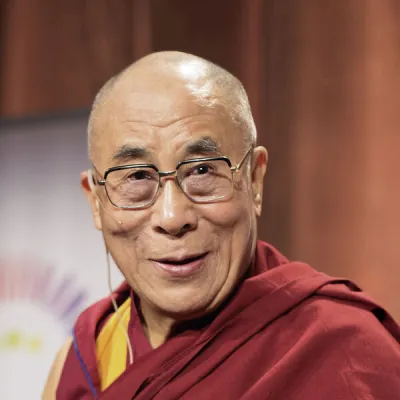
Dalai Lama XIV
Human Design Chart
Biography
A belief central to the Tibetan Buddhist tradition as well as the institution of the Dalai Lama is that the reincarnated person is a living Bodhisattva, specifically an emanation of Avalokiteśvara (in Sanskrit) or Chenrezig (in Tibetan), the Bodhisattva of Compassion. The Mongolic word dalai means ocean. The 14th Dalai Lama is also known to Tibetans as Gyalwa Rinpoche ("The Precious Jewel-like Buddha-Master"), Kundun ("The Presence"), and Yizhin Norbu ("The Wish-Fulfilling Gem"). His devotees, as well as much of the Western world, often call him His Holiness the Dalai Lama. He is the leader and a monk of the newest Gelug school of Tibetan Buddhism.
The 14th Dalai Lama was born to a farming family in Taktser (Hongya village), in the traditional Tibetan region of Amdo, at the time a Chinese frontier district. He was selected as the tulku of the 13th Dalai Lama in 1937, and formally recognised as the 14th Dalai Lama in 1939.
Dalai Lama XIV as a Generator 4/6 in Human Design
Generator 4/6 — Design at a Glance
The Dalai Lama XIV's design points to an inclination towards immense endurance and profound internal energy capacity. He was someone who did not unfold his strength by forcing initiatives or pushing forward his own plans, but exclusively through reacting to impulses from his environment. This configuration corresponds to the Generator type, a being with much sacral energy – comparable to a workhorse that is extremely strong and steady as long as it has the right task.
The central mechanism of his design lies in responding. When he answers inner signals from his solar plexus center – that clear 'Yes! Let's get started!' –, he experiences deep fulfillment and satisfaction. This feeling of reward occurs when his actions are in harmony with this internal compass. Conversely, ignoring these signals or acting against his own will, such as initiating without a prior impulse, leads to frustration and energy loss.
Two pitfalls characterize this design: On the one hand, the risk of investing energy into things where there is no inner desire, which tends towards long-term exhaustion. On the other hand, the feeling of being blocked when prevented from his heart project despite still having full power available. His successful strategy was to wait for life signals and then act from the gut, thereby nobody could stop him.
Emotional Authority
The Dalai Lama XIV's design points to a tendency towards transient emotional fluctuations that made spontaneous judgments appear deceptive. His inner authority resided in the defined Solar Plexus Center – the emotional authority. This mechanism means: Every type except the Reflector can carry this authority; it always takes precedence over other defined centers, regardless of further configurations.
The emotional wave generates a permanent up and down of feelings. The world is always colored by the current mood: Total enthusiasm for something in one moment, an extremely negative view on the same thing in the next. However, the immediate feeling is only a snapshot, a first impression, not necessarily the truth yet. Quick decisions out of this emotional heat can have negative consequences.
Instead, decisions require time-lapse and emotional distance. The more time is given, the deeper and broader understanding arises. This requires patience and multiple reconsiderations of a decision. One should take their time to ask again and again. Over time, intense feelings subside, an emotional distance wins out, and eventually clarity and calmness set in. Then one has gone through the process. This primarily applies to long-term decisions with significant influence on life's course.
The 4/6 Profile — Opportunist / Role Model
The Dalai Lama XIV's design was marked by a clear development line: from an experimental networker in the early phase to a reflective wide perspective in later life. This dynamic stemmed from Profile 4/6 (Networker/Role Model). In the first three decades, Line 6 still acted like Line 3; thus, Dalai Lama XIV appeared as someone who enjoyed experimenting much in relationships and friendships.
With the activation of Line 6, an inner conflict came to light: The desire for community (Line 4) stood in opposition to the need for distance and meaningful reflection (Line 6). This described a lifelong tension between heart and head. The great heart of Line 4 learned to handle its environment carefully to avoid injuries from 'false' people.
Furthermore, Line 6 led to an evolution towards wisdom in chaos. Dalai Lama XIV's design indicated that ineffective action leads to disorder, while correct actions create inner order. In later life, he was expected to meet the demands of a wise role model and stand out through cooperation. Line 6 also marked a transition to spiritual ego (Gate 51), where moderation and careful judgment before acting were central aspects of his internal structure.
Triple Split Definition — Defined & Open Centers
Dalai Lama XIV's design indicated a tendency towards extreme, constant inner activity: a permanent state of vital energy, willpower, and mental pressure. This massive internal force resulted from the definition of all four engines – Sacral, Heart, Root, and Solar Plexus – combined with the mental centers Head and Ajna. The defined Sacral Center generated an inexhaustible vital base, while the Heart Center provided clear willpower and self-responsibility. The existential drive came from the Root Center, filtered through the emotional depth of the Solar Plexus, which served as inner authority and required decisions to be made only after waiting for the emotional wave.
Simultaneously, the defined Head and Ajna Centers created a constant mental pressure to question, understand, and form concepts. This was not spontaneous inspiration but rather a structural necessity to engage with complex connections without directly implementing them into action due to the missing connection to manifestation.
The challenge lay in the open centers: G, Spleen, and Throat. The open G Center meant no fixed identity or direction; Dalai Lama XIV relied on initiation through interaction and environment rather than dictating his own path. The open Spleen Center made him vulnerable to conditioned fears about health and survival, making spontaneous decisions seem risky. Finally, the open Throat Center led to communication not flowing from inner stability but being situational and taken up by the environment. Instead of forcing it, the mechanics were designed to channel this immense energy through strategy and authority rather than leaking it through the open centers.
Channels for change, clarity and communal connection.
Dalai Lama XIV's design indicated a tendency towards unpredictable, mutative change that could not be arbitrarily controlled. His actions were based on inner pulses and spontaneous inspiration working at their own pace. The Mutation Channel 60-3 connected the Root Center with the Sacral Center via the Gate of Limitation (60) and the Gate of Order (3). This channel brought evolutionary change through a pulsating, melancholic process from chaos to order. It required acceptance of limitation and patience until spontaneous mutation occurred. The energy was powerful and permeated how his unique design manifested.
Parallel to this, the Awareness Channel 61-24 connected the Head Center with the Ajna Center via the Gate of Secrets (61) and the Gate of Rationalizing (24). It generated individual knowledge through inspiration and rationalization. This was not a controllable discovery but rather a sudden experience of knowing, a Satori. The mind would repeatedly think it through until the moment of mutation was reached. It was about knowing what is worth knowing and accepting that one cannot know everything.
Both channels emphasize the unpredictability of energy. Dalai Lama XIV showed himself as someone who waited for the right moment for change and insight. He distinguished between what was worth knowing and what wasn't. His personality was marked by this mechanism: a dedication to the happy coincidence of inner truth showing itself in its own time.
Individual Circuitry — Circuit Signature
Dalai Lama XIV's design indicated a tendency towards a pulsating, creative search for individual identity that was nevertheless limited by the need for traditional cooperation and necessary pauses. This configuration resulted from his Triple Definition: three separate, parallel existing energetic groups without direct flow between them.
The Knowledge Circuit connected two isolated segments in him. The connection between Head and Ajna Centers promoted innovative flashes of insight, while the Mutation Channel (3-60) linked Sacral and Root Centers. This generated a pulsating energy for deviations from the known and new expression, yet without direct coupling to mental impulses.
Simultaneously, the Ego Circuit acted as an independent unit connecting Heart and Solar Plexus Centers via the Community Channel (37-40). It established a rhythm of giving and taking within the tribe. Since this circuit lacked connection to the Sacral Center, there was no constant life force; instead, resource building required timeless pauses for regeneration.
The tension field lay in how the pulsating urgency of individual transformation in the Knowledge Circuit met the conservative need for rest and mutual support in the Ego Circuit. Dalai Lama XIV showed himself marked by these separate streams: on one hand, driving force for new things and mutations, on the other hand, embedded in a cyclical process of social exchange that needed recovery to sustain its effect. The mechanics described not a unified whole but the coexistence of individual creative power and tribal resource management.
Right Angle Cross of Tension 2
The 14th Dalai Lama's design is characterized by the presence of the right cross of tension 2. This configuration forms a specific energetic foundation structure that points to internal tensions, which cannot be further specified or concretized. Without additional details about Gates or Channels, the impact of this structure remains general and abstract. It indicates a fundamental pattern containing tension as a central element of inner dynamics without deriving specific behavioral patterns or action impulses from it. The mechanics of this cross thus act as an undefined but present force in the design, suggesting a certain kind of energy posture whose exact nature remains unclear. This is a structural given that implies tension without translating it into concrete life areas or interaction patterns. This vagueness is part of the given data and defines the character trait as a state of potential but unspecified energy.
Saturn Return · Uranus Opposition · Chiron Return · 2nd Saturn Return — Life Cycles
The 14th Dalai Lama's design was marked by a clear developmental line: the step-by-step transition from personal maturity to broad structural responsibility. This dynamic was significantly influenced by Saturn returns, cycles in which inner clarity is often cast into external, institutional forms.
In 1963, at age 28, the 14th Dalai Lama made a decision that concretely manifested this first maturation process: He announced a constitution oriented towards democratic principles for the Tibetan government-in-exile. This was not an isolated act but rather an expression of a design tending to translate individual values into sustainable social structures in this life phase. Saturn energy here promoted the ability to carry responsibility and make it accessible through clear rules and order for others.
The second major cycle confirmed this orientation on a global scale. In 1989, at age 54, the 14th Dalai Lama received the Nobel Peace Prize. This point marked the culmination of a long-term process: The previously created structures and consistent stance now found international recognition. The design shows how integrity and structural work built over decades can express themselves in a form of validation that extends far beyond the individual. Both events underscore a pattern: The 14th Dalai Lama's path was characterized by the ability to bring inner principles into external, sustainable forms stabilizing communities and recognized worldwide.
Generator · Emotional Authority — Synthesis
A central red thread runs through the design: the dynamic balance between internal exploration and external action. Sacral energy (Generator type) in combination with a defined Head Center that continuously inspires and raises questions (Channel 1-8) points to a deep inner driving force, which must be filtered through emotional waves (Emotional Authority). This constellation favors a process of continuous learning and transformation – a pulsating format from the knowledge circuit – expressed in the ability to tread new paths (Channel 3-60) and inspire others. Line 4 in the Profile emphasizes the importance of networks and belonging, while line 6 adds a desire for reflection and exploring deeper existential questions.
The design reveals a central paradox between the need for connection and the search for individual truth. The Heart (line 4) strives for community and cooperation, while the Head (line 6) prefers a distant perspective and thinking about existential questions. This tension is reinforced by emotional authority, which requires time for maturation processes to gain inner clarity – an up-and-down between the desire for belonging and the necessity of finding one's own path. A significant event (Saturn Return) shows how this tension manifests in professional decisions and successes.
3 Defined Channels
Incarnation Cross - Right Angle Cross of Tension 2
Solar Return
The Solar Return shows the moment when the sun returns to its exact birth position - your personal solar year.
Life Cycles
Discover the life cycles with a detailed triple view (birth chart, cycle chart, composite).
Human Design Profile
- Type
- Generator
- Strategy
- To respond - wait for something to respond to
- Authority
- Emotional Authority
- Profile
- 4/6 - Opportunist / Role Model
- Definition
- Triple Split
- Incarnation Cross
- Right Angle Cross of Tension 2
- Date of Birth
- 06.07.1935 04:38
- Place of Birth
- Taktser, China
Frequently Asked Questions
What is the Human Design type of the 14th Dalai Lama?
What Profile does the 14th Dalai Lama have in Human Design?
What Authority does the 14th Dalai Lama have?
What incarnation cross does the 14th Dalai Lama have?
When was the 14th Dalai Lama born?
Discover your own Human Design
Are you also a Generator? Find out in a personal reading how to use your sacral energy correctly and discover deep satisfaction.
More Personalities
Back to overviewAaliyah

Alexia

Angèle

Anne-Marie

Arcángel

Arno