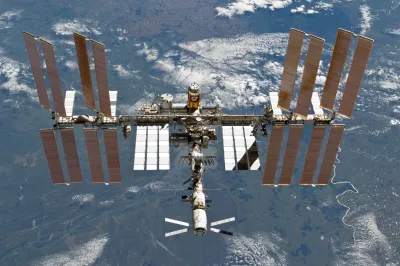
Foto: NASA / Public domain — Wikimedia Commons
Space: International Space Station (ISS)
Human Design Chart
Biography
The project involves five space agencies: the United States' NASA, Russia's Roscosmos, Japan's JAXA, Europe's ESA, and Canada's CSA.
The ISS consists of pressurised modules, external trusses, solar arrays, and other components. ISS components have been launched by American Space Shuttles as well as Russian Proton and Soyuz rockets. In 1984, the ESA was invited to participate in Space Station Freedom. After the USSR dissolved, the United States and Russia merged Mir-2 and Freedom together in 1993.
The ISS serves as a microgravity and space environment research laboratory in which crew members conduct experiments in biology, human biology, physics, astronomy, meteorology, and other fields. The station is suited for the testing of spacecraft systems and equipment required for missions to the Moon and Mars.
Since the arrival of Expedition 1 on 2 November 2000, the station has been continuously occupied for over 22 years (as of March 2023), the longest continuous human presence in space. (In 2010, the station surpassed the previous record of almost 10 years (or 3,634 days) held by Mir.)
The station is serviced by a variety of visiting spacecraft: Soyuz, Progress, the Automated Transfer Vehicle, the H-II Transfer Vehicle, Dragon, and Cygnus. It has been visited by astronauts and cosmonauts from 15 different nations.
Space: International Space Station (ISS) — Generator with Profile 4/6
Space: International Space Station (ISS) is a Generator in Human Design – an energy type with a defined Sacral Center. Generators make up about 36% of humanity and possess an enormous, sustainable life force energy.
The Generator's strategy is to respond to impulses from life rather than initiating. When the Sacral Center responds with a clear "yes" (a gut feeling, an inner spark), that's the right path.
When Space: International Space Station (ISS) lives in alignment with their design, they experience deep satisfaction and fulfillment. The Generator's not-self theme is frustration – a sign that the sacral energy isn't following the right things.
Space: International Space Station (ISS) has Emotional Authority – the most common authority. Decisions should never be made in an emotional high or low, but only when emotional clarity settles in. "Sleep on it" is meant literally here. The emotional wave needs time to run its course.
Space: International Space Station (ISS) carries the profile 4/6 – Opportunist / Role Model. The 4th line represents the Networker: influence and impact unfold through personal relationships and a strong social network. The 6th line represents the Role Model: a life path in three phases – first experimenting (until ~30), then observing from the "roof" (until ~50), and finally authentically embodying the role model.
The incarnation cross "Right Angle Cross of Contagion 4" describes the overarching life purpose and direction of Space: International Space Station (ISS) in Human Design. It consists of the four gate activations of Sun and Earth (personality and design) and only becomes felt when one lives their strategy and authority.
Einfache Definition (Single Definition) - so ist Space: International Space Station energetisch vernetzt.
Definiert bei Space: International Space Station: Sakralzentrum, Wurzelzentrum und Emotionalzentrum (3 von 9). Offen: Kopfzentrum, Ajnazentrum, Kehlzentrum, G-Zentrum, Herzzentrum und Milzzentrum.
Verteilung der Kanäle: Individuell (Wissen): 1 Kanal, Stamm (Schützen): 1 Kanal. Dominanter Schwerpunkt: Individuell - einzigartige Selbstverwirklichung und Mutation.
2 Defined Channels
Incarnation Cross - Right Angle Cross of Contagion 4
Solar Return
The Solar Return shows the moment when the sun returns to its exact birth position - your personal solar year.
Life Cycles
Discover the life cycles with a detailed triple view (birth chart, cycle chart, composite).
Human Design Profile
- Type
- Generator
- Authority
- Emotional Authority
- Profile
- 4/6 - Opportunist / Role Model
- Definition
- Single Definition
- Incarnation Cross
- Right Angle Cross of Contagion 4
- Date of Birth
- 20.11.1998 06:40
- Place of Birth
- Baikonur, Kazakhstan
Frequently Asked Questions
What Human Design type is Space: International Space Station (ISS)?
What Human Design profile does Space: International Space Station (ISS) have?
How does Space: International Space Station (ISS) best make decisions?
When and where was Space: International Space Station (ISS) born?
What is Space: International Space Station (ISS)'s incarnation cross?
Discover your own Human Design
Are you also a Generator? Find out in a personal reading how to use your sacral energy correctly and discover deep satisfaction.
More Personalities
Back to overviewAaliyah

Alexia

Angèle

Anne-Marie

Arcángel

Arno