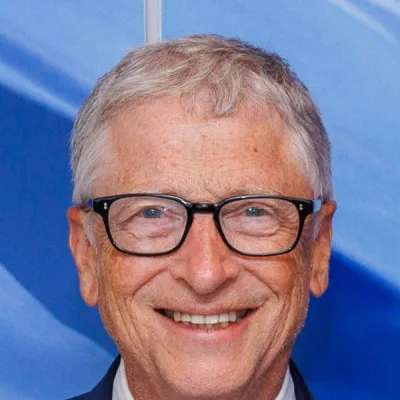
Bill Gates
Human Design Chart
Biography
Born and raised in Seattle, Washington, Gates was privately educated at Lakeside School, where he befriended Allen and developed his computing interests. In 1973, he enrolled at Harvard University, where he took classes including Math 55 and graduate- level computer science courses, but he dropped out in 1975 to co-found and lead Microsoft. He served as its CEO for the next 25 years and also became president and chairman of the board when the company was incorporated in 1981. Succeeded as CEO by Steve Ballmer in 2000, he transitioned to chief software architect, a position he held until 2008.
Bill Gates — Generator with Profile 4/6
Generator 4/6 — Design at a Glance
Bill Gates revealed himself as someone who possessed enormous sacral endurance energy – comparable to that of a workhorse. However, this power was not available through his own initiative but only activated in response to internal impulses. His central strategy was to react rather than initiate.
This design established a clear dynamic: Energy flowed only when there was an accurate response to life signals and brought about deep satisfaction. Acting against this inner compass – whether through forced initiatives or suppressing the impulse – led to frustration, energy depletion, and the risk of burnout. The motto was clear: Do not initiate but wait for a signal from life and then act when the sacral center gave a clear “yes”. If he lived in harmony with this mechanism, no one could stop him; the reward was a feeling of deep fulfillment. Deviations resulted in persistent frustration. Thus, the process of materialization worked differently than for other types: It wasn’t about pushing projects forward through willpower but aligning precisely to the inner rhythm of the “yes” signal from which his immense creative power became effective.
Sacral Authority
Bill Gates demonstrated decision-making that did not take place in the head but was deeply rooted in the body’s center. His design established that his inner truth was communicated through physical signals: a grunt, a hum or a noticeable surge of strength as a direct reaction to external stimuli. This sacral authority is specific to the Generator type and simplifies the process since strategy and authority are identical here – react rather than initiate.
A prerequisite for this was an open emotional center that prevented emotional waves from overshadowing the clear physical response. When Bill Gates encountered something that stimulated his energy, he immediately felt vitality and an inexhaustible enthusiasm. He did not act out of compulsion or abstract planning but because his “sacral motor” kicked in. This allowed him to tackle tasks with great joy and satisfaction, fully immersed in the activity itself without needing external goals for motivation.
Additionally, there was a supportive instance: the active spleen center. In conjunction with the sacral center, this provided quick, spontaneous reaction capability and immediate access to instinctive perception of well-being. This combination allowed him to reliably orient himself towards these physical impulses that served as confirmation of the right path. Thus, his “gut feeling” was his compass-like guiding star in interacting with the world.
The 4/6 Profile — Opportunist / Role Model
Bill Gates showed a development from an impulsive experimenter to a trust-based role model. In the first three decades of his life, his design worked like that of a Line 3: he experimented intensively, especially in relationships and friendships. This corresponded to the early phase of Profile 4/6 before the mature energy set in.
Later, an internal conflict emerged: The Line 4 in Heart sought community connection and network maintenance. It brought persistence with it and ensured that he held onto connections even if they took unexpected turns. At the same time, Line 6 in Head demanded distance and wisdom. This line withdrew to check the sense and required absolute certainty as well as alignment of word and deed. Without this assurance, it refused leadership.
Thus, Bill Gates’ life revolved around the tension between the desire for belonging and the necessity of withdrawal for reflection. In his later years, he was expected to meet the high standards of a wise role model. His big heart remained cautious; it only opened up to others when cooperation was safe and no threat of injury loomed. This balance between network-oriented holding on and searching distance shaped his role as someone who stood out through trusting collaboration, always mindful not to trust the wrong people.
Split Definition — Defined & Open Centers
Bill Gates revealed through his design as someone whose mental concepts could be directly translated into action and expression. This direct line between thinking and doing came from his defined Ajna and Throat Centers: What he conceptually understood, he could immediately speak or act upon. However, this ability was only effective when supported by his inner energy source. His defined Sacral Center provided the vital force for endurance and satisfaction, assuming he responded to initiation rather than initiating himself. Simultaneously, his defined Spleen Center offered a reliable intuitive security in the present moment, protecting him from overrunning.
In contrast stood his open centers, which did not have their own constant sources for identity, willpower, or emotional stability. His open G Center meant that he carried no fixed, unchanging identity but rather showed differently depending on environment and relationship partners; he relied on external initiation to guide him in the right direction. Similarly, his open Heart Center lacked a consistent willpower, which could lead to attempts to prove his worth through promises or competition – a trap leading to frustration due to inconsistent energy availability.
His open Solar Plexus absorbed the emotions of his environment like a barometer. He could easily identify with foreign feelings and be perceived as emotionally unstable, although he was actually just reflecting the climate around him. This required a clear distinction between personal and absorbed emotions to avoid falling into conditioning patterns. Likewise, his open Root Center took on external stress. Instead of being driven by this pressure – often leading to hyperactivity or burnout – he had to learn to recognize this adrenalized state as an external phenomenon and let go rather than personalize it. His open Head Center finally received inspirations and questions from the environment without having to generate them independently; it served to perceive mental shockwaves of others without getting entangled in their confusion. The combination of these open centers made him highly sensitive to his surroundings, but simultaneously required strict adherence to his strategy: waiting for initiation and trusting his defined authorities (Sacral and Spleen) to avoid being overwhelmed by the many voices of the environment.
Channels for caring preservation and curious inspiration.
Bill Gates exhibited a fundamental disposition shaped by the tension field between his boundless curiosity and deep sense of responsibility. His design drove him to constantly seek new perspectives while his personality was geared towards securing structures for the 'tribe'. This dynamic created an impulse to present complex connections as instructive parables, stimulating others, combined with the conscious intention to receive values and resources through care.
The Channel of Curiosity 11-56 connected the Ajna Center with the Throat Center. This connection made him a storyteller: He did not seek final answers but used his discoveries to weave ideas and philosophical considerations into stories. This abstract voice filled gaps in information and stimulated the imagination of the audience, influencing people without relying on dry facts. His creativity lay in creating narrative structures from individual impressions that invited others to question new belief systems.
Simultaneously, the Channel of Preservation 27-50 acted as an opposite pole. This channel connected the Sacral Center with the Spleen Center and endowed him with an aura of trust. His energy focused on providing for and protecting his community. Through the Gate of Care (27), he showed selfless interest in others' well-being, while the Gate of Values (50) ensured that traditional laws and order were maintained. This allowed him to take responsibility and build infrastructure securing the survival and success of the tribe. The combination of inspiring storytelling and pragmatic care enabled Bill Gates to act sustainably both intellectually and socially.
Tribal Circuitry — Circuit Signature
Bill Gates was marked by two separate, parallel energetic blocks: a cognitive-emotional reflection space and a deep biological protective instinct. This split definition meant no direct connection between these areas but rather two coexisting energy fields.
The Meaning-Making Circuit connected his Ajna with the Throat Center through the Channel of Curiosity (Gates 11 and 56). Here, it was not about cold logic but processing emotional waves from the past. This energy flowed cyclically – with beginning, middle, and end – serving to visually reflect past events and give them meaning. The goal was sharing these insights with the collective to learn together from history.
Parallel to this, the Protector Circuit connected his Sacral with the Spleen Center through the Channel of Preservation (Gates 27 and 50). This area was primordial, instinctive, and timeless. It served the protection of genetics and family through care, nutrition, and preservation. While the first circuit reflected and shared the past, this second block ensured physical survival and the maintenance of one's tribe. Both circuits shaped his design equally: on one hand, the need to understand and communicate past emotions, on the other hand, the deep drive to instinctively protect and nourish his family.
Right Angle Cross of the Unexpected 3
Bill Gates was marked by a life pattern that did not rely on linear planning but rather on the ability to create new orders from sudden breaks and chaos. His design was characterized by the right cross of the Unexpected, an archetypal structure defining his life path as a cyclical process of transformation. This is not about steady, predictable progress but about accepting unexpected turns and crises as catalytic forces.
Stability in this pattern did not come from avoiding risks or maintaining existing structures. Instead, it was achieved by confronting and integrating the Unexpected. The destruction of old systems was not a setback but the necessary starting point for revolutionary new foundations. This mechanism requires an attitude that does not reject surprises as disruptive factors but uses them as essential impulses to develop coherent and often groundbreaking solutions from apparent chaos. The focus was always on how something new and effective could emerge from the dissolution of the known, rather than defending the old order.
Saturn Return · Uranus Opposition · Chiron Return · 2nd Saturn Return — Life Cycles
Bill Gates was marked by two clear phase transitions structuring his life. The first significant point occurred in 1986: at age 31, Microsoft went public, making him a young billionaire. This corresponds to the first Saturn Return, a cycle symbolizing adulthood and the building of stable structures in Human Design. Years of groundwork condensed into a socially visible result.
The second phase began in 2005. At age 50, Gates and his then-wife Melinda were named Person of the Year by Time Magazine for their charitable work. This fell within the period of the Chiron Return (around ages 49-51). In this mechanism, it is not about healing old wounds but rather a fulfillment cycle of 'blooming'. If one has lived according to their strategy and authority beforehand, their incarnation cross unfolds increasingly in life. Purpose and meaning become experiential, often tied with roles as mentors or givers. For Bill Gates, this cycle marked the transition from structural achievement to meaningful dissemination of resources and knowledge to society.
Generator · Sacral Authority — Synthesis
A central red thread runs through his design: a deep, sacral energy (Generator type) paired with a constant mental process (defined Ajna Center). This combination generates an unrelenting drive to generate ideas and bring them into the world – a cycle of inner reaction to impulses and conceptual elaboration (Channel of Curiosity). The sacral authority strengthens this by providing an immediate physical response to the potential of an idea, while the profile as a networker/role model emphasizes the urge to share insights and inspire others. The Sense Finder circuit suggests that past experiences are always in processing for deriving lessons for the future and passing them on.
The design reveals a central paradox between the need for connection (Line 4 in Profile) and the desire for independent thinking and exploration (Line 6). This tension manifests as an internal conflict between heart and head, intensified by cyclical experiences. While successes like the IPO and accolades point to a public role, the design also hints at a deeper search for meaning beyond external recognition – a constant weighing of fulfilling expectations against pursuing personal insights.
2 Defined Channels
Incarnation Cross - Right Angle Cross of the Unexpected 3
Solar Return
The Solar Return shows the moment when the sun returns to its exact birth position - your personal solar year.
Life Cycles
Discover the life cycles with a detailed triple view (birth chart, cycle chart, composite).
Human Design Profile
- Type
- Generator
- Strategy
- To respond - wait for something to respond to
- Authority
- Sacral Authority
- Profile
- 4/6 - Opportunist / Role Model
- Definition
- Split Definition
- Incarnation Cross
- Right Angle Cross of the Unexpected 3
- Date of Birth
- 28.10.1955 22:00
- Place of Birth
- Seattle, United States
Frequently Asked Questions
What is Bill Gates' Human Design type?
What Profile does Bill Gates have in Human Design?
What authority does Bill Gates have?
What is Bill Gates' incarnation cross?
When was Bill Gates born?
Discover your own Human Design
Are you also a Generator? Find out in a personal reading how to use your sacral energy correctly and discover deep satisfaction.
More Personalities
Back to overviewAaliyah

Alexia

Angèle

Anne-Marie

Arcángel

Arno