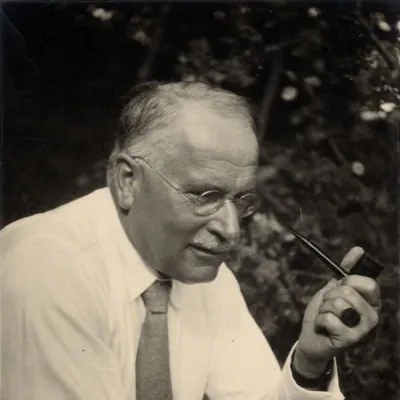
Carl Gustav Jung
Human Design Chart
Biography
Jung worked as a research scientist at the Burghölzli psychiatric hospital in Zurich, under Eugen Bleuler. He established himself as an influential mind, developing a friendship with Freud, founder of psychoanalysis, and conducting a lengthy correspondence regarding their joint vision of human psychology. Freud saw the younger Jung not only as the heir he had been seeking to take forward his "new science" of psychoanalysis, but as a means to legitimise his own work: Freud and other contemporary psychoanalysts were Jews facing rising antisemitism in Europe, while Jung was raised as Christian, although he did not strictly adhere to traditional Christian doctrine, seeing religion, including Christianity, as a powerful expression of the human psyche and its search for meaning.
The Human Design of Carl Gustav Jung: Generator 2/4
Generator 2/4 — Design at a Glance
Carl Gustav Jung possessed immense inner endurance and was known for investing tremendous energy into his work. As a Generator, he had abundant sacral energy that made him an extremely strong 'workhorse'—provided he acted in alignment with his nature. His life strategy did not involve active initiating but rather responding to signals from the environment. Only when his inner self gave a clear 'yes', could he effectively utilize this energy and push projects forward successfully.
However, this design came with two specific risks. On one hand, there was the threat of exhaustion if he engaged in tasks that did not resonate internally and merely wasted his strength. On the other hand, frustration arose when external circumstances prevented him from continuing work on his heart project despite a strong inner drive. Living by the principle of responding from the gut earned him deep feelings of fulfillment and nothing could stop him. Initiating against his internal signal, however, sooner or later led to persistent frustration and a noticeable lack of energy. His success thus depended significantly on whether he responded to impulses or tried to override his natural rhythm.
Emotional Authority
Carl Gustav Jung's design inclined towards profound emotional reflection before making decisions. His inner authority was the Emotional Authority, carried by the defined Emotional Center. In Human Design mechanics, this authority is considered absolutely prioritized: it always takes precedence over all other defined centers in the chart, regardless of their number or type. This meant for him that his perception was constantly colored by the current emotional wave—a perpetual up and down of feelings making the world appear inspiring one moment and negative the next.
A crucial mechanism here is that immediate feeling represents only a snapshot, not the final truth. Spontaneous decisions from such an emotional peak would have proven problematic for his design. Instead, his configuration required patience and time. He had to let decisions mature often through multiple nights of reflection to even out intense feelings. Only when this emotional distance was gained did clarity and calmness set in. This process of 'taking one's time' and inner examination served to recognize deeper connections before making long-term decisions that could significantly influence his life course. His strength thus lay not in the speed of reaction but in the ability to penetrate through emotional turbulence to the true essence of a matter.
The 2/4 Profile — Hermit / Opportunist
Carl Gustav Jung's design inclined towards a constant oscillation between deep withdrawal and close community living. As someone with Profile 2/4, he constantly swung between two fundamental needs: Line 2 representing the urge for solitude and internal processing, and Line 4 indicating the desire to spend time with familiar people within his network. This configuration required him to set clear boundaries—communicating when he sought company and when he needed to remain undisturbed in his 'cave'.
During phases of solitude, Carl Gustav Jung immersed himself in internal processes to gain clarity. Only after satisfying this need for peace did he return to connect with his social environment. This rhythm allowed him to reflect on the knowledge and impulses from his network during isolation, evaluate them, and develop brilliant ideas.
The specific lines underscored this dynamics: The second line in Gate 31 endowed him with a natural leadership ability that without development appeared arrogant or distant from the collective. Simultaneously, Line 4 of Gate 27 showed transpersonal care and generosity in sharing. Carl Gustav Jung had to learn whom he could trust his energy with to avoid blind giving that would have exhausted him. His design thus shaped a person balancing leadership and network maintenance through conscious phases of isolation and reflection.
Split Definition — Defined & Open Centers
Carl Gustav Jung revealed himself as someone with a deeply rooted internal direction and a constant voice. His defined G Center gave him a reliable sense of self-identity and the meaning of his own mission, while his defined Throat Center carried this message to the world. He did not speak out of impulsive drive but from the clarity of his Higher Self.
This expressive ability was fueled by his energy source: the defined Sacral Center. As a Generator, he possessed immense vitality that only became effective when he responded rather than initiated. His strategy involved waiting for life and answering with an inner “yes” or “no” from the gut. If he ignored this sacral response and acted mentally, resistance would arise; if he followed it, he found deep satisfaction in his work.
Alongside this vital force, defined Spleen and Solar Plexus Centers shaped his essence. The Spleen gave him a spontaneous instinct for what was healthy at the moment, while the Solar Plexus offered emotional depth. His inner authority lay within this emotional wave: He had to practice patience and wait for clarity before making decisions. This process helped him achieve a sensitive, multi-layered perception that went beyond fleeting moments.
In contrast, Head, Ajna, and Heart Centers were open. The open Head and Ajna Centers meant his mind was flexible and absorbed ideas from the environment but did not possess a constant mental truth. He tended to identify with others' thoughts or fall into doubt if he didn’t trust his inner authority. An open Heart Center showed an openness to proving his worth through promises or willpower. Instead of genuine willpower, he often sought external validation, which could lead him into spirals of self-doubt if he did not recognize that his value did not need proof. This openness allowed him to mirror and understand the egos and emotional states of others with great sensitivity.
Channels for logical leadership, intuition, impulse and maturation.
Carl Gustav Jung's design tended towards logical, collective leadership combined with a deep intuitive adaptability. He acted through building trust and demonstrating competence rather than absolute authority. This stance came from Channel Alpha 7-31, connecting his G Center to his Throat Center. Gate 7 delivered the logical role of
Collective Circuitry — Circuit Signature
Carl Gustav Jung's design inclined towards strategic, logical thinking free from emotional influence. This attitude stemmed from the Understanding Circuit, which linked his Throat with Identity Centers. Here, the energy of Alpha: focused, future-oriented rationality structured insights clearly communicated. Simultaneously, a completely separate energetic flow existed in his Meaning-making Circuit. It encompassed Sacral, Root, and Solar Plexus Centers as an interconnected unit. Dominating this was cyclical, emotional processing through channels Reification and Recognition, aiming to draw collective lessons from past experiences. Unlike the cool logic of the first circuit, it involved wave-like emotional movements. Given Jung's split definition, these two major circuits were not connected; they operated as parallel forces. A third aspect was the Integration Circuit linking Identity with Spleen Centers. Through Channel Perfect Form, he channeled intuitive knowledge and proper behavior into the highest individuality of the present moment. This strengthened his ability to draw power from reacting to life and making it effective in the current moment. The separation between rational future orientation and emotional past processing shaped his inner experience as two distinct, non-overlapping domains.
Right Angle Cross of the Unexpected 2
Carl Gustav Jung's design indicated a tendency towards unpredictable turning points that often felt like shocks or sudden realizations. This configuration, the Unexpected Right Cross 2, described not linear growth but abrupt changes where old structures suddenly collapsed to make way for new perspectives. For him, this meant that profound insights rarely emerged through step-by-step logical analysis but rather as intuitive flashes that immediately questioned existing beliefs.
This mechanism affected how he dealt with complex psychological phenomena: instead of rationalizing everything, his system allowed the unconscious to suddenly and unexpectedly come to the forefront. It was a dynamics of the "aha-effect," which often came with a feeling of disorientation before clarity emerged. Carl Gustav Jung thus used these sudden insights to uncover deeper truths that were not accessible through conventional means. The power of this design lay in his ability to not fear the unexpected but to accept it as a necessary catalyst for transformation. This fundamentally shaped his approach to human psychology by creating space for spontaneous, often shocking revelations that were then further processed and integrated.
Saturn Return · Uranus Opposition · Chiron Return · 2nd Saturn Return — Life Cycles
Carl Gustav Jung's Human Design showed a tendency to stabilize inner structures and take on responsibility within clear frameworks. This attitude was shaped by his planetary cycles. In 1903, at the age of 28, he married Emma Rauschenbach. This coincided with his first Saturn Return, a phase during which long-term commitments and personal foundations often solidify.
The Uranus opposition marked a time of necessary separation or detachment from established structures. In 1914, at the age of 39, Jung resigned as president of the International Psychoanalytic Association. This event corresponded to the mechanical pressure of this configuration, which often leads to the need to dissolve old bonds in order to follow one's own path.
The Chiron Return, a cycle of fulfillment and blooming life purpose, occurred in 1921 when he published "Psychological Types" at age 46. Here, the incarnation cross was effective; his work crystallized into a coherent expression of his inner truth. Finally, Jung assumed the presidency of the C.G. Jung Institute under certain conditions in 1933, at the age of 58 and during his second Saturn Return. This cycle emphasized again the necessity to exercise authority within defined boundaries and carry structures, underscoring his lifelong engagement with order and responsibility.
Generator · Emotional Authority — Synthesis
Carl Gustav Jung lived as a Generator, whose sacral energy found expression through the definition of his Throat Center, creating a channel for communication and self-expression (Throat Center). This connection to the Identity Center indicated a deep need to speak authentically and convey his inner truth. The Profile Natural Talent/Networker revealed an ongoing oscillation between the desire for inner reflection (Line 2) and the longing for connection and exchange with others (Line 4). This dynamic shaped his ability to gain profound insights as well as share them in a broader context.
A central paradox lay in the tension between his emotional authority and the logical focus of the Understanding Circuit. While he found decisions through a maturing emotional wave, his thinking was marked by structure and future orientation (Gate 31/7). This led to an internal field of tension between intuitive wisdom and rational analysis, which manifested at turning points in his career – both stepping back from a position (1914) as well as taking on new responsibilities (1933) – as well as the need to share and format insights.
4 Defined Channels
Incarnation Cross - Right Angle Cross of the Unexpected 2
Solar Return
The Solar Return shows the moment when the sun returns to its exact birth position - your personal solar year.
Life Cycles
Discover the life cycles with a detailed triple view (birth chart, cycle chart, composite).
Human Design Profile
- Type
- Generator
- Strategy
- To respond - wait for something to respond to
- Authority
- Emotional Authority
- Profile
- 2/4 - Hermit / Opportunist
- Definition
- Split Definition
- Incarnation Cross
- Right Angle Cross of the Unexpected 2
- Date of Birth
- 26.07.1875 19:24
- Place of Birth
- Kesswil, Switzerland
Frequently Asked Questions
What was Carl Gustav Jung's Human Design type?
What Profile did Carl Gustav Jung have in Human Design?
Which Authority guided Carl Gustav Jung?
Which incarnation cross determined Carl Gustav Jung's life?
When was Carl Gustav Jung born?
Discover your own Human Design
Are you also a Generator? Find out in a personal reading how to use your sacral energy correctly and discover deep satisfaction.
More Personalities
Back to overviewAaliyah

Alexia

Angèle

Anne-Marie

Arcángel

Arno