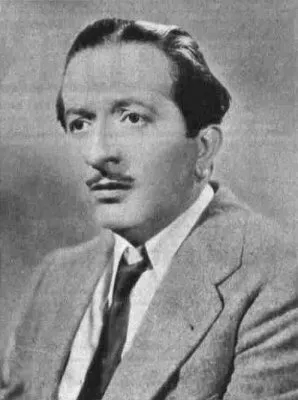
Enrico Viarisio
Human Design Chart
Biography
Equipped of a fine and elegant humour, Viarisio was discovered by actress Paola Pezzaglia, who cast him at 19 as "brillante" in her own theatre company. His career continued with the role of amoroso or male lover in the Carini-Gentili-Betrone theatre company, then passed to Talli-Melato-Betrone, Antonio Gandusio, Dyne Galli, and Nino Besozzi, and the Merlini-Cialente-Bagni company. To raise the company's small profits, Viarisio became the repertory comedian.
Bourgeois audiences appreciated Viarisio's "brilliance" — richly communicative, effervescent, and perfectly to their comfort — in amusing light comedies. In the sentimental comedies and white-telephone cinema of the 1930s, Viarisio was a constant figure, with his moustache and his black, shining hair combed to the back. He was the elegant interpreter of various pleasant stories adapted to film from the stage, such as Non ti conosco più (1936) by Nunzio Malasomma, L'uomo che sorride (1936) and Questi ragazzi (1937) by Mario Mattoli.
During the postwar period he was dedicated above all to the revue, playing opposite Wanda Osiris (Domani è sempre domenica, 1946–47; Si stava meglio domani, 1947–48; Il diavolo custode, 1950–51) and Isa Barzizza (Valentina, 1955). In the 1950s and '60s he lent his impeccable style and his sense of irony to television as well.
He died on 1 November 1967, aged 69, in Milan.
Enrico Viarisio as a Projector 6/3 in Human Design
Enrico Viarisio is a Projector in Human Design – a non-energy type designed to guide and direct others. Projectors make up about 20% of humanity and have a special gift for recognizing and directing the energies and talents of others.
The Projector's strategy is to wait for the right, respectful invitation before contributing their guidance. Without an invitation, the Projector's wisdom is often unrecognized or even rejected.
When Enrico Viarisio lives in alignment with their design, they experience success and recognition. The Projector's not-self theme is bitterness – a sign that their wisdom and guidance isn't being valued.
Enrico Viarisio has Splenic Authority – a spontaneous, intuitive authority. The Spleen speaks softly and only once, in the moment. It manifests as instinctive knowing, a subtle body signal that immediately recognizes what is healthy and safe. Those with this authority must learn to trust the first impulse.
Enrico Viarisio carries the profile 6/3 – Role Model / Martyr. The 6th line represents the Role Model: a life path in three phases – first experimenting (until ~30), then observing from the "roof" (until ~50), and finally authentically embodying the role model. The 3rd line represents the Experimenter: learning through trial and error, embracing life as a practical experiment and growing wise through experience.
The incarnation cross "Left Angle Cross of Identification 2" describes the overarching life purpose and direction of Enrico Viarisio in Human Design. It consists of the four gate activations of Sun and Earth (personality and design) and only becomes felt when one lives their strategy and authority.
The definition of Enrico is: Split Definition.
Enrico has 5 defined centers (Ajna Center, Throat Center, Splenic Center, Root Center and Head Center) and 4 open centers (G Center, Heart Center, Sacral Center and Emotional Center).
Enrico's channels are distributed across: Collective (Sinnfinden, Verstehen): 3 channels. The collective emphasis points to sharing experiences and knowledge with the community.
3 Defined Channels
Incarnation Cross - Left Angle Cross of Identification 2
Solar Return
The Solar Return shows the moment when the sun returns to its exact birth position - your personal solar year.
Life Cycles
Discover the life cycles with a detailed triple view (birth chart, cycle chart, composite).
Human Design Profile
- Type
- Projector
- Strategy
- Wait for the respectful invitation
- Authority
- Splenic Authority
- Profile
- 6/3 - Role Model / Martyr
- Definition
- Split Definition
- Incarnation Cross
- Left Angle Cross of Identification 2
- Date of Birth
- 03.12.1897 04:00
- Place of Birth
- Turin, Italy
Frequently Asked Questions
What Human Design type is Enrico Viarisio?
What Human Design profile does Enrico Viarisio have?
How does Enrico Viarisio best make decisions?
When and where was Enrico Viarisio born?
What is Enrico Viarisio's incarnation cross?
Discover your own Human Design
Are you also a Projector? Find out in a personal reading how to unfold your leadership qualities and recognize the right invitations.
More Personalities
Back to overviewSissy Spacek
Alain-Fournier

Anémone
Ann-Margret

Arletty

Arno