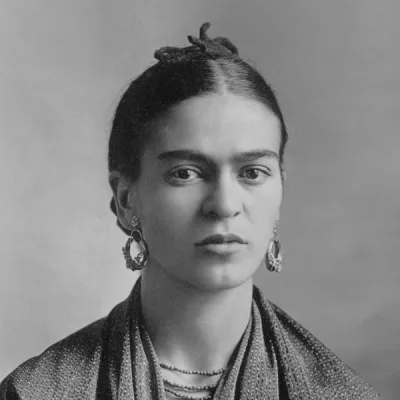
Frida Kahlo
Human Design Chart
Biography
Born to a German father and a mestiza mother (of Purépecha descent), Kahlo spent most of her childhood and adult life at La Casa Azul, her family home in Coyoacán – now publicly accessible as the Frida Kahlo Museum. Although she was disabled by polio as a child, Kahlo had been a promising student headed for medical school until being injured in a bus accident at the age of 18, which caused her lifelong pain and medical problems. During her recovery, she returned to her childhood interest in art with the idea of becoming an artist.
Frida Kahlo — Manifestor with Profile 5/1
Manifestor 5/1 — Design at a Glance
Frida Kahlo appeared as a visionary and pioneer whose Human-Design profile was designed to actively steer the world in new directions. Her Human-Design type, Manifestor, marked her not primarily for executing details or purely leading masses but rather for having a clear vision and making it effective through others. Similar to a ruler who achieves their goals through envoys, she possessed the energy to initiate without needing to fight any battles herself.
This constitutive power inevitably led to polarizing her ideas and essence. As her thinking often surpassed that of her surroundings, she was frequently misunderstood. While some were drawn to her great charisma and followed her, others rejected or even hated her precisely because of these overwhelming visions.
To minimize this internal resistance, it was crucial for her inner balance to communicate her intentions and plans early and precisely. This strategy of informing served to find the right followership and prevent misunderstandings. Living congruently with this need for communication rewarded her with a deep sense of inner peace. Deviating from it and acting without prior information resulted in persistent, deep anger as a direct emotional signal of her design's violation.
Emotional Authority
Frida Kahlo's design inclined towards an emotional fluctuation range: she appeared as someone whose perception of the world was strongly colored by current mood swings. In one moment, she could be totally enthusiastic about something, and in the next view it negatively. This shift wasn't a mistake but rather the mechanism of her defined Emotional Center, carrying her inner authority.
This emotional authority operated under a permanent wave of ups and downs. Her feeling at any given moment was merely a snapshot – an initial impression that wasn't necessarily the final truth yet. Hence, quick, spontaneous decisions made directly from this emotion could have negative repercussions. The mechanism required patience: the more time she took to let a decision mature, the deeper and broader her understanding became.
This process meant that she should revisit decisions multiple times. She had to take her time properly and repeatedly question whether initial enthusiasm or rejection held up. Over time, intense feelings subsided; emotional distance was gained. Only then did clarity and calm set in. This journey through the emotional wave was essential for long-term decisions significantly influencing her life path. By waiting, she avoided negative consequences of impulsive actions and found her true answer beyond the current mood.
The 5/1 Profile — Heretic / Investigator
Frida Kahlo's design established a fundamental stance: She intensively gathered knowledge privately to later provide it as problem-solving for others. As Profile 5/1 – Hero and Researcher – she exhibited through Line 5's almost magnetic property that her environment sought her inner treasures, attracting questions and solution requests without clear boundaries leading to energy depletion, similar to an expert left drained after intensive consultation.
The mechanism described this conflict: Line 5 allowed circumventing obstacles and rules as well as provocation in crisis times for mutation. Simultaneously, Line 1 required time for shock absorption and emotional withdrawal marked by experience and willpower. Frida Kahlo had to learn to say no to maintain the balance between her internal research work and external aid provision. Only this way could she optimally utilize her gifts without being overwhelmed by unbridled demand from her environment. Her path lay in protecting this synthesis of private depth and public charisma through disciplined boundary setting.
Split Definition — Defined & Open Centers
Frida Kahlo's design showed a tendency towards constant expressive strength and inner orientation, paired with high receptivity to external mental and energetic impulses. Her defined throat acted as a reliable anchor point for communication; she did not speak from fleeting thoughts but transmuted messages from her inner self into the world. This was supported by her defined G-Center, which gave her a firm sense of self-identity and a clear direction for her personal path. She knew who she was and could maintain this identity without external validation.
Her emotional authority lay in her defined solar plexus center. Here, clarity came not from immediate reaction but through waiting out the wave cycle of her emotions. Truth revealed itself to her over time after the emotional wave had reached its peak and trough. Simultaneously, her defined spleen center provided spontaneous, intuitive security in the present moment. It warned her against what was unhealthy and gave her direct access to existential consciousness and well-being independent of rational analysis. The constant pressure of her defined root center drove her continually forward to move through the material world and transform survival stress into constructive energy.
In contrast, head, ajna, heart, and sacral centers were open. Her open head and ajna centers made her vulnerable to mental confusion and the pressure to seek answers or inspiration from the environment rather than generating them consistently herself. She tended to identify with foreign concepts or doubts when she did not trust her inner authority. The open heart center lacked consistent willpower; she was conditioned to prove her worth through promises and competition, often ending in a cycle of overextension and self-doubt. Finally, her open sacral center mirrored the vital energy of her environment. She absorbed other people's life force, which could lead to exhaustion as she had no stable boundaries for her availability. Her challenge was not to misunderstand these open fields as her own truth but to navigate them through the stability of her defined centers.
Channels for intuitive elegance, emotional depth and passion.
Frida Kahlo exhibited a spontaneous, intuitive ability to secure her survival in the present moment. The channel of Perfect Form 57-10 connected her spleen with the G-Center. This gave her acute sensitivity to the quality of tones and moods in her environment, often more important than words themselves. She acted spontaneously and appropriately based on deepest intuitive impulses, resolving unfounded future fears. This behavior was an untroubled process of self-love and survival in the moment, moving her existentially through the world. Her creativity differed sharply from rational self-reflection; she created beauty through the authentic life of her uniqueness.
At the same time, her social and creative expression strongly depended on the emotional wave. The channel of Openness 22-12 connected solar plexus and throat center. Its effect was subject to ebb and flow: moodiness, melancholy, or passion determined when it opened. Gate 12 exercised a cautious regulation limiting interaction to people with high mutational potential. She waited until she felt like interacting; only then could her voice emotionally touch others and inspire change.
This mood-driven dynamics was amplified by the channel of Emotion Release 39-55 between root and solar plexus. It set the pulsing on/off wave of moods in motion, a force between ecstatic joy and melancholic uncertainty. Frida Kahlo used this provocation to tickle the minds of others and filter out who was right for her. She lived in the alchemy of this mutational wave without rational filters. Her authenticity allowed her to explore the depths of her mind and influence others through her contagious emotional quality as long as she did not force herself against her own rhythm.
Individual Circuitry — Circuit Signature
Frida Kahlo's design showed a tendency towards pulsating, acoustic expression based on emotional transformation. She revealed herself as someone who carried their unique identity into the world by releasing emotions. This stemmed from the Knowledge Circuit connecting throat, solar plexus, and root centers in her. The channel 'Emotion Release' (Gates 55-39) enabled inner emotional waves to be expressed through the throat center while 'Openness' (Gates 12-22) fed this energy from the root. This flow created a rhythmic, often melancholic power that heralded change.
Parallel to this, Frida Kahlo's Integration Channel 'Perfect Form' (Gates 10-57) connected identity center with spleen center. This connection channeled intuitive knowledge and self-validation directly into her personal essence. It was about realizing strength through proper behavior and inner intuition in the present moment. Since Frida Kahlo had a split definition, these two energetic systems – the emotional expression circuit and the identity-forming integration – existed as separate, non-directly connected streams alongside each other. The first circuit drove forward the external, transformative expression while the second channel secured internal individual validation. Both mechanisms shaped her essence: on one hand, the drive for new knowledge through emotional openness; on the other, the quiet, intuitive assurance of survival and personal form in here and now.
Left Angle Cross of Individualism 1
Frida Kahlo's design revealed a tendency towards radical self-determination. She presented herself as someone who walked her own path, independent of external expectations or collective norms. This attitude was not just a character trait but an expression of a deep mechanical structure: the left cross of individualism 1.
This configuration describes a life task to find identity through consistent differentiation and independence rather than adaptation. It's about the ability to clearly define one's essence and carry it outward without relying on others' approval. The energy of this cross promoted an inner strength that allowed her to remain true to herself even in difficult situations.
For Frida Kahlo, this meant that her actions and decisions were always guided by this internal compass. She lived according to her own rules, which was often perceived as rebellious or willful. Yet at its core, it was an authentic expression of her nature. The mechanics of this cross supported her in not only living but also visibly manifesting her individuality. It was a continuous process of self-discovery and assertion that shaped her life and significantly influenced who she was. Without this inner strength, it would have been difficult for her to follow the path of an individual so consistently.
Saturn Return · Uranus Opposition — Life Cycles
Frida Kahlo's design indicated a tendency to use early life phases through intensive internal structuring to create a stable foundation for later public visibility. This build-up served not for immediate recognition but for creating a solid base on which acknowledgment could rest.
The first Saturn return marks in Human Design mechanics the cycle of initial major professional confirmation and public recognition. It often follows years of learning and inner strengthening. In this phase, previous groundwork condenses into a result that is perceived and valued from outside. It's a moment when one's competence no longer exists only privately but experiences validation through the environment.
Frida Kahlo experienced this transition concretely in 1938 at age 31. During this period, Julien Levy presented her first solo exhibition in his New York gallery. This event exemplified the work of the first Saturn return: it was the point where years of artistic development and personal intensity became public confirmation. The exhibition served as visible proof that inner work found an external resonance. For her design, this marked a step from the private creative phase into a space of recognition, ensuring that visibility rested on established internal strength rather than fleeting attention.
Manifestor · Emotional Authority — Synthesis
Frida Kahlo lived a life marked by a deep drive for self-discovery and creative transformation. As a Manifestor with emotional authority and the Profile Hero/Researcher (5/1), she embodied the ability to develop visions and express them through intense engagement with her inner world. The defined Throat, connected to the G Center and Spleen (Channel 57-10), pointed towards behavior arising from intuitive awareness – an expression of self aimed at perfecting life and transcending conventional boundaries. This process of exploring and refining knowledge, amplified by the Knowledge Circuit, reflected in her work and magnetically drew people seeking solutions.
A central paradox in Frida Kahlo's design lay in the interplay between her manifesting energy and emotional wave. While she was destined as a Manifestor to take initiatives and push forward visions, her emotional authority required maturation of decisions, patience that stood against the impulsive nature of the Manifestor. This tension likely led to phases of intense creativity followed by times of reflection and emotional processing, with the left cross of individualism 1 further intensifying this process. A documented event at age 31 – her first solo exhibition – could have been an expression of this dynamic: a public manifestation of creative energy arising from a deep inner process.
3 Defined Channels
Incarnation Cross - Left Angle Cross of Individualism 1
Solar Return
The Solar Return shows the moment when the sun returns to its exact birth position - your personal solar year.
Life Cycles
Discover the life cycles with a detailed triple view (birth chart, cycle chart, composite).
Human Design Profile
- Type
- Manifestor
- Strategy
- To inform others before acting
- Authority
- Emotional Authority
- Profile
- 5/1 - Heretic / Investigator
- Definition
- Split Definition
- Incarnation Cross
- Left Angle Cross of Individualism 1
- Date of Birth
- 06.07.1907 08:30
- Place of Birth
- Coyoacan, Mexico
Frequently Asked Questions
What was Frida Kahlo's Human Design type?
What Profile did Frida Kahlo have in Human Design?
What Authority did Frida Kahlo have?
What incarnation cross did Frida Kahlo have?
When was Frida Kahlo born?
Discover your own Human Design
Are you also a Manifestor? Find out in a personal reading how to use your initiation power peacefully and dissolve resistance.
More Personalities
Back to overviewBaekhyun

Balthus

Beyoncé

Christian-Jaque
Fergie

Halston