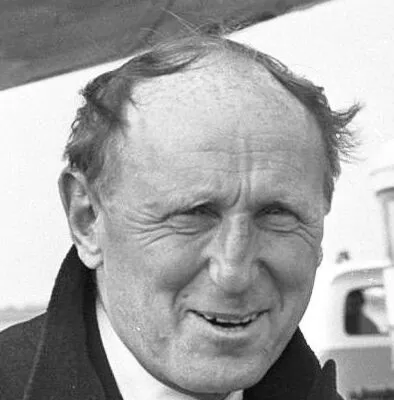
Photo: Wikimedia Commons
Georges Simenon
Human Design Chart
Biography
He was allegedly born George Sim (though this may have been another pseudonym of the 17 that he used) into a poor family in Liege, Belgium, and became a newspaper reporter in 1919, just one month shy of his 16th birthday. As a young reporter, he prowled the corridors of police stations and courthouses, frequenting nightclubs and prostitutes in equal part. At age 17 he had his own column, and published his first novel just before he turned 18. By age 29, he had turned out 277 books.
At age 20, Simenon married Regine Renchon, with whom he had a son. She worked full time as his secretary and assistant. Shortly after the marriage, Simenon hired Henriette Liberge, and what pursued was both a working and physical relationship; she took charge of both the kitchen and the household. (Accounts do not relate how Simenon’s wife felt about this arrangement.)
He lived in France through World War II. His relationship with the German censors had made him enormously wealthy. When the war ended, and his behavior was suddenly becoming a liability, he moved his entourage to the United States, where he met Denyse Ouimet and began an intense affair. Simenon divorced Regine but supported her and their child only under the condition that she live close to him and Denyse. His neighbors in Lakeville, Connecticut, where they settled, were shocked.
Georges Simenon — Projector with Profile 5/1
Projector 5/1 — Design at a Glance
Georges Simenon appeared as someone with a dense, focused aura. His Human Design type was Projector, a configuration that tends to direct energy like a bright light beam directly onto weaknesses in the environment. This trait allowed him to quickly identify systemic flaws in others. However, this direct perception could be perceived as unpleasant or intrusive by those around him, similar to being blinded by a harsh light.
Since Projectors lack a defined Sacral Center, Georges Simenon lacked a constant intrinsic source of life energy. Instead, he moved through phases of high activity and rapid work speed that inevitably had to be followed by necessary rest periods to prevent burnout. Traditional school systems and many societal structures often did not adequately account for this rhythmic need for recovery.
The optimal strategy for his design was to wait for a sincerely meant and appreciative invitation from the environment, rather than initiating independently or expressing criticism directly. By shining with his own harmony, he attracted others who then actively sought out his insights. If Georges Simenon lived in alignment with this waiting and acceptance strategy, he was rewarded with success. If he missed this path, sooner or later the non-self theme of bitterness would surface, a sign that his energy had not been used appropriately.
Emotional Authority
Georges Simenon exhibited a fundamental attitude characterized by emotional wave movements: His perception of the world was always colored by his current mood. In one moment, he could be completely enthusiastic about something, in the next, he saw the same thing in negative light. These fluctuations were not a sign of unreliability but an expression of his inner authority – the defined Emotional Center.
This center fundamentally determined his decision-making process. Since it was defined, Georges Simenon was subject to an emotional wave with permanent ups and downs. His feeling at any given moment only formed a snapshot, a first impression that did not necessarily correspond to his deepest truth yet. Quick, spontaneous decisions based on such emotions could therefore have negative consequences.
The mechanics of his design required patience. The more time he took to let a decision mature, the deeper and more comprehensive he could perceive the situation. This meant that he should properly deliberate and ask himself multiple times. Over time, intense feelings subsided, he gained emotional distance, and clarity as well as calmness set in. Only then had he gone through the process. The necessity of waiting was particularly important for long-term decisions that could have a significant impact on his life course. Emotional authority always took precedence over other defined centers in his chart, regardless of what else might be activated.
The 5/1 Profile — Heretic / Investigator
Georges Simenon appeared as someone who possessed deep, inwardly closed knowledge structures and offered these to others to solve their problems. His design tended towards people seeking him out for answers – similar to an expert who is exhausted after hours of consultation while inquiries continue. This dynamic resulted from his Profile 5/1: Line 1 represented the private research process, diving into personal topics and challenges. Line 5 acted outwardly as a magnetic force; others projected onto him the expectation that he would provide practical solutions for crises or organizational questions.
Without clear boundaries, there was a risk of overloading, as his inner self was constantly confronted with the needs of others. His design promoted an understanding that resources and power must be understood not only materially but also as energy. Higher principles helped him maintain direction and avoid energy loss through false interactions. If he learned to say no, he could preserve the balance between withdrawing for research (Line 1) and his public role as a problem solver (Line 5). This way, he could use his gifts without being burned out by the endless questions of his environment.
Single Definition — Defined & Open Centers
Georges Simenon revealed himself as someone who defined his own resources and value independently. His design indicated a tendency towards self-responsible action: He preferred to be his own boss, following internal mechanisms for when to work or take breaks. This stemmed from his defined Heart Center, which gave him willpower and the ability to keep promises and strive for success. At the same time, he possessed deep emotional intelligence through his defined Solar Plexus Center. His inner authority lay in allowing emotional waves time before making decisions; impulsivity was replaced by a patient waiting until clarity emerged. This structure was supported by his defined Spleen Center, which gave him spontaneous intuition and existential awareness in the "now" – an ability to immediately recognize health-promoting instincts without having to rationalize them. Additionally, his defined Root Center provided a constant inner drive that propelled him forward and helped him cope with stress by nourishing existential awareness.
In contrast, Georges Simenon showed himself to be vulnerable to external influences in mental and communicative areas. His open Head Center meant he did not have a consistent way of processing mental information; he tended to engage with others' questions or doubts when he lacked trust in his own authority. Similarly, his open Ajna Center allowed him to adopt concepts flexibly but without distance, he could hold other people's ideas as his own truth. His open Throat Center also showed uncertainty in communication; instead of speaking consistently, he relied on invitations to speak so as not to feel pressured or make unexpected statements. His open G Center lacked a fixed identity; he often adapted to the environment and sought direction through interaction with others rather than asserting it himself. Finally, his open Sacral Center meant he did not have a constant energy flow. He had to learn not to rely on "borrowed" energy from others but instead respect his inconsistent rhythm and rest sufficiently to avoid exhaustion.
Channels for emotional clarity, community spirit, principles and devotion.
Georges Simenon revealed himself as someone deeply rooted in the mechanisms of cohesion and social bonding. His design indicated a tendency to sense the emotional frequency of groups and stabilize it through clear principles. This primarily occurred through Channel of Synthesis 19-49, which connected the Root Center with the Solar Plexus. This connection created an instinctive pressure to establish or reject belonging based on loyalty and shared values. It was not a logical process but rather an emotional wave that determined who belonged to the "tribe" and who did not. Simenon used this sensitivity to recognize the invisible threads that hold people together—or separate them.
Parallel to this, Channel of Devotion 44-26, connecting Spleen with Heart, showed a sense of entrepreneurial vigilance: an instinctive awareness of what others needed before they knew it themselves. This combination of fine perception (Spleen) and willful implementation (Heart) enabled him to effectively "sell" or convey his observations. He was not merely a passive observer but someone who actively directed attention to what he deemed relevant.
Additionally, Channel of Recognition 30-41 shaped his drive for new experiences. The pressure from the Root Center drove him to cross boundaries and immerse himself in unknown emotional scenarios. This restlessness was amplified by the emotional wave of the Solar Plexus, leading him not only to act but also to deeply feel and reflect on every experience. He sought out nuances in feeling to describe them precisely later.
Channel of Community 37-40 rounded this picture by emphasizing the necessity of contracts and mutual recognition. For Simenon, relationship was always a matter of balance: "I do this for you if you do that for me." This dynamic ensured that his depictions of human interaction never remained abstract but were always grounded in the concrete reality of exchange, loyalty, and the need for a place within the whole.
Tribal Circuitry — Circuit Signature
Georges Simenon's design laid a tendency towards emotional waves that drew from the past. His Meaning-Finding Circuit connected the Solar Plexus Center with the Root Center, creating cyclical emotional currents: feelings and experiences from earlier times would resurface in wave-like patterns, be reflected upon, and serve to uncover hidden connections. This energy was less bound by cooler logic than by the need to understand past experiences and share these insights with others to learn collectively.
Parallel to this, his Ego Circuit connected the Heart, Solar Plexus, Root, and Spleen Centers. Here it wasn't about individual self-awareness but rather clan dynamics: cooperation, mutual support, and the joint creation of resources. The channels promoted dedication, community spirit, and synthesis. Since this circuit did not connect to the Sacral Center, there was no constant life force; instead, pauses were necessary to regenerate energy for the clan. Both circuits formed a unified, defined structure in Georges Simenon, as all centers were directly connected. This shaped him as someone who translated emotional past patterns into collective support and resource creation, always in rhythm with activity and necessary rest.
Left Angle Cross of Revolution 1
Georges Simenon's Human Design profile featured the left side of the Revolution Cross. This configuration suggested an internal tension that often manifested as a drive for change or breaking free from old structures. In Human-Design, the left cross marks a specific energetic focus on transformation and the courage to question established norms. It was not random rebellion but a deeply rooted dynamic seeking new paths where others stayed with the familiar. This energy acted as a driving force that encouraged him to break existing patterns and pursue innovative approaches. The intensity associated with this energy fostered an awareness of what is necessary in change without slipping into destructive chaos. Instead, it directed his attention to points where change was possible and needed. It helped him free himself from conventional expectations and develop his own, often unconventional solutions. This trait shaped him as someone who did not just observe but actively participated in dissolving old forms to make way for the new. The energy of the left cross thus played a central role in determining his attitude towards tradition and progress. It gave him the ability to find clarity in moments of uncertainty and pull others along with their own transformative power without losing focus on what is essential.
Saturn Return · Uranus Opposition · Chiron Return · 2nd Saturn Return — Life Cycles
Georges Simenon's life phases were structured by clear cyclical turning points. His design indicated a tendency to take on new societal roles or set creative impulses at certain age stages, based on prior internal condensation.
In 1931, at the age of 28 during his first Saturn Return, he staged a grand ball for promoting the Maigret series. This cycle often marks the moment when years of groundwork coalesces into a sustainable public outcome and establishes an initial stable identity.
Ten years later in 1942, at the age of 39 during the Uranus Opposition, new Maigret novels appeared after an eight-year hiatus. This phase often brings unexpected changes or rediscoveries of one's potential that can realign a previous path.
The Chiron Return around his 49th year is a fulfillment cycle where one's purpose increasingly unfolds. In 1952, Simenon was appointed President of the Mystery Writers of America – an acknowledgment of his lifelong work and validation of his role within his community.
Finally in 1960 at the age of 57 during his second Saturn Return, he became President of the Jury for the International Film Festival in Cannes. This cycle often cements a reached position and firmly anchors life's work in public perception before shifting focus to passing on or reflecting.
Projector · Emotional Authority — Synthesis
Georges Simenon was a Projector whose life seemed marked by a profound need to recognize the potential and flaws of others (Synthesis Channel). This did not manifest as direct criticism but rather in his ability to offer solutions – a role he repeatedly took up through his work. His emotional authority required time for insight maturation, forcing him to go through an internal weighing process before sharing judgment. Line 5 in Profile amplified this tendency, as he gathered knowledge and made it available to others often until his own exhaustion (Hero/Researcher).
A central paradox lay in the tension between his need to project guidance and the cyclical nature of his emotional wave. While supporting others with a keen sense for their challenges, he needed time himself to gain clarity (Purpose Circuit). The recurring successes in cycles – from promotional actions to honors – seem to indicate an ability to align this inner dynamic with the outside world and communicate observations effectively.
4 Defined Channels
Incarnation Cross - Left Angle Cross of Revolution 1
Solar Return
The Solar Return shows the moment when the sun returns to its exact birth position - your personal solar year.
Life Cycles
Discover the life cycles with a detailed triple view (birth chart, cycle chart, composite).
Human Design Profile
- Type
- Projector
- Strategy
- Wait for the respectful invitation
- Authority
- Emotional Authority
- Profile
- 5/1 - Heretic / Investigator
- Definition
- Single Definition
- Incarnation Cross
- Left Angle Cross of Revolution 1
- Date of Birth
- 13.02.1903 00:10
- Place of Birth
- Liège, BEL
Frequently Asked Questions
What is Georges Simenon's Human Design type?
What Profile did Georges Simenon have in Human Design?
Which Authority did Georges Simenon possess?
What incarnation cross did Georges Simenon have?
When was Georges Simenon born?
Discover your own Human Design
Are you also a Projector? Find out in a personal reading how to unfold your leadership qualities and recognize the right invitations.
More Personalities
Back to overviewSissy Spacek
Alain-Fournier
Anémone

Angeli
Ann-Margret

Bourvil