
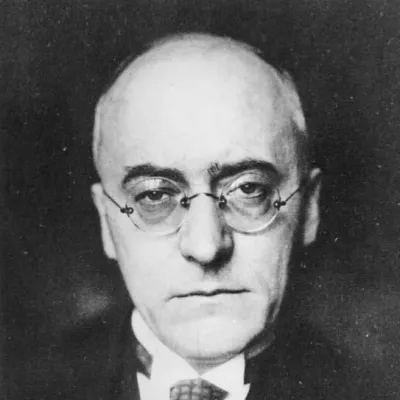
Heinrich Brüning
Human Design Chart
Biography
A political scientist and Christian social activist, he entered politics in the 1920s and was elected to the Reichstag in 1924. In 1930, he was appointed interim chancellor, just as the Great Depression took hold. His austerity policies in response were unpopular, with most of the Reichstag opposed, so he governed by emergency decrees issued by President Paul von Hindenburg, overriding the Reichstag. This lasted until May 1932, when his land distribution policy offended Hindenburg, who refused to issue any more decrees, and Brüning resigned.
After Hitler took power, Brüning fled Germany in 1934. He eventually settled in the United States. From 1937 to 1952, he was a professor at Harvard University. He returned to Germany in 1951 to teach at the University of Cologne, but again moved to the United States in 1955 and lived out his days in retirement in Vermont. Heinrich Brüning died on 30 March 1970 at age 84 in Norwich, Vermont.
Brüning remains a controversial figure in Germany's history, as historians debate whether he was the "last bulwark of the Weimar Republic" or the "Republic's undertaker", or both. Scholars are divided over how much room for manoeuvre he had during the Depression, in a period of great political instability. While he intended to protect the Republic's government, his policies, notably his use of emergency powers, also contributed to the gradual demise of the Weimar Republic during his chancellorship.
Heinrich Brüning — Manifesting Generator with Profile 5/1
Manifesting Generator 5/1 — Design at a Glance
Heinrich Brünning revealed himself as an Manifesting Generator, a hybrid form between Generator and Manifestor. His design endowed him with constant sacral energy, which was not intended for self-initiated action but rather waited to be activated by external impulses. Simultaneously, he possessed the ability to skip steps and swiftly draw results into his life. This speed carried two specific risks: He tended to omit important intermediate steps, causing backlogs and frustration when he had to catch up later. Additionally, he often reacted to multiple impulses simultaneously and started several projects in parallel. Without strict adherence to his strategy – wait and react to life – his creative drive quickly turned into exhaustion. Only when his sacral center gave a clear “Yes” signal for an activity could he feel deep satisfaction. In this state, multitasking was no obstacle but rather the source of his strength; he needed variety and a playful mode to use his energy efficiently. The constant urge to finish one thing before starting another stood in opposition to his natural rhythm. His effectiveness thus depended on whether he learned to wait for genuine resonance instead of anticipating it and whether he accepted that his speed was only useful when guided by inner confirmation.
Emotional Authority
Heinrich Brünning displayed a decision-making stance that did not follow immediate impulsiveness but was based on internal emotional clarity. His inner authority was Emotional Authority, carried by the defined Solar Plexus Center. In Human Design mechanics, this authority is always prioritized; it takes precedence over all other defined centers in the chart, regardless of their number or type. This meant for him that his current mood was only a temporary coloring and did not necessarily reflect the deeper truth of his situation.
He was subject to an emotional wave that showed itself in a permanent up-and-down of feelings. What appeared inspiring in one moment could be negatively evaluated in the next. Therefore, quick, spontaneous decisions based on immediate emotion were often counterproductive for him. Instead, his design required patience: He had to take time to let a decision mature. This happened through multiple sleepovers and conscious hesitation until intense emotions subsided. Only then did he gain emotional distance, leading to clarity and calmness. This process was particularly important for long-term decisions as they significantly shaped his life course. Heinrich Brünning thus learned to adorn himself with patience and let questions linger until the emotional flood receded and a well-founded decision became possible.
The 5/1 Profile — Heretic / Investigator
Heinrich Brühning revealed himself as someone who utilized deep knowledge reserves to offer solutions to others in times of crisis. His design as Hero/Researcher (Profile 5/1) gave him a magnetic presence: Others actively sought his insights, calling him to problem-solving for the community. This dynamic was based on Line 5, which makes knowledge available, and Line 1, which lays the foundation through research.
However, this configuration contained a specific risk: Without clear boundaries, overloading threatened as the demand for his solutions could exceed his capacity. Brühning also projected a power presence (Gate 34, Line 5), which should be intimidating and break resistance in crisis situations but could also cause unease and paranoia when questioning his authority. This second-generation destruction required careful handling of power.
At the same time, his lower trigram (Gate 40, Line 1) needed regular rest pauses to recover willpower. Metaphors like moon phases highlighted that recovery preceded renewed work. In the second generation of this gate, prolonged solitude led to inner unrest and complicated partnerships. Brühning had to learn to say no to maintain balance between private research and public problem-solving; otherwise, he risked being drained while others continued seeking answers. His strength lay in connecting deep knowledge with the ability to effectively apply it during crises, provided he consistently protected his recovery phases.
Triple Split Definition — Defined & Open Centers
Heinrich Brünning was someone who constantly felt an internal pressure to ask questions and find answers. His design linked the Head Center with the Ajna Center, creating a continuous mental process: inspiration would arise, but without direct energy for implementation, this often led to concern or frustration when he tried to turn thoughts into actions immediately. Instead, his aura had an effect on others by encouraging them to think.
His communication was characterized by the defined Throat Center; he consistently spoke from his mind and articulated concepts with a firm, trustworthy manner. This was supported by the willpower of the Heart Center, giving him clear structure: He enjoyed controlling his resources and keeping promises, which strengthened his self-esteem as long as he did not set unrealistic expectations for others.
As a Generator, Brünning had a defined Sacral Center, a source of immense vitality. His strategy was to wait and respond with an inner yes or no tone to questions rather than initiating himself. Only this way could the necessary energy be available for long-term tasks; mental initiatives without sacral confirmation led to resistance and exhaustion.
At the same time, he had to trust the emotional waves of the Solar Plexus Center. His internal authority lay in patience: He waited until the emotional wave calmed down to gain clarity. Impulsive decisions at the high or low points of this wave would have created chaos; only in emotional equilibrium did he find the truth of a situation.
In contrast, his G-Center and Spleen Center were open. The open G-Center meant that he had no fixed identity or direction but oriented himself to his environment. He tended to seek love and orientation by slipping into various roles rather than presenting a stable personal identity. The open Spleen Center made him vulnerable to fears about health and survival; he was sensitive to the well-being of his surroundings and leaned towards clinging to people with defined spleens for a sense of security, making him susceptible to conditioning influences.
Channels for powerful community, maturation and mental clarity.
Heinrich Brünning showed a basic attitude that was marked by a deep, often restless inner drive. His design laid out a tendency toward continuous activity driven by the Channel of Charisma 34-20. This connection between Sacral and Throat Center created a physiological pressure to act in the moment; the raw energy of power (Gate 34) sought immediate expression through the Gate of Now (Gate 20). This resulted in a life force that made it difficult for him to sit still. His effectiveness depended on following this sacral reaction rather than being guided by external expectations.
At the same time, he possessed the potential for community building through the Channel of Community 37-40. Here, the emotional depth of Solar Plexus (Gate 37) connected with the willpower of Heart (Gate 40). Brünning sought his place in the whole and understood that genuine connections rested on mutual benefit and carefully negotiated agreements. He relied on being personally invited to contribute his strength for group goals, where loyalty and fair distribution were paramount.
His mind worked with the Channel of Abstraction 64-47. The pressure from Head Center (Gate 64) drove him to filter every experience through a kaleidoscope of mental images to understand hidden connections behind facades (Gate 47). This process was often confusing and required patience until a clear, inspiring story emerged from the flood of possibilities.
Furthermore, he went through the Channel of Maturity 53-42, which propelled him to live experiences fully and draw wisdom from them. Each new phase built on the previous one; an early termination would lead to repetition of the cycle. Brünning learned that true development was only possible by going through each stage completely and then reflecting upon it.
Collective Circuitry — Circuit Signature
Heinrich Brühning's design showed itself through three separate, parallel acting energetic blocks. In the first block, the Integration Circuit connected Throat with Sacral Center via Channel 20-34 (Charisma). This created a direct line from life force to expressiveness, allowing him to draw strength from reacting to life and implement it in the moment.
A second, isolated block consisted of the Ego Circuit connecting Heart and Solar Plexus Centers (Channel 40-37, Community). Here, mutual giving and taking as well as emotional support within the collective were at play. Since this area was not connected with Sacral Center, a constant energy source was missing; Heinrich Brühning therefore needed quiet pauses to regenerate his resources for these social dynamics.
The third block included the Meaning-Finding Circuit with two separate parts: Head and Ajna Centers (Channel 64-47, Abstraction) as well as Sacral and Root Centers (Channel 42-53, Maturity). This configuration directed attention to reflecting on the past. Emotional waves from Solar Plexus - here not directly connected to other blocks - shaped a cyclical way of learning from earlier experiences. The abstract processing in Head-Ajna area did not flow directly into emotional or physical levels but acted as an independent cognitive instance. Overall, this triple definition shaped a life with clearly delineated functional areas: direct expressive strength, need-oriented social cooperation, and reflective past learning that did not overlap but existed side by side.
Left Angle Cross of Duality 2
Heinrich Brüning's Human Design shows a tendency towards deep, often unspoken tension: the drive for inner wholeness in confrontation with outer fragmentation. This configuration, known as the left dual cross 2, does not describe a simple unity but rather an ongoing process of balancing seemingly irreconcilable poles. It is an archetypal structure aimed at resolving oppositions not through suppression of one pole but by integrating them into a higher whole.
For Heinrich Brüning, this meant that his path was less about harmonious accord and more about navigating dualities. The mechanics of this cross demanded dedication to the process itself – enduring the contradiction between what is and what should be. It wasn't about quick fixes or superficial compromises but deep work to connect two separate worlds. This energy often created a sense of isolation or misunderstanding, as the inner logic of this union remained hard to grasp externally. Heinrich Brüning lived in this field of transformation where every decision was also a weighing between loss and gain. The challenge lay in not seeing duality as an enemy but rather as a necessary engine for developing a more comprehensive truth. His design thus carried the burden of mediation without resorting to simple answers.
Saturn Return · Uranus Opposition · Chiron Return · 2nd Saturn Return — Life Cycles
Heinrich Brüning's middle years were marked by a professional career characterized by profound structural breaks followed by reorganization. His design pointed towards cycles tied to questions about meaning and fulfillment, especially when he followed his inner authority.
The Chiron Return, a fulfillment cycle between the ages of 49 and 51, signaled for him a phase where his incarnation purpose could increasingly unfold – provided he lived according to his strategy. In 1934 at age 49, Heinrich Brüning left Germany to avoid imminent arrest. This step was not merely a retreat but a decisive moment of alignment: He ended an old structure to make space for the further unfolding of his purpose.
Five years later in 1939 at age 54, this was followed by the second Saturn Return – a period when long-term commitments and authority are renegotiated. Heinrich Brüning received a full professorship in administrative science at Harvard University. This marked the material anchoring of previously created freedom: The prior alignment during the Chiron cycle allowed him to build stable structures in a new environment and institutionalize his expertise. His design thus showed a clear sequence: First, letting go of the familiar for personal integrity, then building new, solid foundations.
Manifesting Generator · Emotional Authority — Synthesis
He was a Manifesting Generator whose life was marked by deep sacral energy (sacral center) and constant pressure to solve problems (defined Head Center). This combination created a continuity of action – he responded to impulses, utilized his knowledge base (5/1 Profile), and produced solutions accessible to others. The Channel of Charisma linked sacral reaction with the Throat Center, indicating that his actions sprang from an inner source of power once he reacted to something. Emotional authority required time for decision-making and waiting out emotional waves, creating internal tension when combined with the quick energy of a Manifesting Generator.
A central paradox lay in the interplay between his sacral drive and emotional depth. On one hand, he was destined to act quickly and set things in motion (sacral reaction), on the other, he needed time to process emotions and fully grasp the implications of decisions (emotional authority). This led to a cyclical pattern: The urge to act followed by reflection phases, evident in events that included both swift reactions and long-term career decisions.
4 Defined Channels
Incarnation Cross - Left Angle Cross of Duality 2
Solar Return
The Solar Return shows the moment when the sun returns to its exact birth position - your personal solar year.
Life Cycles
Discover the life cycles with a detailed triple view (birth chart, cycle chart, composite).
Human Design Profile
- Strategy
- To respond - wait for something to respond to
- Authority
- Emotional Authority
- Profile
- 5/1 - Heretic / Investigator
- Definition
- Triple Split
- Incarnation Cross
- Left Angle Cross of Duality 2
- Date of Birth
- 26.11.1885 17:00
- Place of Birth
- Münster (Nordrhein-Westf.), Germany
Frequently Asked Questions
What Human Design type was Heinrich Brünning?
Which Profile did Heinrich Brünning have?
What Authority did Heinrich Brünning have?
What is Heinrich Brünings' incarnation cross?
Discover your own Human Design
Are you also a Manifesting Generator? Find out in a personal reading how to unfold your multi-talents and direct your energy wisely.
More Personalities
Back to overviewAaliyah

Aldair

Alexia

Alizée

Angèle

Angeli
