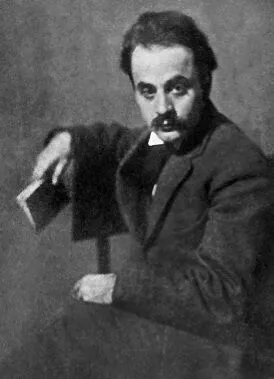
Kahlil Gibran
Human Design Chart
Biography
Born in Bsharri, a village of the Ottoman-ruled Mount Lebanon Mutasarrifate to a Maronite Christian family, young Gibran immigrated with his mother and siblings to the United States in 1895. As his mother worked as a seamstress, he was enrolled at a school in Boston, where his creative abilities were quickly noticed by a teacher who presented him to photographer and publisher F. Holland Day. Gibran was sent back to his native land by his family at the age of fifteen to enroll at the Collège de la Sagesse in Beirut. Returning to Boston upon his youngest sister's death in 1902, he lost his older half-brother and his mother the following year, seemingly relying afterwards on his remaining sister's income from her work at a dressmaker's shop for some time.
In 1904, Gibran's drawings were displayed for the first time at Day's studio in Boston, and his first book in Arabic was published in 1905 in New York City. With the financial help of a newly met benefactress, Mary Haskell, Gibran studied art in Paris from 1908 to 1910.
Kahlil Gibran as a Generator 1/3 in Human Design
Generator 1/3 — Design at a Glance
Kahlil Gibran revealed himself as someone with immense inner endurance and strength, comparable to a workhorse that provided energy for tasks as long as there was intrinsic motivation. His design indicated that he possessed this enormous capacity to materialize life content, but only under one specific condition: He had to react to signals from his environment rather than initiate independently. The motto of his system was clearly 'react, do not initiate'.
This mechanism was directly linked to his sacral center. This center released energy when it responded to impulses and received a clear inner signal like 'Yes! Let's get started!'. When Kahlil Gibran followed this strategy – waiting until life spoke to him and then acting from the gut – he was rewarded with a deep sense of fulfillment. In these moments, his creative power was inexhaustible and no one could stop him.
Conversely, his chart revealed two significant pitfalls. The first occurred when he did things that brought him no joy; then he squandered his energy and tended towards exhaustion states. The second danger lay in being held back from his heart project despite still wanting to continue working with full power. If he acted against his design and tried to initiate independently or push through things compulsively without waiting for the inner signal, sooner or later he encountered persistent frustration and a noticeable lack of energy. His satisfaction thus depended entirely on whether he reacted or initiated.
Sacral Authority
Kahlil Gibran was a Generator whose decision-making was shaped by Sacral Authority. This internal guidance did not manifest as intellectual analysis but rather as an immediate physical reaction to external stimuli. His design allowed him to feel vitality and inexhaustible energy when his sacral motor engaged with something. This manifested in gut feelings or bursts of power – often audible as grunts, hums, or a confirming 'Mhm'. Such signals were reliable indicators for him that an activity could be fulfilled with joy and enthusiasm without pursuing an external purpose.
A crucial prerequisite for this clear guidance was his open Emotional Center. Since this center was undefined, his emotional perception fluctuated but did not disturb the Sacral Authority, instead affirming it as the primary instance. The Generator's strategy – to react rather than initiate – was identical with his inner authority here. This simplified his process: He didn't need to think to be right, but waited for a physical impulse. If he reacted and felt energy, he acted; if this resonance was missing, he withdrew. Thus, he lived in a state that allowed him to immerse himself fully in his activities, driven by an inner satisfaction independent of external validation.
The 1/3 Profile — Investigator / Martyr
Kahlil Gibran's design indicated a tendency towards intensive research and practical experimentation. As someone with the Profile 1/3, he was naturally a researcher who always wanted to learn more, coupled with a drive to test knowledge through trial and error. His life revolved around this dynamic: Line 1 promoted theoretical knowledge and planning, while Line 3 required testing and learning from mistakes. Sometimes this led to internal tensions when the desire for perfect foreknowledge blocked the step towards implementation. Yet even self-earned and tested insights formed his core theme; if Kahlil Gibran deemed something good, he had previously examined it both theoretically and practically in depth. His judgment thus rested on solid experience. Additionally, an energy of transformation and hidden relationships (Gate 54, Line 1) worked within him, enabling influence through secret alliances. Simultaneously, the process of adapting to life through intuitive clarity (Gate 57, Line 3) shaped him. This configuration described a life task: Not just collecting knowledge but validating it in practice and thereby bringing about profound changes.
Split Definition — Defined & Open Centers
Kahlil Gibran's design showed a tendency towards continuous, structured conception that directly translated into expression. His defined Ajna Center ensured constant mental thinking and trustworthy concepts, while his also defined Throat Center reliably communicated these thoughts. This connection allowed him to speak what he thought without external disturbance.
The energy source for this came from his defined Sacral Center. As a generator, he possessed vital reserves of power that were only available through reacting to external impulses. Initiation led to frustration; waiting and responding was the key to satisfaction. Additionally, his defined Spleen Center contributed spontaneous intuition and well-being in the present moment.
At the same time, Kahlil Gibran was vulnerable to several open centers for conditioning. His open Head Center allowed him to take on mental pressure and questions from others, which could lead to confusion if he did not trust his inner authority. His open G Center meant no fixed identity; he reflected the environment and had to learn that direction and love were initiated through correct places and encounters, not by seeking himself.
His open Heart Center made him vulnerable to the urge to prove his worth or make promises he could not keep – a classic Non-Self mechanism. Furthermore, his open Solar Plexus absorbed foreign emotions, causing emotional waves that were not his own. Finally, his open Root Center took on external stress. Kahlil Gibran had to learn to recognize and release this pressure rather than being overwhelmed by hyperactivity. His mechanics showed: strength lay in mental expression and sacral responses; challenges lay in separating from foreign stress, emotions, and identity pressures.
Channels for spontaneous insight and individual intuition.
Kahlil Gibran was known for his unique ability to translate complex insights into clear, transformative language. His design featured the Channel of Structuring 43-23, which connected spontaneous mental breakthroughs with the process of assimilation. This allowed him not only to think innovative perspectives but also to formulate them so expressively that they could change collective thought. His challenge was to give space to this inner logic and wait for the right moment to articulate it so his message would be understood rather than rejected.
Parallel to this, the Channel of Power 34-57 linked deep intuitive awareness with sacral life force energy. This configuration created a strong survival instinct and the ability to react spontaneously to dangers or vibrations in the environment. It kept him acoustically attentive and physically present, selectively absorbing only what aligned with his intuition.
Additionally, Gates like 54 fostered a drive for worldly and spiritual connection, while Gate 53 promoted freedom for new developmental cycles and pioneer spirit. Gate 9 supported detailed elaboration and perfection of his work through focused energy. Overall, this resulted in a person deeply rooted in intuition with the potential to cause structural changes in others' consciousness through clear communication if he followed his inner rhythms.
Individual Circuitry — Circuit Signature
Kahlil Gibran was marked by two separate yet parallel functioning energetic streams. The Knowledge Circuit connected his Ajna and Throat Centers via the Channel of Structuring (Gates 43 and 23). This created a pulsating energy aimed at translating innovative thoughts into clear, acoustically effective structures. It was about expressing a unique identity through formulating new connections.
Independently, the Integration Circuit connected his Sacral with his Spleen Center (Channel 34-57). Here power flowed from reacting to life together with intuitive knowledge. This stream served to secure survival through correct action in the present moment, supported by inner intuition and vital resonance.
Since Kahlil Gibran had a Split Definition, these two systems were not directly connected. The creative expression from Head and Throat stood alongside the intuitive life force from Sacral Center and Spleen as independent energy fields. This meant that his intellectual structuring was not automatically steered by his intuitive survival energy but existed as a separate dimension of his design. Both streams shaped his essence: on one hand, the ability to structure and express new things; on the other hand, the capacity to generate power through intuition and reaction to the environment and become effective in the present moment.
Right Angle Cross of Penetration 4
Kahlil Gibran carried the design of the right cross of penetration. This configuration established a fundamental disposition characterized by deep inner reflection and a particular way of perception. In Human Design, this cross describes a specific energetic structure often associated with an intense engagement with the Inner Self. It was not about external action in the traditional sense but rather a stance of dwelling and understanding.
The mechanics of this design showed that Kahlil Gibran tended to penetrate situations and experiences from within. Instead of immediately acting outward, he first sought connection with his own essence. This penetration was a process of clarification where outer impressions were transformed into inner certainty. It was about grasping the essence of what was experienced before reacting.
This pattern shaped his way of interacting with the world. He searched for deeper meanings and connections that lay beneath the surface. The energy of this cross fostered a calm but resolute presence stemming from clear inner alignment. Kahlil Gibran lived this dynamic by taking time to separate the essential from the non-essential. His strength lay in his ability to gain clarity through intensive inner work and then authentically radiate it outwards. This was not an active penetration of others, but a deep-rooted presence in his own truth.
Saturn Return · Uranus Opposition — Life Cycles
Kahlil Gibran's design indicated a tendency towards structured, long-term development that condensed into clear life phases. This configuration describes a path marked by inner maturity and the building of solid foundations, with turning points often accompanied by an intensified focus on personal responsibility.
In 1912, at age 29, Kahlil Gibran moved to New York where his work 'Broken Wings' was published. For his design, this marked the first Saturn return, a cycle during which years of groundwork often condensed into tangible results. This moment showcased the effectiveness of his inner structure: life demanded a new base, and Kahlil Gibran responded with a concrete step into a new environment along with the publication of a significant work. It was a point where inner maturity manifested externally – not as a sudden break but as a logical continuation of his development.
Later in 1920 at age 37, he founded the Arabic literary society Arrabitah. This fell during the Uranus opposition period, a phase often associated with a desire for greater autonomy and the wish to create or question existing structures. Here, Kahlil Gibran's ability to act not only individually but also initiate a community that aligned with his values was evident. The founding of Arrabitah expressed a drive to anchor his voice in a collective framework while maintaining independence from established systems. Both events underscored a pattern: Kahlil Gibran used astrological turning points to pour inner impulses into external, sustainable forms – whether through relocation and publication or by creating his own literary platform.
Generator · Sacral Authority — Synthesis
Kahlil Gibran lived deeply rooted in his sacral center (Generator type), whose energy propelled him to gain insights through experience and experimentation (Profile 1/3). This drive was not fixated on external goals but served the continuous expansion of his inner knowledge (Knowledge Circuit). The defined mental component (Ajna Center) enabled him to develop and penetrate concepts (Channel of Structuring) that he then shared in a powerful form. His energy found fulfillment in diving deep, examining, and passing on what was gained – a cycle of inner exploration and outer expression evident in professional ventures (Saturn Return, Uranus Opposition).
A central paradox lay in the combination of his sacral authority with the need for constant examination. While his body signaled through bursts of energy from the sacral center when an activity was right, Profile 1/3 prompted him to keep researching and experimenting further. This might have led to internal tension between trusting immediate bodily reactions and the desire for complete intellectual certainty before accepting or communicating something as given.
2 Defined Channels
Incarnation Cross - Right Angle Cross of Penetration 4
Solar Return
The Solar Return shows the moment when the sun returns to its exact birth position - your personal solar year.
Life Cycles
Discover the life cycles with a detailed triple view (birth chart, cycle chart, composite).
Human Design Profile
- Type
- Generator
- Strategy
- To respond - wait for something to respond to
- Authority
- Sacral Authority
- Profile
- 1/3 - Investigator / Martyr
- Definition
- Split Definition
- Incarnation Cross
- Right Angle Cross of Penetration 4
- Date of Birth
- 06.01.1883 04:00
- Place of Birth
- Bcharre, Lebanon
Frequently Asked Questions
What was Kahlil Gibran's Human Design type?
Which Profile did Kahlil Gibran have?
What Authority guided Kahlil Gibran?
What incarnation cross did Kahlil Gibran have?
When was Kahlil Gibran born?
Discover your own Human Design
Are you also a Generator? Find out in a personal reading how to use your sacral energy correctly and discover deep satisfaction.
More Personalities
Back to overviewAaliyah

Alexia

Angèle

Anne-Marie

Arcángel

Arno