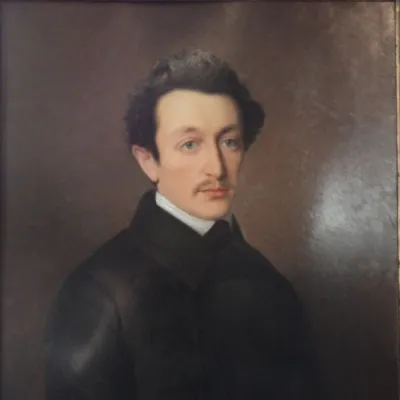
Moses Hess
Human Design Chart
Biography
Born in the French-occupied Rhineland, Hess was raised in a traditional Jewish home but broke away in his youth to pursue a path of philosophy and radical politics. His first book, The Holy History of Mankind (1837), proposed a socialist society founded on a synthesis of Jewish and Christian ethics, mediated through the philosophy of Baruch Spinoza. In the 1840s, he became a central figure among the Young Hegelians, where he developed a theory of "ethical socialism" and was one of the first thinkers in the German tradition to articulate a sophisticated theory of alienation rooted in social and economic conditions.
After the failure of the Revolutions of 1848, Hess grew disillusioned with the prospects of Jewish integration in Europe.
The Human Design of Moses Hess: Generator 5/1
Generator 5/1 — Design at a Glance
Moses Hess revealed himself as someone who possessed immense, enduring strength, comparable to a workhorse ready to carry heavy loads. His Generator design indicated that this energy was released not through arbitrary initiative but through reaction to internal impulses. His motto was clear: not to initiate but to react. When life sent a signal and his sacral center – the motor of his endurance – responded with a clear 'Yes', he could respond with consistent action. This was the key to his effectiveness.
Living by this pattern rewarded him with a deep sense of fulfillment. However, if he went against this mechanism by starting things he didn't really want to do, or if he was prevented from continuing his heart project when he wanted to, he was in danger. These two stumbling blocks – wasting energy on unwanted tasks or interrupting the flow when at full power – led to frustration and a lack of energy. His success thus depended on whether he managed to act from the gut and respond to the right signals rather than being led by external constraints or false initiatives.
Emotional Authority
Moses Hess lived with an inner authority defined by his emotional center. This meant that his decisions could never be based on a first, impulsive impression but required a necessary maturation period. His emotional wave generated a constant up and down of feelings, coloring the world through the current mood. What was seen as exciting in one moment could be perceived as negative in the next. These fleeting impressions were not the final truth but merely snapshots. Quick, spontaneous actions from such emotions often proved detrimental, as they missed the deeper clarity.
The mechanics of his emotional authority demanded patience. Only through repeatedly sleeping on decisions and delaying could the initial frenzy of feelings dissipate. Over time, he gained emotional distance, leading to calmness and true insight. This process was especially crucial for long-term life decisions. Regardless of other defined centers in his chart, emotional authority always took precedence. It dictated that he had to take time to recognize the depth and breadth of a situation before acting. This ensured that his choice did not follow a passing whim but was based on a stable, clear foundation.
The 5/1 Profile — Heretic / Investigator
Moses Hess revealed himself as someone who gathered deep, detailed knowledge to provide others with solutions to concrete problems. His design as a 5/1, the Hero and Researcher, shaped this dynamic: Line 1 drove him to meticulous preparation and weighing of opportunities and dangers. He sought the truth behind the surface, where intuition and detail work were crucial. This inner research formed the basis for his external role.
Line 5 gave him a nearly magnetic aura that attracted others. People sought his advice, recognizing his knowledge as a source of practical solutions. This aligned with the function of the fifth line, taking charge and creating new possibilities in crises through clear boundaries. Yet this attraction carried a danger: without clear boundaries, he risked being exhausted by the endless questions and needs of others, similar to an expert drained after intense consultation.
His path lay in finding the balance between retreating for his own research and engaging with the community. By learning to say no sometimes, he could optimally use his gifts. He understood that leadership did not mean helping everyone immediately but waiting for the right moment for mutations and new structures. This way, he avoided confusion and secured his role as a reliable source, not just designing theoretical plans but providing actionable, real answers to the challenges of his time.
Quadruple Split Definition — Defined & Open Centers
Moses Hess was characterized by a design marked by immense inner stability and assertive willpower. His defined Heart, G, and Sacral Centers gave him a clear identity, a reliable energy source, and the ability to keep promises. He had a firm inner direction and used his vital energy to actively engage, rather than passively wait. This contrasted with his open Head Center. Here, he lacked consistent mental inspiration; instead, he was vulnerable to the pressure of finding answers to questions that were not his own. This open center tended to get stuck in doubts and confusion when trying to solve mental problems that belonged to others. The danger was that he might be overwhelmed by this external mental burden, rather than trusting his inner authority. His defined Solar Plexus acted as an emotional authority, meaning he needed patience to gain emotional clarity before acting. His defined Throat allowed him to express his thoughts and feelings reliably, while his defined Spleen Center gave him a spontaneous, intuitive perception of the „now“. His defined Root Center provided the constant pressure to move forward and survive. Moses Hess thus lived with a strong, active foundation of will, energy, and identity, but had to learn not to accept the mental noise of his open Head Center as his own truth, but to rely on his deeper, defined centers.
Channels for community, focus, intuition and curious exploration.
Moses Hess was someone who possessed a rare ability to focus with absolute precision on a single topic while simultaneously showing a profound, intuitive adaptability to his environment. His design included the Channel of Concentration 52-9, connecting the Root and Sacral Centers. This energy created a calm, passive pressure to remain still and avoid distractions, allowing for logical evaluation of details and perfection of patterns. It was a formative energy that shaped the entire design: Hess waited for his Sacral Center to react before acting, enabling him to gradually penetrate complex connections.
Parallel to this, the Channel of Perfect Form 57-10, connecting the Spleen and G Centers, was at work. Through Gate 57 of intuitive insight and Gate 10 of self-behavior, he moved existentially through the world. This configuration allowed him to release unfounded future fears and act spontaneously but appropriately, securing his survival. He lived in the here and now, guided by an acute sensitivity to the quality of his environment, which helped him to love himself and accept his life without seeking external recognition.
His intellectual drive came from the Channel of Curiosity 11-56, connecting the Ajna and Throat Centers. Here, he linked ideas from Gate 11 with the narrative power of Gate 56. Hess was less interested in dry facts than in weaving stories from his discoveries that taught or entertained others. His creativity was evident in his ability to transform philosophical contemplations into compelling parables that stimulated the imagination of listeners.
Emotionally and socially, the Channel of Community 37-40, connecting the Solar Plexus and Heart Centers, shaped him. Through Gate 37 of friendship and Gate 40 of solitude, he sought his place in the whole. He understood the necessity of building bridges between individuals to create a community where everyone had a respected place. His motivation was not material gain, but emotional clarity and the willpower to make fair agreements that benefited all involved. Additional influences like the genetic care of Gate 27 or the mutative power of Gate 28 supported this stance by guiding him towards self-preservation and the right timing of risks.
Collective Circuitry — Circuit Signature
Moses Hess's design tended towards structured concentration. The Understanding Circuit connected his Sacral with his Root Center, generating focused energy that wanted to develop logical strategies for improving the future, free from emotional conditioning.
Parallel to this, a curiosity was evident that reflected experiences from the past. The Meaning Circuit connected his Ajna with his Throat Center. Here, it was about analyzing emotional waves and past events to gain insights that could be shared with the collective. This energy was cyclical and wave-like.
Another aspect was community building. The Ego Circuit connected his Heart with his Solar Plexus Center, promoting cooperation and the joint creation of resources through mutual support. Since there was no connection to the Sacral Center, pauses were necessary to maintain energy for the tribe.
Finally, the Integration Circuit provided individual self-reinforcement. It connected his Identity with his Spleen Center, channeling power from the intuitive reaction to life and correct behavior to realize it in the present.
These four separate groups – Sacral/Root, Ajna/Throat, Heart/Solar Plexus, and Identity/Spleen – did not form a continuous connection in Moses Hess, but existed as parallel, independent forces. Each group worked on its own without energy flow to the others, leading to a multi-layered but fragmented inner dynamics.
Left Angle Cross of Distraction 2
Moses Hess's design indicated a tendency towards inner conflict, manifesting as the left cross of distraction. This configuration shaped a lifestyle in which consciousness often oscillated between opposing poles. Instead of a clear, direct alignment, a pattern of being pulled in different directions developed, influencing decisions and actions.
In Human Design, this cross describes a specific energy that tends to block itself or divert itself before it can fully unfold its potential. It is not a lack of ability but a structural challenge: the energy seeks an escape, but often finds only apparent solutions that sidestep the real issue. This led Moses Hess to find himself in phases of uncertainty, where the focus was diverted from the central task.
The mechanics of this cross mean that the power that could contribute to a solution is often invested in internal conflicts or distractions. It is a structure that must learn to deal with its own indecision without valuing it as personal failure. For Moses Hess, this was a defining factor that shaped his paths and decisions. The challenge lay in recognizing the distractions and not accepting them as final answers but rather as clues to a clarity yet to be found. Thus, the search for his own center became a continuous process marked by this specific energetic orientation.
Saturn Return · Uranus Opposition · Chiron Return · 2nd Saturn Return — Life Cycles
Moses Hess's design indicated a tendency towards structural anchoring, manifesting in clear life phases. The first Saturn return often marked the transition from preparation to public positioning. In 1837, at 25 years old, he published his first book, 'The Holy History of Mankind.' This work outlined a socialist social order based on a synthesis of Jewish and Christian ethics. It was a concrete career decision, where years of groundwork condensed into a tangible, publicly visible result.
Later, the dynamics of the Uranus opposition often brought unexpected breaks or necessities for escape from existing structures. In 1849, at 37 years old, he fled to Strasbourg. This was not a planned journey but a reaction to an acute crisis that uprooted him from his usual environment and initiated a new, uncertain phase.
The Chiron return around the 49th year is a fulfillment cycle in which personal meaning increasingly unfolds in life. In 1861, at 49 years old, Hess returned to Germany. This return symbolized not just a geographical movement but the approach to his true life task and the realization of his purpose.
Finally, the effects of the second Saturn return shaped his later creative power. In 1869, at 57 years old, he went to Basel as a delegate to the fourth congress of the First International. This engagement showed the maturity of his strategic orientation: he used established structures to translate his visionary ideas into political practice and sustainably anchor them.
Generator · Emotional Authority — Synthesis
He was a Generator whose life was marked by a deep, sacral energy (Design View). This energy always sought tasks in which it could unfold, but emotional authority (Authority) required careful consideration before decisions were made. The Hero-Researcher Profile (Profile Role) reinforced this trait, driving him to acquire knowledge and make it available to others – a process that was fulfilling but also exhausting. The defined mental center (Centers) supported the ability to develop and convey concepts, while the Channel of Concentration (Channels-Gates) provided a formative energy to capture and structure details.
A central paradox in his design lay in the tension between the need for deep engagement in meaningful work (sacral center) and the emotional wave that prevented quick decisions. The cycles showed that he was active in phases of professional development and engagement (Saturn Returns, Chiron Return), but also experienced moments of crisis and flight (Uranus Opposition), hinting at an internal conflict between the desire for creation and the necessity to protect oneself from overexertion. This alternation between deep engagement and withdrawal shaped his life style.
4 Defined Channels
Incarnation Cross - Left Angle Cross of Distraction 2
Solar Return
The Solar Return shows the moment when the sun returns to its exact birth position - your personal solar year.
Life Cycles
Discover the life cycles with a detailed triple view (birth chart, cycle chart, composite).
Human Design Profile
- Type
- Generator
- Strategy
- To respond - wait for something to respond to
- Authority
- Emotional Authority
- Profile
- 5/1 - Heretic / Investigator
- Definition
- Quadruple Split
- Incarnation Cross
- Left Angle Cross of Distraction 2
- Date of Birth
- 21.01.1812 17:00
- Place of Birth
- Bonn, Germany
Frequently Asked Questions
What was Moses Hess's Human Design type?
What Profile did Moses Hess have in Human Design?
What authority guided the decisions of Moses Hess?
What incarnation cross determined the life path of Moses Hess?
When was Moses Hess born?
Discover your own Human Design
Are you also a Generator? Find out in a personal reading how to use your sacral energy correctly and discover deep satisfaction.
More Personalities
Back to overviewAaliyah

Alexia

Angèle

Anne-Marie

Arcángel

Arno