
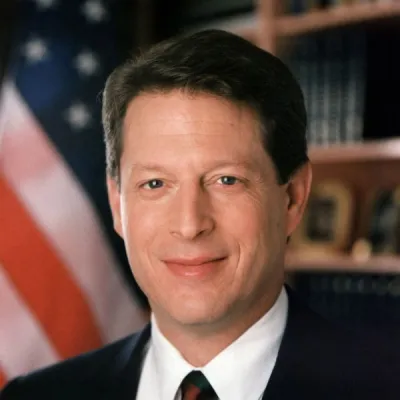
Al Gore
Human Design Chart
Biography
What does Manifestor 2/4 mean for Al Gore?
Manifestor 2/4 — Design at a Glance
Al Gore appeared as someone who actively sought to steer the world in a new direction – not by personally executing every detail but through setting a clear vision and mobilizing others. His design positioned him as a trailblazer: similar to an emperor in ancient Rome, who does not fight battles himself but sends soldiers to expand his empire. This structure means that he initiates and delegates while others take on the operational work.
However, this style of leadership inevitably polarizes. As his thoughts often reach further than those around him, he is misunderstood. Some people love his big dreams and follow him; others reject him precisely because of these visions or even with hatred. This pain point of misunderstandings is a core characteristic of his type.
To navigate this dynamic, informing is crucial. By communicating his intentions timely and precisely, Al Gore could find the right supporters – those willing to back him up. If he followed this strategy of informing as well as his inner authority, he was rewarded with a deep sense of internal peace. Conversely, living against this design led to persistent, deep anger. His path was thus marked by the tension between visionary leadership and the need to generate understanding rather than rejection through clear communication.
Ego Authority
Al Gore exhibited a fundamental stance where spontaneous, uncensored expression was considered central truth – not careful consideration. This tendency stems from his authority in the ego (Will), a configuration that only Projectors or Manifestors with defined Ego-Center as well as open Emotional, Sacral and Spleen Centers can display. As this authority is rare and comes with great graphic openness, there was high susceptibility to external impulses. The challenge lay in distinguishing one's own interests from those of others: the mind often served adaptation to the environment, while true will manifested spontaneously through the throat.
To follow this inner voice, it was essential to listen to oneself when speaking and separate spontaneity from subsequent thinking. When Al Gore did something that truly mattered to him, he had the necessary willpower to achieve goals and keep promises. This could appear egoistic externally as it primarily revolved around actions being rewarding for himself – whether through material success or the urge to transcend boundaries and blaze new trails first. However, after goal achievement, a pause was strictly necessary; continuous work would have led to unhealthy exhaustion.
The 2/4 Profile — Hermit / Opportunist
Al Gore showed a clear tension between a deep need for withdrawal and simultaneous attraction to community. His design suggested that he constantly oscillated between two poles: the urge to be alone and the desire to spend time with familiar people. This profile 2/4 dynamic, often described as a natural talent or networker, requires a secure environment to master this oscillation.
Line 2 in his design caused extreme reactivity upon interference. When his space was violated, he reacted surprisingly harshly – 'Violence before justice' – followed by neptunian regret over the severity of these measures. This protected his inner cave where he found calm and clarity.
Simultaneously, line 4 worked through analysis and waiting for suitable alliances. It emphasized the contrast to combat and sought trust within the network. Aggressive resistance hindered more than it helped here; instead, patience was crucial to find the right partners.
The combination of these lines meant that clear communication of his needs was essential for Al Gore: 'I need company' or 'Leave me alone.' Only when the need for solitude was fulfilled could he emerge from his retreat and reflect on his network's knowledge. In this phase of integration, brilliant ideas often emerged based on synthesis of isolated reflection and social analysis. His design thus showed how withdrawal is not isolation but preparation for effective networking.
Single Definition — Defined & Open Centers
Al Gore's design is characterized by a clear distinction between mental inspiration and physical implementation. His defined Head, Ajna, and Throat centers form a continuous structure that constantly drives him to question and conceptualize. This mechanism does not provide direct answers or action impulses but rather poses questions to the world in order to inspire others to think. Since these mental centers are not connected to energy-driven motors, he did not have constant generative energy available for the direct implementation of his ideas. A desire for immediate manifestation would have led to frustration; instead, his strength lay in communicating concepts so clearly that they resonated with others.
Parallel to this, his defined G and Heart centers provided a stable internal identity and willpower. These solo definitions gave him a clear self-image and the ability to fulfill promises without being directly linked to the chain of mental inspiration. This created tension between the desire for control (Heart) and the necessity to wait for inspiration.
The open Sacral, Solar Plexus, Spleen, and Root centers marked areas of receptivity. Without his own generative energy in the Sacral center, he tended to be overwhelmed by his environment if he did not pause. The open Solar Plexus center made him susceptible to interpreting others' emotions as his own, which could lead to inner confusion rather than standing on his own emotional truth. The open Spleen and Root centers also meant a mirror function for intuition and stress: He absorbed the fears and pressure of his environment instead of having stable survival impulses or intuitive security. This required mindfulness to avoid falling into conditioned patterns of exhaustion or emotional overload.
Channels for inspiration, willpower, logic and structure.
Al Gore's fundamental approach was based on individual inspiration: he lived his uniqueness authentically, inspiring others through his example to change their perspective. This effect is not achieved by mere explanation but by acting as an individual and thereby drawing attention. At the same time, he faced the challenge of translating this creative identity into structured, material results, which required taking responsibility for resources and hierarchies.
The Inspiration Channel 1-8 connects the G Center with the Throat Center through the Gate of Self-expression (1) and the Gate of Contribution (8). It is the public outlet for creative potential and leadership in the Knowledge Circuit. People with this channel inspire by demonstrating their individual direction – like a pianist whose performance encourages listeners to play the piano themselves. This requires courage to stand out from the crowd and an inner, authentic authority.
Simultaneously, the Money Line Channel 21-45 connected his Heart Center with his Throat Center through the Gate of the Hunter (21) and the Gate of the Gatherer (45). This channel expresses the authority to survive as a hierarchy on a material level. It demands control over one's work rhythm and resource management, so as not to suffer from the pressure of constantly having to prove oneself. The key lies in balancing the desire for recognition of individuality with the necessity of acting materially independent and self-determined.
Additionally, the Logic Channel 63-4 shaped his thinking by connecting the Head Center with the Ajna Center through the Gate of Doubt (63) and the Gate of Formulation (4). This is the doubting mind that constantly filters patterns to see if they are consistent. Doubt here is essential for logic; an answer only holds until a consistent, verifiable pattern emerges from it. There is little room for unfounded belief – something must work to be logical.
The Structuring Channel 43-23 connected the Ajna Center with the Throat Center through the Gate of Insight (43) and the Gate of Assimilation (23). It allowed spontaneous breakthroughs to be received as unique perspectives and communicated in a way that reinforced efficiency. Innovative thoughts were thus conveyed in a manner that changed how people see and think.
Individual Gates like Gate 38 (Pressure/Struggle for Life's Meaning) or Gate 48 (Logical Correction/Perfectionism) supported this dynamic by setting boundaries to preserve individual integrity as well as analyzing deeper connections within the collective.
Individual Circuitry — Circuit Signature
Al Gore's design inclined towards innovative, emotionally colored expression. His simple definition linked all active centers in a single coherent flow: Head, Ajna, Identity, Heart, and Throat centers were directly connected with each other. This created an uninterrupted stream of mental inspiration through emotional resonance to verbal manifestation.
The Knowledge Circuit shaped this kind of expression. Through the Inspiration Channel (Gates 1-8) and the Structuring Channel (Gates 43-23), it linked Ajna, Identity, and Throat centers. This allowed not only thinking new insights but also bringing them into the world with a pulsating acoustic energy and individual creativity. The emotional wave from the Solar Plexus (included in this overall flow) colored this expression, thereby initiating change for others – driven by the need to follow one's own path and live mutations as deviations from the existing.
Parallel, the Understanding Circuit worked through Logic (Gates 63-4) between Head and Ajna centers. This provided focused rational clarity and strategic structure within the creative impulse. Thus, insight was logically underpinned before being expressed emotionally.
The Ego Circuit contributed through the Money Line (Gates 45-21) between Throat and Heart centers. This connected expression directly to identity and the will to create resources. Al Gore thus showed himself as someone who, through his authentic, logically grounded, and emotionally intense expression, not only shared knowledge but also mobilized material and social support – always in service of his unique identity and common welfare.
Right Angle Cross of Tension 1
Al Gore's design revealed a tendency towards internal tension and the drive for clarity. He was someone who felt compelled to find answers under pressure, not out of fear but from a deep desire to get to the point. This attitude is described by the right cross of Tension 1. It is a configuration that generates inner friction until a decisive insight occurs. The person often feels that something isn't quite right or incomplete, which drives them to seek the truth.
The mechanics of this circle work with tension as a motor. As long as uncertainty exists, energy remains bound. Only when clarity is achieved does this tension release and allows for effective action. Al Gore was thus programmed not to accept situations superficially but to penetrate them to their core. This did not happen as an intellectual game but as an existential necessity of his design. The tension served to keep him alert and focused. Without this internal pressure, his attention might have been scattered. Instead, it channels his energy into the search for the one right solution or decisive factor. This structure shaped his entire work through a consistent focus on the essential until there was still uncertainty.
Saturn Return · Uranus Opposition · Chiron Return · 2nd Saturn Return — Life Cycles
Al Gore's design showed a clear structuring through cyclical turning points that shaped his political career. In 1976, at age 28, he was elected to the House of Representatives. This marked the first Saturn Return: a moment when years of groundwork condenses into a solid result and identity is strengthened.
Ten years later in 1988, he unsuccessfully ran for US President. Here came the Uranus Opposition. This cycle demands a radical redefinition of one's role; old structures break down to make way for new self-understanding – often accompanied by apparent setbacks that are necessary.
In 2000, Gore lost the election against George W. Bush. At age 52, he was in his Chiron Return. In Human Design mechanics, this is not a healing process in a clinical sense but an actualization cycle: one's life purpose unfolds increasingly, meaning becomes experiential even if external results do not meet expectations.
Finally, in 2005, he received the Webby Award for his lifetime work. At age 57, this marked the second Saturn Return. This cycle crowns previous phases: The newly found identity and deepened understanding of one's purpose culminate in an acknowledged stable position. Al Gore's path illustrates how these four cycles shape authority, identity, and purpose step by step.
Manifestor · Ego Authority — Synthesis
A central red thread runs through the design: the dynamics between inner drive and external effect. As a Manifestor (Design View), this person is destined to initiate and lead, yet it always happens under the condition of their ego-authority (Authority) based on spontaneous, unfiltered expression. The line 2/4 in Profile (Profile Role) intensifies this tension by emphasizing the pendulum swing between withdrawal and community – an inner need for recharging alternates with the desire to connect and influence. The defined Head and Ajna (Centers), coupled with the channel of Inspiration (Channels-Gates), generates a steady flow of ideas and questions that want to be channeled through the Throat Center – a creative impulse that can both inspire and put pressure.
The central paradox lies in the connection between inner clarity and external resistance. Ego-authority demands authenticity and uncensored expression, while the nature of the Manifestor (Design View) already has a polarizing effect. This is further intensified by the knowledge of one's individuality (Switches). Documented events show that career high points (Saturn Return 1, Webby Award) and crises (Chiron Return) are closely linked to the drive for expression – an interplay between success and setbacks shaped by the necessity of self-assertion and one's own path.
4 Defined Channels
Incarnation Cross - Right Angle Cross of Tension 1
Solar Return
The Solar Return shows the moment when the sun returns to its exact birth position - your personal solar year.
Life Cycles
Discover the life cycles with a detailed triple view (birth chart, cycle chart, composite).
Human Design Profile
- Type
- Manifestor
- Strategy
- To inform others before acting
- Authority
- Ego Authority
- Profile
- 2/4 - Hermit / Opportunist
- Definition
- Single Definition
- Incarnation Cross
- Right Angle Cross of Tension 1
- Date of Birth
- 31.03.1948 12:53
- Place of Birth
- Washington, United States
Frequently Asked Questions
What is Al Gore's Human Design type?
What profile does Al Gore have in Human Design?
Which authority determines Al Gore's decisions?
What is Al Gore's incarnation cross?
When was Al Gore born?
Discover your own Human Design
Are you also a Manifestor? Find out in a personal reading how to use your initiation power peacefully and dissolve resistance.
More Personalities
Back to overviewAaliyah

Alexia

Alizée

Angèle

Anne-Marie

Arcángel
