
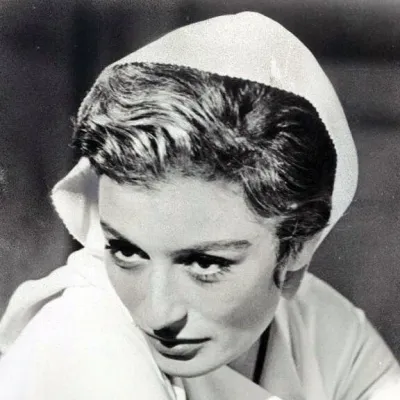
Anouk Aimée
Human Design Chart
Biography
She appeared in 70 films from 1947 until 2019, including La Dolce Vita (1959), Tragedy of a Ridiculous Man (1981) and A Man and a Woman at the height of her career, in 1966, for which she was nominated for the Academy Award for Best Actress.
Of her four marriages, the last was to British actor Albert Finney on 7 August 1970. She had one child, Manuela Papatakis (born 1951), from her second marriage to director Nico Papatakis.
Anouk Aimée died in Paris on 18 June 2024 at age 92.
The Human Design of Anouk Aimée: Manifesting Generator 6/2
Manifesting Generator 6/2 — Design at a Glance
Anouk Aimée lived as an Manifesting Generator, a hybrid configuration of constant sacral energy and the ability to skip steps. This design gave her the power to quickly pull things into her life but also carried the risk of frustration through excessive speed or multitasking without inner consent - her specific non-self theme.
Her strategy was not to initiate herself but to react to impulses from the environment. Only when her sacral center responded with a clear “yes,” did she begin to act. This feedback loop was essential for constructively using her natural speed and avoiding the need to catch up on skipped steps.
Anouk Aimée showed herself most effective in her creative drive when pursuing multiple projects simultaneously. For her design, the advice of finishing one thing completely before starting another was counterproductive. Instead, she found deep satisfaction and fulfillment by entering a “play mode.” In this state, she used her energy for variety and fun, thereby turning her hybrid nature into a motor for sustainable creativity and inner confirmation.
Emotional Authority
Anouk Aimée displayed an internal dynamics where spontaneous impulses were often misleading and true clarity only emerged through temporal distance. Her design carried emotional authority, meaning that her defined Emotional Center formed the basis of her decision-making - independent of other defined centers in her chart. This configuration subjected her to a permanent emotional wave: Her perception of the world was always colored by the current mood state. What appeared inspiring at one moment could seem negative in the next. However, this first impression was merely a snapshot and not necessarily her deeper truth.
Quick decisions based on immediate emotion could therefore have negative consequences. The mechanism of her authority required patience: She had to let decisions mature, ideally through multiple sleepovers. Only when intense feelings subsided and emotional distance was gained did clarity and calmness set in. This process was particularly crucial for long-term life decisions as it ensured that actions were based on a broader understanding rather than fleeting moods. Anouk Aimée lived in a system guiding her to be patient and ask questions multiple times before taking a final position.
The 6/2 Profile — Role Model / Hermit
Anouk Aimée's design showed a clear shift: from experimental trial and error in youth to wiser, reflective distance in adulthood. As a 6/2 profile (Role Model/Natural Talent), she primarily acted through the energy of Line 3 before her 30th birthday. During this phase, personal experience gathering and actively trying out various life paths were central, with setbacks often leading to temporary retreats.
After turning 30, Line 6 was activated. This transition marked a period of intense introspection and healing. Anouk Aimée metaphorically retreated into her “Cave,” looking back at earlier experiments with great distance. This phase fostered deep self-awareness and eventually led to a role as a wise model, attracting others through life wisdom.
This maturation process integrated the tension between two different service postures. On one hand, Gate 27 (Line 6) worked with an altruistic care drive aiming at fairness and trust in oneself and others for productive help. On the other hand, Gate 19 (Line 2) shaped a selective service under exchange conditions. Here it was about targeted use of personal resources in return for recognition or support within the clan. Through maturation, Anouk Aimée learned to combine these two aspects - unconditional giving and conditional exchange - into a coherent stance of conscious care.
Split Definition — Defined & Open Centers
Anouk Aimée was revealed as someone with a constant vital energy source that she could only utilize through reaction rather than initiation to avoid frustration. Her mechanics were characterized by the combination of manifestation (defined throat + motor), willpower (heart), and emotional depth (solar plexus as authority). The defined throat acted as a pivot point for manifesting her messages from the motors (heart/sacral) and emotional authority.
The challenge lay in not acting impulsively or expending too much energy through excessive talking/doing, but rather waiting for the correct sacral response and emotional clarity. With four defined centers (throat, heart, sacral, solar plexus), she was an energetic and willful personality. The defined heart center gave her willpower and a desire to determine her own life, while the sacral center provided vital energy. The solar plexus as emotional authority required patience; truth revealed itself only over time through the emotional cycle.
At the same time, Anouk Aimée was vulnerable to conditioning due to several open centers. Her open head center made her susceptible to mental pressure waves and questions that were not her own, leading to confusion if she responded to them. The Ajna center being open meant a flexible but unstable mind; she tended to adopt other people's concepts rather than having firm opinions of her own. The open G center lacked a fixed identity, causing her to often align with the directions and identities of her environment for security. Additionally, the spleen center being open led to a fundamental fear of survival and susceptibility to spontaneous but unwise decisions when following the conditioning search for compliance. Her open root center absorbed external stress, leading to feelings of pressure that she did not generate herself.
Channels for ambitious leadership and passionate intimacy.
Anouk Aimée showed a tension between her natural inclination towards merging and her intentional pursuit of control. Her Design Channel of Pairing 59-6 anchored her in an electromagnetic presence of intimacy connecting the sacral rhythm with the emotional wave of the solar plexus. This channel required patience: she had to wait for her emotional clarity to arrive before nurturing relationships sustainably and enabling fertility in creative or interpersonal areas. Her intensity could quickly create trust but also risked misunderstandings if others perceived her closeness as flirting.
At the same time, on a personality level, the Money Line Channel 21-45 worked as a conditioned pattern. This channel connected the heart center with the throat center and reflected the desire for control over material resources. It urged taking responsibility to protect the ego and sought balance between hard work and necessary rest. Here, independence was paramount: she needed to feel like her own boss to avoid stress, even though this made delegation difficult.
Additionally, Gates such as 27 (Care), 19 (Resources/Safety), and 40 (Freedom through Work) shaped her approach. Gate 27 promoted altruistic warmth while Gate 19 emphasized the need for a safe territory. Gate 40 expected recognition as reward for performance. These configurations underscored the necessity of combining material security with emotional authenticity, where the inner rhythm took precedence over external pressure.
Tribal Circuitry — Circuit Signature
Anouk Aimée displayed a duality of resource-oriented cooperation and deep instinctive protective drive. Her design presented two separate but parallel functioning energy fields. In the Ego Circuit, the Money Line (Channel 21-45) connected heart and throat centers, promoting clear understanding of giving and taking as well as building material resources through communication. Since this circuit did not connect to the sacral center, this activity required regular rest pauses for regeneration due to a lack of constant life force.
At the same time, the Archer Circuit worked through Pairing (Channel 6-59), linking the sacral with solar plexus centers. This connection created an ancient emotional intuition for protecting genetics and family. Here, instinctive spleen energies merged with strong feelings to ensure care, preservation, and defense of the familial core.
The dynamics lay in balancing these two poles: on one hand, strategic, communicative management of resources within a group that required pauses; on the other, direct emotional life force for nurturing and protecting her own kin. Anouk Aimée lived this tension by acting cooperatively while also preserving her inner family through intuitive emotions without these two systems energetically overlapping directly.
Left Angle Cross of Alignment 1
Anouk Aimée's Human Design revealed a tendency towards structural orientation and clear inner alignment. She was someone whose actions were based on a stable foundation that allowed her to organize complex situations and move forward with clarity. This aligned with the pattern of the left Alignment 1 cross, which in Human Design describes a specific life task: seeking hidden truth and sharing these insights with others.
This configuration shaped her fundamental approach. Anouk Aimée lived in a world where uncovering connections that were not immediately apparent to others was crucial. Her design challenged her to recognize these hidden structures and convey them in ways that could be accepted by her environment. It was a dynamic interaction between individual perception and social responsibility.
The mechanics of this cross emphasized the importance of orientation in space and relationships. Anouk Aimée relied on an inner logic that went beyond pure intuition. She used her ability to structure to reduce uncertainties and create clarity. This did not happen through coercion or dominance, but by setting a positive example and providing a stable framework.
Her path was marked by the necessity of carrying this inner alignment outward. Anouk Aimée understood her role in bridging abstract truths with everyday life. This required patience and deep conviction about the validity of her insights. Through this approach, she contributed to others finding clearer perspectives on their own reality.
Saturn Return · Uranus Opposition · Chiron Return · 2nd Saturn Return — Life Cycles
In 1960, at age 28, Anouk Aimée gained international recognition for her role in “La Dolce Vita.” For her design, this moment marked the first Saturn return, a critical turning point where inner maturity became visible and adult identity was solidified. This cycle signaled the transition from youth to full responsibility for one's life. Years of groundwork now condensed into a viable outcome that clearly defined her position in the world. Instead of still being in an experimental phase, she entered a period of affirmation and structuring. The Saturn return challenged her to integrate accumulated experiences and establish a stable foundation for future life stages. At this age, it often becomes clear which paths are sustainable and which were merely transitional phases. For Anouk Aimée, this meant that her previous journey was validated by this public success, allowing her to build further on solid ground. The mechanics of this cycle underscore the necessity of taking responsibility and becoming aware of one's role without falling back into old patterns. It was a moment of clarity where the potential of youth transformed into concrete achievement.
Manifesting Generator · Emotional Authority — Synthesis
Anouk Aimée lived a life marked by profound responsiveness and an inner compass. Her defined sacral energy enabled her to tackle tasks with vitality and endurance as long as they were confirmed by the inner authority of the heart and emotional wave. This combination of reactive power and need for inner clarity shaped her work approach and engagement with creative processes – a constant balancing act between spontaneous action and allowing things to develop at their own pace. The connection between Throat and Heart Centers allowed her an authentic self-expression, enhanced by the ability to reflect and emotional depth.
A central tension in Anouk Aimée's design lies between the need for inner clarity and openness to external influences. While the defined Heart Center provided strong willpower and direction, open centers were receptive to environmental energies. This led to a dynamic interplay between self-determination and adaptability – constantly navigating between expressing one's self and integrating experiences from the world. This paradox created a complex personality embodying both strength and vulnerability.
2 Defined Channels
Incarnation Cross - Left Angle Cross of Alignment 1
Solar Return
The Solar Return shows the moment when the sun returns to its exact birth position - your personal solar year.
Life Cycles
Discover the life cycles with a detailed triple view (birth chart, cycle chart, composite).
Human Design Profile
- Strategy
- To respond - wait for something to respond to
- Authority
- Emotional Authority
- Profile
- 6/2 - Role Model / Hermit
- Definition
- Split Definition
- Incarnation Cross
- Left Angle Cross of Alignment 1
- Date of Birth
- 27.04.1932 12:00
- Place of Birth
- Paris, France
Frequently Asked Questions
What is Anouk Aimée's Human Design type?
What Profile did Anouk Aimée have in Human Design?
What Authority did Anouk Aimée have?
What incarnation cross did Anouk Aimée have?
When was Anouk Aimée born?
Discover your own Human Design
Are you also a Manifesting Generator? Find out in a personal reading how to unfold your multi-talents and direct your energy wisely.
More Personalities
Back to overviewSissy Spacek

Aldair
Alizée

Anémone

Angeli
Ann-Margret
