
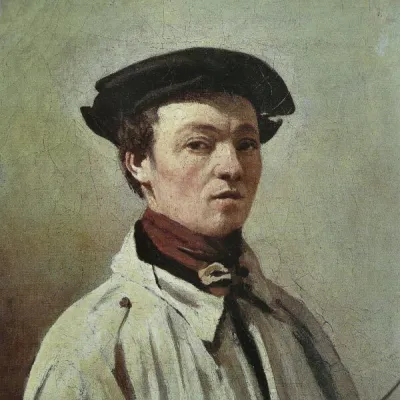
Camille Corot
Human Design Chart
Biography
Camille Corot — Projector with Profile 4/6
Projector 4/6 — Design at a Glance
Camille Corot showed himself to be someone who possessed the ability to immediately recognize flaws in other people's systems. His Human-Design type was Projektor, meaning his energy acted like a bright flashlight: it illuminated areas in others that were still dark or not functioning properly. This dense, focused aura could sometimes be perceived as unpleasant by the environment, especially when he addressed these flaws directly – comparable to shining a light directly into someone's face and criticizing their bumpy relationships.
Since his Sacral Center was undefined, Camille Corot did not have a constant, intrinsic source of life energy. Instead, he experienced phases of high activity followed by necessary rest periods to prevent burnout. The best strategy for him was to wait for a respectful and sincerely meant invitation from others rather than taking the initiative himself. By shining a light on his harmonious uniqueness, he automatically drew people who then asked for his insider tips. If he lived according to this design, he was rewarded with success; if he ignored it, it led sooner or later to the non-self theme of bitterness.
Emotional Authority
Camille Corot's inner authority carried the defined Emotional Center. This meant that he could not make decisions immediately but had to submit to an emotional wave characterized by a constant up and down of his feelings. His perception of the world was always colored by his current mood; what appeared inspiring in one moment could seem negative in the next. This emotional fluctuation required patience: quick, spontaneous judgments based on temporary feelings often proved misleading and not sustainably correct.
The mechanics of his emotional authority dictated that he needed time to let a decision mature. Only through repeatedly "sleeping on" questions and waiting for the wave movement could he gain clarity. Intense initial feelings had to subside so that emotional distance and calmness could set in. This process was particularly crucial for long-term, life-defining decisions.
A central mechanism of his configuration was that the Emotional Center as authority always took precedence – regardless of which other centers were also defined in his design. As long as the Emotional Center was activated, it determined the path of inner guidance. Camille Corot thus showed himself to be someone who did not find his truth in the first impulse but through consciously distancing from the current emotional heat and waiting for the subsequent calm phase.
The 4/6 Profile — Opportunist / Role Model
Camille Corot's design set a trend that marked his early years through intense experimentation in relationships and friendships. As a 4/6 profile, he initially appeared before Saturn’s return as a pure networker (Line 3), actively seeking connections. With the activation of Line 6, however, an inner conflict emerged: the desire to belong to a community clashed with the need to withdraw and contemplate the meaning of life. This tension between Heart (Line 4) and Head (Line 6) shaped his development.
The fourth line required time for its internal process; it waited for the right moment to express details in harmony and simplicity. If pulled out of this phase of asceticism too early, corrections would have been necessary. Only when the details were organized could he articulate them. Later, there arose an expectation to function as a wise role model. The sixth line oversaw the entire process and reflected on who could bring it to completion. It was about finding trust in growth and sharing its benefits with others. Refusing to do so led Saturn to self-alienation. His path involved advancing this cooperation cautiously, always mindful of not opening his large heart to the wrong people.
Split Definition — Defined & Open Centers
Camille Corot was characterized by a persistent mental activity that raised questions and formed concepts. His defined Head and Ajna centers created a constant pressure to understand; he was not destined to directly implement these thoughts into action but rather provide them as inspiration for others. This mental energy flowed into his defined Throat center, allowing him to communicate his concepts reliably. However, his inner authority lay in the emotional realm: The defined Solar Plexus center demanded patience. Camille Corot had to wait out the emotional wave to gain clarity instead of impulsively reacting to feelings. This depth allowed him a sensitive understanding of situations that only revealed itself over time. This process was supported by his defined Spleen center and its associated Root pressure, giving him spontaneous physical security and an instinct for what was healthy in the moment as well as an existential survival drive.
At the same time, his vulnerability was evident in the undefined centers. His open Throat center meant he did not have a fixed identity or direction; he tended to orient himself according to his surroundings and often sought a place where he felt belonging rather than declaring a personal life mission. His open Heart center made him susceptible to the pressure of proving his worth. He could spiral into self-doubt when trying to keep promises or compete, which did not align with who he was. Additionally, his Sacral center was open, meaning he did not have constant generative energy; instead, he absorbed the vitality of others, which could exhaust him if he did not respect that his energy came in spurts and needed pauses for regeneration.
Channels for logic, acceptance, life purpose and emotional clarity.
Camille Corot's design inclined towards analytical skepticism and emotional intensity. His mind was geared to filter patterns persistently to distinguish constancy from randomness. This happened through the Logic channel 63-4, which understood doubt as an essential part of thinking; a response was only considered true if it was practically verifiable and consistent. Unresolved questions generated mental pressure here that could turn into fear when no logical solution was found.
Parallel to this, his mind organized visual impressions through the Accepting channel 17-62. This mechanism translated complex patterns into detailed language and opinions. Camille Corot sought the inner order of information to integrate it into a coherent worldview. What did not logically fit into this structure he could not understand. This gave him the ability to explain things precisely but also created a need to verbally confirm his perspective.
On an energetic level, the Life Struggle channel 38-28 shaped his actions. He actively sought fights that carried deep personal meaning and stubbornly resisted expectations that contradicted his individual integrity. This struggle was not merely a pursuit of victory but a means of individuation and finding life purpose.
Emotionally, he moved in the pulsating wave of the Feelings channel 39-55. Here passion and melancholy alternated, driven by a provocative nature that challenged the minds of others. His moods were not weakness but a mutative process requiring authenticity. Only when acting in the right mood could he unfold his full creative depth; forced action led to inner disintegration. This configuration described someone who sought truth through logical verification, found meaning through conscious struggle, and accepted emotions as driving force.
Collective Circuitry — Circuit Signature
Camille Corot's design inclined towards separate, parallel operating energetic streams. As a person with Split Definition, he had two independent power centers: a logically-strategic flow and an emotionally-intuitive stream that were not directly connected.
The Understanding Circuit linked his Head, Ajna, and Throat centers into a closed circuit. This created focused rational energy for structuring thoughts and their clear articulation. The channels 'Logic' (63-4) and 'Accepting' (17-62) allowed him to visually grasp complex connections and strategically convey them without emotional influence.
Simultaneously, there existed a completely separate field: The Knowledge Circuit linked Spleen, Root, and Solar Plexus centers. Here the channels 'Life Struggle' (38-28) and 'Feelings' (55-39) shaped a pulsating, emotional wave of individual identity and creativity. Intuition from the Spleen met the emotional depth of the Solar Plexus and the endurance of the Root.
These two systems – cool ratio and hot emotion – ran alongside each other without mixing. Camille Corot was someone who could share clearly structured insights on one hand, while being driven by deep, often melancholic emotional waves on the other. His life task lay in integrating these different energies: to walk his unique path through emotional authenticity and simultaneously bring logical strategies for change into the world. The separation of groups meant that rational decisions were not automatically carried by emotional security and vice versa.
Right Angle Cross of Maya 2
Camille Corot's design carried the signature of the right cross of the Maya. This configuration set a specific inner tension: the urge to shape one's life through concrete actions and creations, paired with the awareness that these works are part of a larger collective whole.
In Human Design, this cross marks a point of transformation. It connects personal power in action with a universal mission. Those who carry this structure often feel called not only to act for themselves but also to leave something behind that transcends the individual and serves or inspires others. It is a pattern of dedication to something felt as sacred or of high importance.
For Camille Corot, this meant that his work was not merely personal expression but understood as a contribution to a greater whole. The energy of this cross demands authenticity and the willingness to submit to a higher order without losing one's own voice. It is about finding balance between the 'I' and the 'We'. His path was marked by this dual nature: acting individually, working collectively. This created a deep connection with his task that went beyond mere success and culminated in a kind of service to beauty or truth he sought to embody.
Saturn Return · Uranus Opposition · Chiron Return · 2nd Saturn Return — Life Cycles
Camille Corot's design set a tendency towards cyclic development phases shaped by external structures. His path did not show as a steady flow but rather as a series of milestones linking inner maturation with concrete life stations. This corresponded to the mechanics of Saturn returns, times when long-term stances condense and new levels of responsibility arise.
In 1825, at age 29, he traveled to Rome and painted for three years in the Campagna Romana. This first Saturn return marked a transition into a phase of serious artistic consolidation. The design here demanded that previous groundwork coalesce into a solid result before new steps were taken.
The Uranus opposition around his 40th year often brought unexpected turns or a break with established patterns. In 1836, he painted 'Avignon from the West'. This work emerged during a phase marked by the need to question old structures and adopt new perspectives, visible in the chart as an impulse for change.
The Chiron return around his 50th year is a fulfillment cycle where one's inner purpose increasingly unfolds. In 1846, Corot was named Knight of the Legion of Honor. This recognition was not merely a reward but a visible confirmation that he had followed his path according to his strategy and his life mission was now socially acknowledged.
The second Saturn return around his 56th year further deepened this structuring. In 1852, the portrait of the abbess of the Annunziata convent in Boulogne-sur-Mer emerged. During this phase, it was about stabilizing acquired achievements and laying a sustainable foundation for the next years, described in his design as a time of anchoring and responsible action.
Projector · Emotional Authority — Synthesis
Camille Corot lived a life path marked by a deep inner drive towards analysis and understanding (defined Head Center, Logic Channel). This urge to recognize and question patterns fed his ability to perceive the essential in his surroundings – bringing 'light into darkness', typical for Projectors. Emotional authority also required time for decision maturation while Profile as Networker/Role Model combined the desire for connection with a need for inner reflection (Line 4 against Line 6). This combination led to profound observational skills and subtle understanding of underlying world structures.
Simultaneously, Corot was marked by a central paradox: the conflict between the need to be perceived as part of a community (Line 4) and the inner calling to adopt an independent perspective (Line 6). This showed in recurring themes of his work often reflecting both connection with nature and a distant, almost melancholic view. The key moments of his life – from early career phases to awards – were always connected to the interplay of these forces driving him to gain knowledge and express it creatively (Knowledge Circuit).
4 Defined Channels
Incarnation Cross - Right Angle Cross of Maya 2
Solar Return
The Solar Return shows the moment when the sun returns to its exact birth position - your personal solar year.
Life Cycles
Discover the life cycles with a detailed triple view (birth chart, cycle chart, composite).
Human Design Profile
- Type
- Projector
- Strategy
- Wait for the respectful invitation
- Authority
- Emotional Authority
- Profile
- 4/6 - Opportunist / Role Model
- Definition
- Split Definition
- Incarnation Cross
- Right Angle Cross of Maya 2
- Date of Birth
- 16.07.1796 01:30
- Place of Birth
- Paris, France
Frequently Asked Questions
What was Camille Corot's Human Design type?
What profile did Camille Corot have?
What authority did Camille Corot possess?
What incarnation cross did Camille Corot have?
When was Camille Corot born?
Discover your own Human Design
Are you also a Projector? Find out in a personal reading how to unfold your leadership qualities and recognize the right invitations.
More Personalities
Back to overviewSissy Spacek

Alain-Fournier

Anémone

Ann-Margret

Baekhyun

Balthus
