
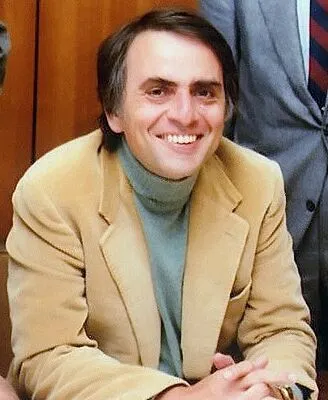
Carl Sagan
Human Design Chart
Biography
He co-wrote and narrated the 1980 documentary series Cosmos: A Personal Voyage, which has been seen by at least 500 million people in 60 countries and won two Emmy Awards and a Peabody Award. Cosmos, the companion volume, was the bestselling science book to date. A lifelong science fiction fan, Sagan entered the genre with Contact, which was adapted as the film of the same name. He was a founding member and first president of the Planetary Society. He proposed the Pale Blue Dot photograph of Earth taken by Voyager 1.
He had a lifelong interest in the possibility of extraterrestrial life and is generally credited with contributions to the Arecibo message, with a much more significant role developing the Pioneer plaques and the Voyager Golden Record, universal messages that could potentially be understood by any intelligence that might find them.
The Human Design of Carl Sagan: Projector 4/6
Carl Sagan is a Projector in Human Design – a non-energy type designed to guide and direct others. Projectors make up about 20% of humanity and have a special gift for recognizing and directing the energies and talents of others.
The Projector's strategy is to wait for the right, respectful invitation before contributing their guidance. Without an invitation, the Projector's wisdom is often unrecognized or even rejected.
When Carl Sagan lives in alignment with their design, they experience success and recognition. The Projector's not-self theme is bitterness – a sign that their wisdom and guidance isn't being valued.
Carl Sagan has Emotional Authority – the most common authority. Decisions should never be made in an emotional high or low, but only when emotional clarity settles in. "Sleep on it" is meant literally here. The emotional wave needs time to run its course.
Carl Sagan carries the profile 4/6 – Opportunist / Role Model. The 4th line represents the Networker: influence and impact unfold through personal relationships and a strong social network. The 6th line represents the Role Model: a life path in three phases – first experimenting (until ~30), then observing from the "roof" (until ~50), and finally authentically embodying the role model.
The incarnation cross "Right Angle Cross of the Sphinx 4" describes the overarching life purpose and direction of Carl Sagan in Human Design. It consists of the four gate activations of Sun and Earth (personality and design) and only becomes felt when one lives their strategy and authority.
In Carl's Bodygraph, we find a Split Definition.
Of the 9 centers in the Bodygraph, 4 are defined for Carl: G Center, Throat Center, Root Center and Emotional Center. 5 centers remain open.
Circuit distribution: Collective (Understanding, Sensing): 3 channels, Tribal (Ego): 1 channel. Carl is particularly shaped in the "Collective" area - sharing experiences and knowledge with the community.
4 Defined Channels
Incarnation Cross - Right Angle Cross of the Sphinx 4
Solar Return
The Solar Return shows the moment when the sun returns to its exact birth position - your personal solar year.
Life Cycles
Discover the life cycles with a detailed triple view (birth chart, cycle chart, composite).
Human Design Profile
- Type
- Projector
- Strategy
- Wait for the respectful invitation
- Authority
- Emotional Authority
- Profile
- 4/6 - Opportunist / Role Model
- Definition
- Split Definition
- Incarnation Cross
- Right Angle Cross of the Sphinx 4
- Date of Birth
- 09.11.1934 17:05
- Place of Birth
- New York, New York, United States
Frequently Asked Questions
What Human Design type is Carl Sagan?
What Human Design profile does Carl Sagan have?
How does Carl Sagan best make decisions?
When and where was Carl Sagan born?
What is Carl Sagan's incarnation cross?
Discover your own Human Design
Are you also a Projector? Find out in a personal reading how to unfold your leadership qualities and recognize the right invitations.
More Personalities
Back to overviewSissy Spacek

Alain-Fournier

Anémone

Angeli

Ann-Margret

Bourvil
