
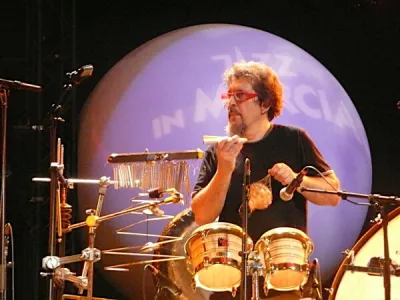
Cyro Baptista
Human Design Chart
Biography
Baptista arrived in the U.S. in 1980 with a scholarship to Creative Music Studio in Woodstock, New York. During the 1980s, he worked on films with John Zorn and appeared on Zorn's albums in the 1990s. Also in the '90s, he appeared on albums by Marisa Monte, Holly Cole, and Cassandra Wilson. In 1997 he released his first solo album, Vira Loucos, with cover versions of music by Heitor Villa-Lobos. The album was recorded with Marc Ribot and Nana Vasconcelos and released by Avant, a label owned by Zorn. He was a member of Zorn's band Dreamers.
He recorded with pianist Herbie Hancock on his album Possibilities. He recorded and performed worldwide with Hancock's Grammy award-winning Gershwin's World. He toured with Yo-Yo Ma's Brazil Project and appeared on the Obrigado Brazil, which won two Grammy awards. He collaborated with Wynton Marsalis and the Lincoln Center Jazz Orchestra for a Brazilian Carnival modern jazz concert. For over two years, he toured with Paul Simon and appeared on his Concert in Central Park album. He has toured worldwide with Sting.
Baptista has also worked with Paul Simon, Trey Anastasio, Laurie Anderson, Badi Assad, Derek Bailey, Gato Barbieri, Daniel Barenboim, Kathleen Battle, David Byrne, Dr. John, Brian Eno, Melissa Etheridge, Stephen Kent, Ivan Lins, Bobby McFerrin, Medeski Martin & Wood, Milton Nascimento, Robert Palmer, Carlos Santana, Tim Sparks, Spyro Gyra, James Taylor, Michael Tilson Thomas, and Caetano Veloso
Baptista formed Beat the Donkey, a percussion and dance ensemble. The name comes from a Portuguese expression for "let's do it" or "let's go". The band's personnel and genre are in flux.
What does Manifesting Generator 3/5 mean for Cyro Baptista?
Manifesting Generator 3/5 — Design at a Glance
Cyro Baptista's Human Design shows a tendency towards hybrid work methods: a constant energy source paired with the ability to skip steps and proceed in parallel. As an Manifestor Generator, he had defined sacral power, which made the strategy of responding rather than initiating absolutely necessary to avoid frustration – his specific non-self theme.
Unlike pure Generators, Cyro Baptista could quickly draw things into his life through Motor Center connections to the Throat Center. This speed allowed him to skip intermediate steps and work on multiple projects simultaneously. However, problems arose when important steps were skipped or inner authority did not continuously consent. In such cases, he had to go back and fill in gaps, which led to friction.
Deep satisfaction only showed up in "play mode." This occurred when Cyro Baptista responded to impulses and his sacral center consistently signaled "yes." Under these conditions, parallel working was no obstacle but a source of his creative power. The pressure to complete one thing before starting the next worked counterproductively for him. Instead, variety and constant checking of inner consent promoted his satisfaction. His design therefore required not only reaction but also continuous validation through the sacral center to shape his own speed as helpful rather than frustrating.
Emotional Authority
Cyro Baptista's inner authority was anchored in the defined Emotional Center. This established a fundamental tendency towards cyclical emotional waves that significantly shaped his perception and decision-making process. Regardless of other definitions within his design, this emotional structure took precedence: it determined the rhythm in which Cyro Baptista achieved clarity.
The mechanics of this authority described a constant up-and-down of feelings. In one moment something could be found absolutely inspiring, only to be seen as deeply negative in the next. This shift was not instability but rather the natural physiology of the Emotional Center. The current feeling was always just a snapshot, not an ultimate truth. Spontaneous reactions to these initial impressions risked misjudgments since they ignored the full context of the emotional wave.
The strategy involved allowing time. Cyro Baptista was most effective when he did not make decisions immediately but let them go overnight multiple times. This process of pondering and waiting enabled intense feelings to subside and an emotional distance to develop. Only then would true clarity and calmness emerge. Through this conscious relinquishment of immediacy, Cyro Baptista could ensure that his choice stemmed from a deep, comprehensive understanding, not from a passing mood. This patience was the key to long-term stability.
The 3/5 Profile — Martyr / Heretic
Cyro Baptista revealed through his design as someone who does not accept knowledge theoretically but generates it through personal experimentation and often failure. As an Experimental Hero (Profile 3/5), he believes nothing until he has experienced it himself. This Line 3, amplified by the energy in Gate 10, drives him to adapt without losing his essence. Public failure is painful but essential: it serves as a martyrdom from which practical wisdom arises.
This acquired knowledge Cyro Baptista then uses in the role of the Saviour (Line 5). He offers solutions for others' crises and does so with an attractive wealth of experience. Line 5 projects expectations of immediate help, creating tension with the necessary learning phase of Line 3. Success depends on proper timing; an instinctive rhythm brings serendipity. If this rhythm is right, he becomes a role model. When the experiment fails in public, his authority suffers, but these very mistakes are the price for later heroic effectiveness. His design therefore requires Cyro Baptista to endure his own failures so that he can authentically help others later on.
Split Definition — Defined & Open Centers
Cyro Baptista showed a consistent inner structure, characterized by clear identity and a deep reactive energy source. His defined G Center gave him reliable self-assurance and a sense of direction; he knew who he was and where he belonged without having to impose this on others. This inner security served as the foundation for his communication: The also defined Throat Center acted as a pivot point, translating messages from within himself out into the world. His voice did not stem solely from thought but from his identity and vitality.
The power behind these expressions came from his defined Sacral Center. Cyro Baptista possessed immense vital energy, which was only available through reaction. Initiation led to exhaustion for him; only when he was asked or invited could his Sacral Center respond with a clear "yes" or "no," thereby ensuring sustainable action capability. This reactive dynamic was modified by the defined Solar Plexus: His emotional authority required patience. He had to wait out the waves of his feelings to reach clarity rather than reacting impulsively to highs and lows. Additionally, the defined Spleen Center offered spontaneous intuition in the present moment for health and existential decisions, while the defined Root Center provided a constant pressure that needed to be channelled to avoid slipping into obsessive action.
In contrast, Head, Ajna, and Heart Centers were open. Cyro Baptista had no consistent personal thoughts or theories; his mind reflected the inspirations of his environment. He tended to catch mental confusion from others if he was not mindful. Especially the open Heart Center lacked persistent willpower. It was vulnerable to pressure to make promises or prove value – a trap that could lead him into cycles of self-doubt instead of trusting in his inner authority. His strength lay in using these open areas as mirrors without identifying with their contents.
Channels for emotional transformation, authentic intuition and powerful being.
Cyro Baptista displayed a fundamental attitude of radical self-acceptance that did not come across as egoism but rather as a calm affirmation of inner convictions. This aura was shaped by the Channel of Exploration 34-10: Here, the sacral reactive force (Gate 34) connected with autonomous behaviour in the G Center (Gate 10). Cyro Baptista acted not on impulse but patiently responded to life. This sacral confirmation gave individual beliefs a sturdy structure; by honouring himself without imposing anything on others, he served as a living example of authentic self-love. Simultaneously, the Channel of Perfect Form 57-10 was at play, linking intuitive insight from the Spleen (Gate 57) with the G Center. This enabled spontaneous, life-preserving behaviour in the present moment. Cyro Baptista moved existentially and unburdened through the world, guided by an acute perception of the quality of his surroundings – less through words than through vibrations. This intuitive clarity released unfounded future anxieties and fostered a deep appreciation for his own body. The combination of sacral patience and intuitive presence defined a personality that perfected its uniqueness simply by being who it was. Others were strengthened in their self-love through this unadorned authenticity, not through instruction but through the example of someone fully present here and now.
Individual Circuitry — Circuit Signature
Cyro Baptista showed an energetic, inward-focused orientation. His design connected the Sacral Center with the Identity Center (Channel 10-34). This connection created a pulsing power in the present moment, grounded in firm self-worth and individual convictions. Cyro Baptista lived his truth authentically without always needing to put it into words; the missing channel to the Throat Center meant that this inner strength was not primarily expressed through eloquence but rather through presence.
Parallel to this, there was a separate energy group: The Solar Plexus, Root, and Throat Centers were linked together (Circles 35-36, 30-41). Here, the emotional processing of the past flowed in waves, collectively creating meaning. These two systems – individual grounding and collective feeling – existed separately in Cyro Baptista's design, operating as parallel forces without direct connection.
Additionally, he integrated power from reacting to life (Gate 34) through intuitive knowledge (Gate 57), enhancing his ability to act in the moment. This configuration marked him as someone who combined inner stability with emotional depth, where individual integrity and emotional learning coexisted energetically separate yet parallel.
Right Angle Cross of the Vessel of Love 4
Cyro Baptista's Human Design profile points to a tendency towards deep, often painful dedication. His path was marked by the experience of unconditional love as a central driving force, coupled with the price of suffering through the 'vessel'. This configuration does not describe a romantic ideal but an intense process: carrying emotional burdens for others or a higher cause in order to enable transformation.
The right cross 4 marks this specific path of readiness to sacrifice and service to love. It is not about superficial affection, but an existential bond that often comes with loss or pain. Cyro Baptista showed himself in this pattern as someone who grew through enduring emotional intensity and giving without expecting immediate reciprocity. The mechanics of this cross require that love be lived in action – often at personal cost – rather than just felt. This creates a deep resonance, but can also lead to exhaustion if the limits of the 'vessel' are ignored. The focus is on how this dedication shapes character and what lessons can be drawn from the pain of unconditional giving without losing one's essence.
Saturn Return · Uranus Opposition · Chiron Return · 2nd Saturn Return — Life Cycles
Cyro Baptista's life journey shows a clear structuring through two decisive cycles that shape his artistic development. In 1980, at age thirty, he moved to New York. This marks his first Saturn Return: a time when inner maturity and outer responsibility come together. Here, long-term work condenses into a solid foundation for the future; it is the moment of consolidation and laying the groundwork for later growth.
Another cycle demonstrates this logic in 1997, when at age seventy-four he released his first album as bandleader. This falls within the Chiron Return, a fulfillment cycle between ages forty-nine and fifty-one. During this phase, one's incarnation cross unfolds increasingly; meaning and purpose become experiential if one has lived according to their own strategy beforehand. It is not healing of old wounds but a blooming period when deeper life tasks come into full realization. Both events – the move as foundation-laying and the album as expression of fulfillment – illustrate how these astrological returns set turning points: once through structuring and binding, another time through actualizing the inner core.
Manifesting Generator · Emotional Authority — Synthesis
Cyro Baptista seems to be marked by a deep internal drive that manifests in his ability to walk an authentic and independent path (Channel 34-10, 25-51). This individuality is strengthened by strong body awareness and intuitive perception of the moment (defined Root and Spleen Centers), allowing him to react spontaneously and powerfully to life circumstances. The connection of sacral energy with a defined Throat Center indicates that he has a natural ability to express his inner truth and bring it into the world – an expression of self-love that can inspire others (Channel 34-57).
A central tension lies in the combination of emotional depth (defined Solar Plexus) and the drive for new experiences (Channel 36-35). While his emotional authority invites him to let decisions ripen and gain clarity, he is simultaneously driven by a desire for change and experiencing new possibilities. This dynamic requires a balance between waiting for emotional clarity and allowing spontaneity to find both inner satisfaction and outer expression.
5 Defined Channels
Incarnation Cross - Right Angle Cross of the Vessel of Love 4
Solar Return
The Solar Return shows the moment when the sun returns to its exact birth position - your personal solar year.
Life Cycles
Discover the life cycles with a detailed triple view (birth chart, cycle chart, composite).
Human Design Profile
- Strategy
- To respond - wait for something to respond to
- Authority
- Emotional Authority
- Profile
- 3/5 - Martyr / Heretic
- Definition
- Split Definition
- Incarnation Cross
- Right Angle Cross of the Vessel of Love 4
- Date of Birth
- 23.12.1950 02:00
- Place of Birth
- Bela Vista (São Paulo), Brazil
Frequently Asked Questions
What is Cyro Baptista's Human Design type?
Which Profile does Cyro Baptista have in Human Design?
What authority does Cyro Baptista follow?
What incarnation cross does Cyro Baptista have?
When was Cyro Baptista born?
Discover your own Human Design
Are you also a Manifesting Generator? Find out in a personal reading how to unfold your multi-talents and direct your energy wisely.
More Personalities
Back to overviewAaliyah

Aldair

Alexia

Alizée

Angèle

Angeli
