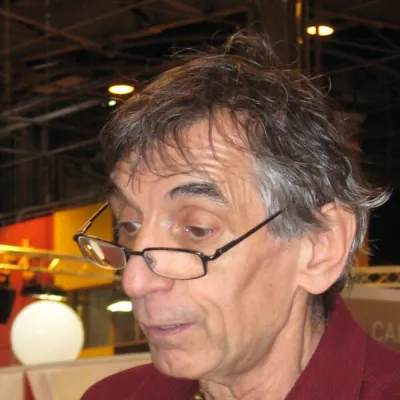
Edmond Baudoin
Human Design Chart
Biography
Baudoin was an art professor from 1999 to 2003 at the University of Quebec.
Edmond Baudoin as a Reflector 1/3 in Human Design
Reflector 1/3 — Design at a Glance
Edmond Baudoin revealed himself as someone who did not possess constant personal energy but rather intensely reflected his environment. His design as a Reflector without defined centers meant that he had no stable internal structures to stabilize his behavior. Instead, he absorbed the energy of others and natural rhythms such as seasons or moon phases particularly strongly and then emitted them.
This mechanism required him to adopt a specific strategy: waiting for at least one lunar cycle before making important decisions. Through this wait, he could synchronize with natural cycles. When Edmond Baudoin followed this rhythm, he automatically found people and environments that suited him well. He could observe the world free from attachment and was rewarded with a sense of joyful surprise.
However, if he lived against his design and made decisions without waiting, it led to deep, lasting disappointment about himself or the state of the world. His life task consisted in acting as a mirror for humanity by perceiving and reflecting surrounding energies rather than setting constant impulses.
No Inner Authority
Edmond Baudoin did not have an internal physical authority for decision-making. Instead, he oriented externally: either through resonance and exchange as a mental projector or cyclically over the moon cycle as a reflector. This configuration is rare; mental projectors do not have center activation below the throat center, reflectors none at all.
As a mental projector, Edmond Baudoin gathered information in dialogue with various people. Through energetic interactions in his open centers, dormant potentials were activated and provided specific information. This allowed him to view issues from many perspectives and express them differently. His high resonance capability helped him find the right environment and suitable conversation partners for this exchange.
The evaluation of these diverse inputs was a complex process requiring time and withdrawal. Only in peace could Edmond Baudoin see through the clutter, distinguish what made sense and belonged to him. Thus he developed his specific intelligence: filtering out the essential from a mass of information, making it meaningful and structuring it. This formed his capital as a projector.
Alternatively, if he was a reflector, his decision-making depended on the moon cycle. For important decisions, he needed about 28 days until the moon had traveled through his entire body graph. Thus reliable conditioning patterns repeated themselves, giving him orientation about who he is and what belongs to him. In both cases: He should never be rushed. A key was staying in a comfortable environment with trusted people to deepen his sense of rightness.
The 1/3 Profile — Investigator / Martyr
Edmond Baudoin revealed himself as someone who linked theoretical foundations with practical experience. His design tended towards validating knowledge not only by collecting it but through direct application and mistakes. This dynamic arises from his Profile 1/3, the Researcher and Experimenter. Line 1 emphasized the need for a stable foundation and self-care without harming others. Here, envy served as an indicator for necessary improvements in personal care.
Simultaneously, the energy of line 3 drove him to learn through trial and error. This was an individual process aimed at efficiency and adaptation to the collective. Saturn in this line stood for material ambition and discipline. Edmond Baudoin moved within the tension field between fear of insufficient knowledge – typical for line 1 – and the urgent need, as demanded by line 3, to learn through action.
When he confirmed something as good, it was the result of a rigorous testing process: both theoretically grounded and practically proven. His judgment was based on self-earned insights. Development led from isolated self-care towards collective efficiency through material discipline and experience. Thus, he integrated seemingly contradictory demands by proving his theoretical knowledge in practice and building trustworthy expertise.
No Definition — Defined & Open Centers
Edmond Baudoin revealed himself as a pure mirror of his environment, without his own constant energy source or defined centers. His design was characterized by nine open centers: Head, Ajna, G, Heart, Sacral, Solar Plexus, Spleen, and Root, along with the Throat. This meant extreme vulnerability to conditioning; he absorbed inspiration, identity, will, vitality, emotions, fears, and stress from his surroundings.
In the mental realm (open Head and Ajna centers), Edmond Baudoin tended to get stuck in doubts or seek answers that did not come from him. He risked taking other people's questions as his own truth. Without a fixed identity in the G Center, he adapted himself, sought direction and love through others rather than defining it for himself. The open Heart Center led him to try proving his worth by making promises or competing, although he lacked the constant energy to do so.
In the physical and emotional realm, he took up foreign vitality via the open Sacral center, which could lead to exhaustion if he did not pause. The open Solar Plexus center made him amplify and personalize emotions from the environment, while the open Spleen center triggered fears of survival or health, often through attachment to defining individuals for security. The open Root Center absorbed stress, leading to hyperactive behavior to escape this pressure. The open Throat meant he sought attention or spoke without inner confirmation.
The challenge lay in not identifying these absorbed energies as his own reality. Edmond Baudoin was dependent on waiting for invitations and his inner authority rather than acting out of conditioning. Only through observing the 'borrowed' could he develop wisdom and avoid spirals of mental confusion, emotional chaos, or willful overextension. His path lay in trusting the strategy, not fighting against the missing internal compass.
Channels & Gates
Edmond Baudoin's actions and leadership style were deeply marked by a genetic foundation of profound care. This altruistic warmth did not just serve as background noise but as a fundamental energy source that colored all other aspects of his design. Gate 27, the Gate of Care, brings in a magical, all-encompassing quality focused on self-preservation and species preservation. It's not only about one's own children but the entire clan; this role enhances the quality of all activities through its warmth.
This foundation also determined his approach to the moment. Gate 28, the Player's Gate, governs decision-making in the here and now, whether to take risks or avoid them. It requires persistence in listening into the current moment because there is fear that one's life has no value. Every person has a personal expiration date; correct risk-taking means acting according to one's own strategy and authority, often bringing about sudden changes.
Parallel to this, Gate 41, the Gate of Evolutionary Crisis, worked as well. Unique among genetic codons as a source of feeling, it drives development from experience to experience. This gate focuses on specific crises that must be navigated, where an appropriate desire helps maintain a certain coolness despite emotional fluctuations.
Finally, Gate 31 shaped his style of leadership. As a role gate, it represents the transfer of power and identity into the collective. The mechanics of leading here are not mental instructions but pure energetic transmission. To achieve effect, this energy must be transmitted to others. In Edmond Baudoin's case, this transmission was always filtered through Gate 27's caring warmth, making his leadership an act of support and protection for the clan.
Circuit Signature
Edmond Baudoin showed complete neutrality regarding the energetic patterns of circuits. His design had no fixed structures here, making him an open mirror to external influences. Without inherent constraints or fixed processes in this area, he remained unbiased and reacted flexibly to his environment rather than being steered by internal patterns.
This openness results from 'No Definition' in the circuit domain. With no channels active, there was no specific energy typically dominating perception or behavior patterns. Edmond Baudoin was thus free of typical drives or blockages that defined circuits bring with them. He could take in situations without preconceived energetic filters and processed information directly from the present, unburdened by recurring internal cycles.
The absence of this definition granted him natural impartiality. While other people can be driven or held back by specific circuit energies, Edmond Baudoin remained neutral and adaptable in this aspect of his design. He functioned as a pure resonance field for the energy of people and environments he encountered without distorting or dominating them through his own fixed circuit patterns. This freedom allowed an authentic and immediate interaction since no internal constraints prestructured his reactions.
Right Angle Cross of the Unexpected 1
Edmond Baudoin revealed himself through a fundamental attitude that did not simply accept the usual framework but stood open to sudden upheavals. His design carried the potential for surprising insights or events that entered without prior warning and shattered existing structures. This is the effect of the right cross of the Unexpected 1, a configuration that does not rely on linear planning but rather on the ability to interact with the unforeseen.
For Edmond Baudoin, this meant that turning points in his life often appeared abruptly and unexpectedly. Instead of following a rigid path, he was dependent on aligning himself with this mechanical property: being prepared to use moments of surprise as sources of new insights. This mechanism did not foster slow development but punctual breakthroughs that dissolved old patterns and opened up new perspectives. It was not about controlling the unforeseen but integrating it as an integral part of his experiential world. As a result, stability was found not through avoiding risk but through flexible adaptation to unexpected circumstances. Edmond Baudoin used this energy to move forward in situations where others might seek refuge, while he received new impulses precisely there.
Saturn Return · Uranus Opposition · Chiron Return · 2nd Saturn Return — Life Cycles
Edmond Baudoin showed himself in the middle of his life as someone whose inner structure increasingly emerged and solidified into concrete recognition and new responsibility. His design marks two decisive transitions that are not random turning points but cyclical phases signaling maturation.
The Chiron Return around the age of 50 is a fulfillment cycle: Here it becomes visible what has crystallized over years as core purpose. For Edmond Baudoin, this bloom occurred in 1992 when he won the Prix du meilleur album for “Couma acćo.” This success was not an isolated moment of luck but the expression of a long-term development that now showed its full effect and confirmed his creative path.
Later followed the second Saturn Return, a phase of structural anchoring and transition into new roles. During this period, specifically from 1999 at the age of 57, Edmond Baudoin took up the position as Professor of Art at the University of Quebec, an office he held until 2003. This step highlighted the second aspect of his cyclical structure: The establishment of a stable, authoritative presence in teaching. Both phases together — artistic confirmation and academic anchoring — show how his design shaped life quality through clear stages of meaning-making and role definition.
Reflector · No Inner Authority — Synthesis
Edmond Baudoin's design reveals a profound ability to reflect the energy of his environment and adapt to it. As a Reflector without defined centers, he is not a constant carrier of energy but a mirror of the world around him — both nature and people. This openness shapes his perception and requires a waiting strategy that allows him to live in harmony with natural cycles and make authentic decisions. The Profile of Researcher/Experimentator (1/3) intensifies this process through constant seeking of knowledge and experience, gaining insights by trying things out himself and testing them. The focus on Gates 28, 41, 27, and 31 in the cross indicates that Baudoin's life is marked by confrontation with risks, changes, care, and the transmission of power — all dynamic aspects amplified by his open nature.
The central paradox in Baudoin's design lies in the tension between his ability for deep resonance with the environment and the lack of inner, defined authority. He takes everything on but must still find a way to recognize what truly belongs to him. This openness can be both a source of great inspiration and profound disappointment as he is constantly exposed to external influences. Repeated evidence of success and career development (Prix du meilleur album, Professorship) shows that Baudoin's ability to adapt and use the energy of his environment has enabled him to pursue creative paths and find recognition — albeit always dependent on external conditions.
Incarnation Cross - Right Angle Cross of the Unexpected 1
Solar Return
The Solar Return shows the moment when the sun returns to its exact birth position - your personal solar year.
Life Cycles
Discover the life cycles with a detailed triple view (birth chart, cycle chart, composite).
Human Design Profile
- Type
- Reflector
- Strategy
- Wait a lunar cycle (approx. 28 days)
- Authority
- No inner authority - learn more
- Profile
- 1/3 - Investigator / Martyr
- Definition
- No Definition
- Incarnation Cross
- Right Angle Cross of the Unexpected 1
- Date of Birth
- 23.04.1942 14:00
- Place of Birth
- Nice, France
Frequently Asked Questions
What is Edmond Baudoin's Human Design type?
Which profile does Edmond Baudoin have?
What authority does Edmond Baudoin have?
What incarnation cross does Edmond Baudoin have?
When was Edmond Baudoin born?
Discover your own Human Design
Are you also a Reflector? Find out in a personal reading how to find the right environment and understand your unique mirror effect.
More Personalities
Back to overviewAlain-Fournier

Angeli
Baekhyun

Jihyo

Juninho

Martial