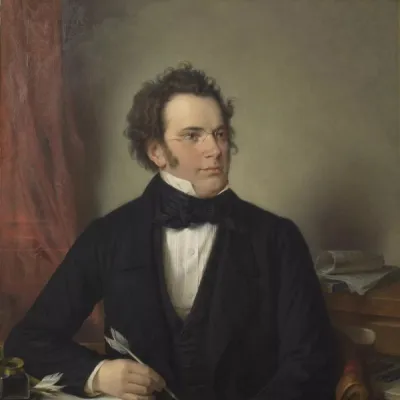
Photo: Wikimedia Commons
Franz Schubert
Human Design Chart
Biography
What does Manifestor 5/2 mean for Franz Schubert?
Manifestor 5/2 — Design at a Glance
Franz Schubert's design established him as a pioneer whose role was to develop visions and put others in charge of their implementation. Similar to a ruler who oversees the vast empire but leads battles through his followers, his essence manifested in this leading distance. However, this configuration brought with it a specific inner conflict: His often superior perspectives led to misunderstandings and polarization. While some people loved his big dreams and followed him, others rejected or even hated him because of these visions.
To minimize this split and find the right followership, informing was the central tool of his design. Through timely and precise communication of his intentions, he could reduce misunderstandings. If Franz Schubert lived according to this strategy of informing, he was rewarded with a feeling of inner peace. When he deviated from this path and acted without this preparatory clarity, it instead resulted in persistent, deep anger. His design therefore demanded not only the carrying of visions but above all disciplined communication thereof to generate inner calm rather than rage.
Emotional Authority
Franz Schubert's design established a tendency towards emotional wave motion that made spontaneous impulses appear unreliable. His inner authority was Emotional Authority carried by the defined Emotional Center. This mechanism worked independently of other definitions in his chart; activating this center always determined his decision-making.
Schubert was subject to constant ups and downs of emotions. The world appeared colored by the current mood: total enthusiasm for something at one moment, a negative view of it the next. However, the immediate feeling remained only a snapshot, an initial impression that did not necessarily reflect truth yet. Quick decisions from this emotional state could therefore have negative consequences.
Instead, his design required patience and time. The longer Schubert gave space to a decision, the deeper he could see. This meant repeatedly sleeping on important questions and consciously delaying action. Over time, intense feelings subsided, emotional distance gained strength. Only then did clarity and calm set in – the process was complete. This mechanism particularly shaped long-term life decisions that significantly influenced his life course. By waiting until emotional tranquility, he secured access to his true inner voice beyond fleeting mood feelings.
The 5/2 Profile — Heretic / Hermit
Franz Schubert's design established a tendency towards internal contradiction: the desire for admiration clashed with the urge to isolate oneself. As a 5/2 (Hero/Natural Talent), he sought retreats to develop his talent undisturbed in the
Single Definition — Defined & Open Centers
Franz Schubert's design laid a foundation of constant willpower and reliable expression, though it was marked by complex emotional filtering. His defined Heart Center gave him the ability to actively shape his life and fulfill promises with emphasis; he possessed the energy to set "I want" into the world. This determination directly fed into his defined Throat Center, which served as a pivot point to transform inner impulses into clear communication and visible actions. Yet between will and execution stood his inner authority: the defined Solar Plexus Center. Here lay the necessity of trusting the emotional wave. Schubert showed himself to be someone who did not make decisions in fleeting moments but waited until emotional clarity set in—often only after a night's sleep. This tension between the immediate urge of the heart and the necessary patience of emotions shaped his actions significantly.
At the same time, his open centers acted as mirrors for the environment. His open G Center meant that he did not carry a fixed, unchangeable identity but oriented himself in relationships and places; he tended to ask where the right direction lay rather than generate it himself. The open Sacral Center made him vulnerable to "borrowed" energy: He could easily overload by taking on the work rhythms of others without feeling his own boundaries. Similarly, his open Root Center absorbed external stress, which could lead to a sense of inner unrest that did not originate from within him. His open Head and Ajna Centers left him flexible for inspirations but warned against getting lost in the confusion of foreign questions or misinterpreting concepts as personal truth. His strength lay in using his stable voice and will while learning not to confuse borrowed energies and identities with his own self.
Channels for ambitious action and emotional openness.
Franz Schubert's design inclined towards emotionally driven social expression that heavily depended on the timing of his mood. Channel 22-12 connected his Solar Plexus Center with the Throat Center, meaning that his ability to communicate and be creative was determined by the waves of his feelings – mood, passion, or melancholy. He often expressed these inner states creatively, yet Gate 12 provided a necessary restraint that could isolate him temporarily when he did not feel in the right frame of mind. Authentic interaction was only possible for him if he waited for his emotional wave; otherwise, he risked misunderstandings and withdrawal.
At the same time, Franz Schubert exhibited a strong will towards material control and independence in his personality. Channel 21-45 connected his Heart Center with the Throat Center, creating a tension between serving the tribe and his personal need for autonomy. Gate 21, the Hunter's Gate, pushed him to take responsibility and work hard, while Gate 45, the Gatherer’s Gate, claimed authority over resources. He sought to be the boss of his own destiny to avoid stress and ensure his peace. This configuration challenged him to assert his will in a way that both protected his own interests and served others, often through mastery of the material plane. The dialectic between his moody, emotional expression in his design and his will-driven claim to sovereignty in his personality profoundly shaped his essence.
Tribal Circuitry — Circuit Signature
Franz Schubert's design laid a tendency towards parallel, energetically separated focal points: on one hand, the innate, creative expression; on the other hand, the shared creation of resources. These two areas existed side by side without directly flowing into each other.
In the Knowledge Circuit, Franz Schubert had Channel "Openness" connecting the Throat Center with the Solar Plexus Center. This created a direct flow from emotional wave and pulse to acoustic expression. It was about shaping new identity and transformation through this creative impulse – an energy that felt melancholic and pulsating.
Parallel to this, in the Ego Circuit, there existed Channel "The Money Line," which connected the Throat Center with the Heart Center. Here, individual expression was not the primary focus; instead, cooperation and material well-being were emphasized. This circuit promoted mutual support and the accumulation of resources for the tribe. Since there was no connection to the Sacral Center, constant life force was lacking; thus, the design required periods of rest for regeneration to maintain these communal forces.
Franz Schubert therefore manifested in two distinct paths: the emotional-creative impulse flowed outward through the throat, while the heart-throat complex formed the basis for traditional, cooperative structures. Both circuits were energetically active but remained as separate systems – on one hand, individual transformation; on the other hand, tribe-based provision.
Left Angle Cross of Refinement 2
Franz Schubert's design carried the structure of the left Refinement 2 Cross. This configuration acted as an organizing element that shaped his inner orientation. Since this mechanism specifically targets refinement and precision, his essence was characterized by a tendency towards meticulous detail and careful calibration of impulses. The left Refinement 2 Cross is an archetypal pattern in Human Design that does not dictate external action but determines the quality of internal processing. It demands a kind of clarity that does not arise from noise or haste, but through consistent reduction to the essential. For Franz Schubert, this meant that his energy often flowed towards refined perception before manifesting outwardly. Without further specific Gate or Channel assignments in the given context, the statement power of this Cross remains abstract: it signals a nature geared towards elegance and exactitude, yet without the pressure to immediately display these qualities visibly. The structure served more as a background framework for his decisions rather than as a driving force. In the absence of concrete biological expression forms like defined channels that could activate this Cross, his expression in this area remained subtle and internally oriented. This created a foundation on which other aspects of his design could operate without the Cross itself being dominant in the foreground.
Saturn Return — Life Cycles
Franz Schubert's design laid a tendency towards late confirmation, which condensed during the phase of the first Saturn Return. This cycle marks in Human Design the transition from development to a sustainable structure where years of internal work often become visible and recognized externally. It is a time of maturation when one's potential is no longer just sought but lived and confirmed.
In 1827, at the age of 30, this pattern concretely manifested in Franz Schubert: He was persuaded by friends to hold his own concert, which turned out to be a great success. This event illustrates the mechanics of the Saturn Return as a moment of validation. The success was no coincidence but aligned with the energetic maturity of this life phase where internal substance translates into external reality. For his design, this was a typical time when preliminary work condensed into tangible results and one's position in life was strengthened by environmental feedback. The Saturn Return acts here as a catalyst for confirmation by connecting inner development with outer resonance.
Manifestor · Emotional Authority — Synthesis
Franz Schubert lived a path marked by an internal tension between the urge to take a pioneering role and the necessity of emotional maturity. As a Manifestor with Emotional Authority, he possessed visions and the impulse to initiate new things (Manifestation), yet his decisions required time to filter through the emotional wave and reveal their true quality. This dynamic was evident in his tendency to express creative impulses (Channel 22-12) but always accompanied by a sense of caution and the need for internal confirmation.
A central paradox in his design lay in the combination of the Profile Hero/Natural Talent and openness to transformation. He carried the gift of evoking emotional responses and initiating change through his unique voice (Throat Center) (Knowledge Circuit), while simultaneously possessing a natural inclination towards withdrawal and self-observation. This contradiction led to his potential not always being immediately apparent; instead, he worked on himself to refine his abilities – a process that found expression in the later success of a publicly celebrated concert.
2 Defined Channels
Incarnation Cross - Left Angle Cross of Refinement 2
Solar Return
The Solar Return shows the moment when the sun returns to its exact birth position - your personal solar year.
Life Cycles
Discover the life cycles with a detailed triple view (birth chart, cycle chart, composite).
Human Design Profile
- Type
- Manifestor
- Strategy
- To inform others before acting
- Authority
- Emotional Authority
- Profile
- 5/2 - Heretic / Hermit
- Definition
- Single Definition
- Incarnation Cross
- Left Angle Cross of Refinement 2
- Date of Birth
- 31.01.1797 13:30
- Place of Birth
- Wien, Austria
Frequently Asked Questions
What was Franz Schubert's Human Design type?
What profile did Franz Schubert have?
What authority did Franz Schubert possess?
What incarnation cross did Franz Schubert have?
When was Franz Schubert born?
Discover your own Human Design
Are you also a Manifestor? Find out in a personal reading how to use your initiation power peacefully and dissolve resistance.
More Personalities
Back to overviewAaliyah

Alexia

Alizée

Angèle

Anne-Marie

Arcángel