
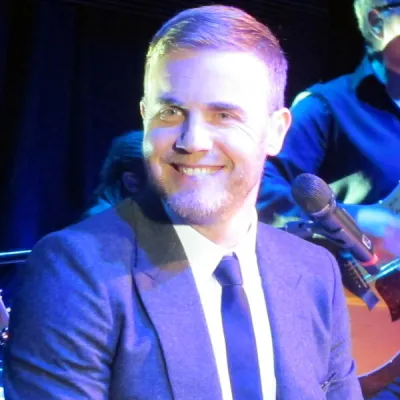
Gary Barlow
Human Design Chart
Biography
Barlow was a member of the group "Take That" which was successful in its own right. The group split up in 1996 and shortly afterward, Barlow released his first solo endeavor, "Forever Love" which became a hit.
He married Dawn Andrews on January 12, 2000 and the couple has three children. The eldest, named Daniel, was born on August 16, 2000. Emily arrived on May 31, 2002 and Daisy followed on January 14, 2009.
In 2005 a documentary was released about the group "Take That" and Barlow published his memoir "My Take" in 2006.
Gary Barlow — Generator with Profile 4/6
Generator 4/6 — Design at a Glance
Gary Barlow possessed immense endurance and an inner drive that required specific conditions to be effective. As a Generator, his design suggested that his strength did not flow from self-initiated pushing of plans but rather when he responded to external impulses. This mechanism means: waiting for a signal from the environment and then acting upon it once the inner center gives clear confirmation.
This principle of 'Reacting instead of Initiating' was crucial for his well-being. When Gary Barlow followed this strategy by responding to offers or situations that engaged his sacral energy, he experienced deep satisfaction and fulfillment. His energy source remained stable and sustainable in such cases.
Conversely, ignoring this principle had severe consequences. Initiating actions without inner resonance or suppressing the natural urge to create led to frustration and a noticeable loss of energy. Similarly risky was doing things that did not genuinely excite him, as his great capacity would then be misused. Also problematic was being prevented from working on his heart project despite having the internal power available. The balance lay in listening to the 'Yes' of his gut and responding accordingly rather than fighting against the flow of his nature.
Sacral Authority
Gary Barlow's decision-making is guided by sacral authority. His design shows a tendency not to choose primarily through reason but to trust inner, physical resonance. This is specific for the Generator type where strategy and inner authority are identical: waiting for the body's reaction to external stimuli.
The authenticity of his decisions lies in the physical vitality response. When his sacral motor reacts to an impulse, it expresses as grunting, humming or a feeling of inexhaustible energy and enthusiasm. These bodily signals confirm the right path. Without this reaction, the design signals abstinence; it is then wise not to act. Gary Barlow was born to engage in activities with joy without strict purposefulness being necessary.
Additionally, an activated spleen center supports this authority. It allows for quick, spontaneous reactions and immediate access to instinctive perception of physical well-being. Thus, Gary Barlow can reliably be guided by this combined inner voice that unites the energy of the sacral center with the intuition of the spleen. His process is thereby simplified: he reacts authentically to life rather than steering it through analysis.
The 4/6 Profile — Opportunist / Role Model
Gary Barlow's design was marked by a clear developmental line: in the first three decades, an experimental, relationship-centered approach dominated. This phase was characterized by Line 4, which works within existing boundaries and promotes mutations. Gary Barlow used this time to learn how to cautiously open his heart through diverse social contacts and friendships without being hurt by false people.
With the activation of Line 6 after Saturn return, the dynamics shifted towards the role of a role model. Here, an inner conflict between the deep need for community (Line 4) and the urge for intellectual distance and meaning-making (Line 6) was revealed. Line 6 oversees the entire circuit and evaluates decisions based on consistent values. Gary Barlow faced the challenge of taking leadership roles not out of power hunger but due to the significance of his values or rejecting them.
This shift from experimental youth to wise distance in later life shaped his development. The ability to generate within boundaries while maintaining an overview of value consequences formed the foundation for his later expectation as a cooperative role model. The tension between connection and isolation remained a central feature of his design, which he sought to master through consistent values.
Single Definition — Defined & Open Centers
Gary Barlow's design shows a clear inner orientation with strong, reactive energy foundations. His defined G Center gave him a reliable self-identity and deep knowledge of his life direction without relying on others. This internal security allowed him to support others in their development rather than directing them. Complementing this stability was his defined Sacral Center, which served as a constant source of vital energy. His strategy involved not initiating but responding spontaneously with yes or no answers to requests to avoid frustration and exhaustion. Another foundation was his defined Root Center, providing consistent pressure for movement and survival, enabling him to face challenges with determined endurance.
In contrast, the Head, Ajna, Throat, Heart, Solar Plexus, and Spleen Centers were open. This openness made him situationally receptive to external influences in areas of inspiration, thinking, communication, willpower, emotions, and health signals. He tended to absorb mental confusion or emotional waves from his environment rather than interpreting them as personal truth. Instead of being led by the pressure to find answers or force attention – typical pitfalls for open centers – his mechanics were designed to use these fields as mirrors of the surroundings. By trusting in his defined inner authority, he avoided getting entangled in conditioned patterns like proving his worth through willpower or making spontaneous decisions out of uncertainty. Instead, he remained an observer of external moods while waiting for the right invitation to bring in his own energy.
Channels for resource management and evolutionary change.
Gary Barlow's design tends towards pulsating, non-linear energy. His mechanics are shaped by two strong channels: Channel of Mutation 60-3 and Channel of the Beat 14-2. Both belong to his individual circuitry and create a rhythmic dynamic from chaos and order, combined with melancholy and innovation.
Channel of Mutation 60-3 connects the Root Center (Gate 60: Limitation) with the Sacral Center (Gate 3: Order). This channel brings about evolutionary change through unpredictable impulses. The energy is adrenalized and generative but comes in pulses – active, then still. During pauses, internal tension arises, perceived as melancholy. The key lies in not fighting or rationalizing this mood but patiently waiting for the next impulse. Mutation happens suddenly, like music between notes, forcing adaptation. Those who trust this rhythm bring change to their environment; those who resist fall into frustration.
Channel of the Beat 14-2 connects the Sacral Center (Gate 14: Power Competence) with the G Center (Gate 2: Higher Knowledge). This channel enables finding new directions and encouraging others in them. Gate 14 focuses on material resources for mutation, while Gate 2 directs identity and direction. Together they generate a powerful life energy that promotes innovation and uniqueness. Gary Barlow can open up new perspectives through honest reactions to life without planning or chasing fate. His aura strengthens others finding their own direction.
Together these channels shape a personality living in the present moment, trusting the inner pulse, and producing innovation through reaction rather than strategy.
Individual Circuitry — Circuit Signature
Gary Barlow's design tends towards pulsating acoustic creativity serving as a means of reinforcing his individuality. This configuration is shown by the Knowledge Circuit, which specifically connects his Identity, Sacral, and Root Centers directly. This energetic flow allowed him not only to generate new insights but also to express them rhythmically and emotionally filtered.
Two concrete channels shaped this mechanism: The Channel 'The Beat' (Gates 2 and 14) provided a pulsating format energy grounded in the present moment and favoring acoustic expression forms. Parallel to this, the Channel 'Mutation' (Gates 3 and 60), introduced deviations from the existing state, bringing change into the world. Since these centers are directly connected in Gary Barlow, a continuous stream of creative impulses emerged all the way to physical expression. The energy flowed from identity through the Sacral Center as a source of creativity down to the Root Center providing necessary pressure and urgency. This allowed him to convey his unique perspective through emotional waves and initiate transformation without relying on external validation. The connection of these three centers created a stable foundation for this original path of knowledge acquisition and world change through personal expression.
Right Angle Cross of Laws 4
Gary Barlow's Human Design indicates a tendency towards deep structural order that goes beyond mere rules. His inner programming is geared toward seeking the fundamental principles that hold life and society together. This manifests not as superficial adherence to regulations but as an intense desire to understand the 'laws' behind chaos.
This attitude stems from the energy of the right cross of Laws 4. It involves a configuration that seeks stability and continuity through clear, proven structures. Those who carry this energy tend to reduce uncertainty by relying on established systems or deeply rooted values. It is less about rebellion and more about the desire for a secure foundation upon which one can build.
For Gary Barlow, this meant that his actions were often guided by an implicit search for this inner compass. He sought ways to bring complex reality into understandable, manageable patterns. This mechanism shaped how he interacted with the world: not through chaotic experiments but by working through and understanding processes deemed stable. It was an anchoring energy that helped him find peace within himself by acknowledging and respecting the underlying principles of order.
Saturn Return · Uranus Opposition · Chiron Return — Life Cycles
Gary Barlow's Human Design shows a clear structuring of his career through planetary cycles, each emphasizing a specific aspect of self-expression. The first Saturn Return marked 1999 at age 28 as the moment of commercial anchoring: the calendar for Calendar Girls became marketable. This cycle condensed years of groundwork into a tangible, material result and solidified his position in public consciousness through concrete success structures.
The Uranus Opposition brought a necessary break with established patterns in 2011 at age 40 when Gary Barlow organized GB40 on his birthday, marking the first solo performance after eleven years. This cycle often demands breaking collective bonds for individual autonomy; here it was a conscious return to personal artistic voice independent of earlier group structures.
The Chiron Return in 2018 at age 47 acted as a phase of fulfillment and confirmation of original purpose. The release of the 21st Anniversary Re-issue of his debut album Open Road symbolized this blooming period. In this fulfillment cycle, one's incarnation cross unfolds increasingly; Gary Barlow returned to his artistic roots, not as healing from wounds but as meaningful completion of his original intent. These three phases illustrate how his design strategically aims at anchoring, individual differentiation, and ultimately purpose-driven integration.
Generator · Sacral Authority — Synthesis
Gary Barlow's Human Design is marked by a profound continuum that manifests through the connection of generative energy and the drive for authentic expression. As a Generator with sacral authority, he lives in a world that challenges him to respond to impulses—a mechanism that grants deep fulfillment when acting in harmony with his inner rhythm. This responsiveness is amplified by the defined Sacral and Root Centers, signaling a constant source of life force and the ability to take on challenges. The recurring emphasis on mutation (Channel 3-60) and beat (Channel 14-2) indicates that change and innovation are central elements of his path—a continuous realignment driven by accepting limitations and embracing new directions.
Central to Gary Barlow's design is a paradox between inner strength and external pressure. The defined G Center gives him clear identity and direction, while several open centers (Head, Ajna, Solar Plexus, Heart, Spleen) make him susceptible to external influences. This openness allows for the absorption of inspiration and understanding of other perspectives but also carries the risk of losing oneself in conditioning or forgetting one's path. Thus, he navigates between the need for authentic expression and the challenge of preserving his inner truth amidst a world full of expectations and judgments.
2 Defined Channels
Incarnation Cross - Right Angle Cross of Laws 4
Solar Return
The Solar Return shows the moment when the sun returns to its exact birth position - your personal solar year.
Life Cycles
Discover the life cycles with a detailed triple view (birth chart, cycle chart, composite).
Human Design Profile
- Type
- Generator
- Strategy
- To respond - wait for something to respond to
- Authority
- Sacral Authority
- Profile
- 4/6 - Opportunist / Role Model
- Definition
- Single Definition
- Incarnation Cross
- Right Angle Cross of Laws 4
- Date of Birth
- 20.01.1971 12:20
- Place of Birth
- Frodsham, United Kingdom
Frequently Asked Questions
What is Gary Barlow's Human Design type?
What are Gary Barlow's Profiles according to Human Design?
What authority does Gary Barlow have in Human Design?
Which incarnation cross is active for Gary Barlow?
When was Gary Barlow born?
Discover your own Human Design
Are you also a Generator? Find out in a personal reading how to use your sacral energy correctly and discover deep satisfaction.
More Personalities
Back to overviewAaliyah

Alexia

Alizée

Angèle

Anne-Marie

Arcángel
