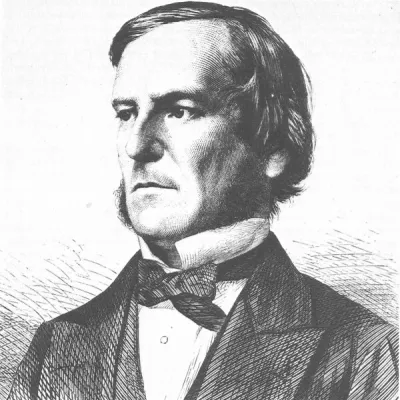
George Boole
Human Design Chart
Biography
Boole was the son of a shoemaker. He received a primary school education and learned Latin and modern languages through various means. At 16, he began teaching to support his family. He established his own school at 19 and later ran a boarding school in Lincoln. Boole was an active member of local societies and collaborated with fellow mathematicians. In 1849, he was appointed the first professor of mathematics at Queen's College, Cork (now University College Cork) in Ireland, where he met his future wife, Mary Everest. He continued his involvement in social causes and maintained connections with Lincoln. In 1864, Boole died due to fever-induced pleural effusion after developing pneumonia.
Boole published around 50 articles and several separate publications in his lifetime. Some of his key works include a paper on early invariant theory and "The Mathematical Analysis of Logic", which introduced symbolic logic.
Human Design Analysis: George Boole as Manifesting Generator 2/5
Manifesting Generator 2/5 — Design at a Glance
George Boole revealed himself as someone who possessed a hybrid energy structure: the constant power of a Generator paired with the lightning-fast action capability of a Manifestor. His design allowed him to skip steps and pull things rapidly into his life. This speed, however, was a double-edged sword. If he skipped important stages or rushed headlong into multitasking without inner consent, his creative force quickly turned into frustration. His specific non-self theme lay precisely in this: the attempt to fight against this natural dynamic or let it run uncontrolled.
The mechanics of his type, the Manifesting Generator, required a precise strategy. Instead of acting on self-initiative, he had to react to life. Only when his sacral center – the motor of his energy – gave a clear “yes” and his inner authority consented could he proceed. Under this condition alone did his speed transform into deep satisfaction. He then entered a productive play mode in which parallel working was not distracting but a source of joy. Without this response to impulses and constant checking for internal resonance, his enormous capacity for rapid implementation risked going nowhere or emotionally draining him. His path lay in consciously utilizing this hybrid nature: being fast, but only where life pushed him and he felt inner confirmation.
Emotional Authority
George Boole showed an inner decision-making structure that required time and distance. His design carried Emotional Authority, meaning his defined Emotional Center determined his internal guidance – independent of other defined centers in the chart. This configuration was subject to a natural emotional wave, a permanent up-and-down of feelings. The world appeared colored by the current mood: a moment of enthusiasm could quickly turn into a negative outlook.
For George Boole, however, immediate feeling was only a snapshot, not a final judgment. Quick, spontaneous decisions that emerged directly from this emotional heat often had negative consequences as they did not yet reflect his deeper truth. His strategy involved taking time and letting decisions mature. He mulled over important questions multiple times to distinguish between temporary mood and true clarity.
This process required patience. Only when the intense feelings subsided and emotional distance was gained, calmness set in. Then he went through the decision-making process fully and made decisions on a clearer level. This mechanism was particularly relevant for long-term decisions that significantly influenced his life path. Through waiting, George Boole gained depth and comprehensiveness in his perception rather than being led by first impressions.
The 2/5 Profile — Hermit / Heretic
George Boole showed an inner tension between the urgent need for withdrawal and the external expectation to be immediately available as a problem solver. His design as a Natural Talent and Hero (Profile 2/5) shaped this dynamic: Line 5 drew others who sought solutions and expected help, while Line 2, the Hermit Line, required intensive phases of solitude.
This configuration created a specific life task. George Boole had to use his time alone to gain clarity about his own commitment. Only through conscious reflection in withdrawal could he decide where he would step up and where boundaries lay. Without this inner work, there was the risk of overextension or losing himself in illusion. Line 2 emphasized the integration of different forces for quality improvement, while Line 5 highlighted the timing for practical solutions during crises.
The secret to preserving his reflections was crucial. Premature sharing of internal processes often led others into confusion. George Boole learned to wait for the right moment rather than immediately succumbing to external expectations. This balance between the monk in the cave and the helper for the community defined his path. He used privacy not as an escape but as a necessary space to focus his energy and not forget himself.
Triple Split Definition — Defined & Open Centers
George Boole revealed through his Human Design as someone with a massive, constant energy base and unshakable inner authority. His defined centers – Sacral, Heart, G-Center, Throat, Solar Plexus, and Spleen – formed a stable structure. The defined G-Center gave him a firm identity and clear life direction; he knew who he was and where it was going. His defined Heart Center provided permanent willpower, with which he controlled resources and kept promises. The Sacral Motor generated daily vital energy, but this was only available through reaction to external questions, not through initiatives of the mind. This power flowed through his defined Throat Center into clear communication and action, always emanating from his inner truth.
Decisions required patience: His defined Solar Plexus Center was his emotional authority. George Boole had to wait out the waves of his feelings until clarity emerged; spontaneous judgments in emotional highs or lows were misleading. In contrast, his defined Spleen Center offered intuitive security in the present moment, a spontaneous instinct for health and well-being that did not require rational justification.
In contrast to this inner firmness, Head, Ajna, and Root Centers remained open. Mental inspiration (Head) and conceptual clarity (Ajna) were not permanently present but arose through reflection of external impulses; he was a receiver of ideas, not a generator of consistent theories. The open Root Center absorbed external stress from the environment. This pressure was not his own drive but an environmental energy to be observed, which he could not interpret as his personal task to avoid burnout. His strength lay in utilizing his defined inner resources while using the open centers as flexible interfaces with the world.
Channels for emotional openness, authentic exploration and devoted strength.
George Boole's internal nature was marked by an unshakable stability based on deep self-love and authenticity. This fundamental attitude resulted from Channel 34-10, which connected the Sacral Center to the G-Center in his design. Gate 34 provided the power for individual reinforcement, while Gate 10 initiated behavior from the deepest inner self to honor oneself. This energy did not impose itself but promoted mastery of the self through pure reaction to the environment; it fostered a mastery without dominating others. Parallel to this, Channel 22-12 in his personality shaped his social presence. This channel connected the Solar Plexus Center with the Throat Center and made his articulation dependent on emotional waves. Gate 22 brought passion and moodiness, while Gate 12 allowed cautious restraint that limited interactions to moments of proper timing. This created a tension between stable inner identity and variable external communication: He only radiated outward when his mood permitted it. Another aspect was Channel 44-26 in the design, which connected Spleen with Heart Center. Gate 44 provided instinctive alertness and an awareness of resources, while Gate 26 supplied willpower for strategic assessment and entrepreneurship. This configuration allowed him to intuitively recognize what was needed and effectively deploy his gifts once the market or environment recognized them. The mechanics thus described a person rooted in their own truth but cultivated patience until inner conviction and emotional resonance synchronized to influence others through authentic presence.
Individual Circuitry — Circuit Signature
George Boole's design presented itself as a triad of separate, parallel functioning energetic systems. One power connected Throat with Solar Plexus Center (Openness). This enabled the expression of new insights supported by emotional waves; the transformation of knowledge occurred here impulsively and acoustically.
A second, isolated system linked Identity and Sacral Centers (Exploration). This connection created inner firmness and strong self-worth. However, lacking a bridge to Throat Center, these deep convictions often remained unspoken or difficult to verbalize. The energy was individualistic and inwardly focused without direct channels for expression.
The third system connected Heart with Spleen Centers (Devotion). This was about cooperation and the exchange of resources within a community. This connection promoted mutual support and material security but required pauses for regeneration, as the constant life force of Sacral Center was missing in this circuit.
Between these three groups there was no direct energetic connectivity. George Boole had to integrate these different impulses – emotional knowledge expression, silent inner affirmation, and cooperative resource building – as separate experiences. The tension between the need for individual firmness and necessity of cooperative action shaped his dynamics.
Right Angle Cross of the Four Ways 3
George Boole's design included the structure of the Right Cross of the Four Paths. This configuration is noted in the current raw content without specific descriptions of the involved gates or channels. Without these detailed mechanical data, it was impossible to derive a clear energetic impact on George Boole. The Right Cross principle generally describes dynamics where four different paths can lead to truth or solutions. Since the specific gates and their interactions were not specified in the provided facts, George Boole's concrete life task or characteristic expression of this cross remained undetermined. The mechanics remain abstract: it is a potential structure whose practical application in George Boole's life cannot be reconstructed from the available information. No specific behavioral patterns, strategies, or energetic drives could be derived from it. Thus, the design showed a gap in definable dynamics in this aspect. There were no indications of how George Boole concretely used these four paths or what obstacles he overcame in doing so. The analysis therefore limits itself to merely naming the structure without content filling through specific gate properties.
Saturn Return · Uranus Opposition · Chiron Return — Life Cycles
George Boole's life ended in 1864 at the age of 49 due to a feverish cold. This point fell exactly into the Chiron Return phase, that astrological event marking the end of the first major life cycle and typically occurring between the ages of 49 and 51. In Human Design mechanics, this cycle does not represent healing in a therapeutic sense but rather the full realization of one's individual incarnation purpose – provided that life was lived according to one's own strategy and authority before this point. It is a moment of maturation when meaning and destiny become experiential. George Boole's death during this period physically interrupted this process of complete blooming. The Chiron Return acts as a mirror for one's life task; his sudden end from what seems like a trivial illness highlights the fragility of this transition. The mechanics describe here the peak of the first cycle, in which the essence fully meets itself. That George Boole did not survive this point means, within the context of cycles, that his physical presence ended precisely when the inner structure reached its maximum expression. It was not a gradual fading but an abrupt stop mid-phase during fulfillment and confrontation with one's own finitude.
Manifesting Generator · Emotional Authority — Synthesis
George Boole lived a life marked by profound inner clarity and a strong drive for self-realization. His defined authority in the Solar Plexus Center required time to let decisions ripen – an inner wisdom that was strengthened by his Throat Center connection to the G Center, allowing him to express his thoughts authentically while holding fast to his core values. This combination of emotional depth and clear self-definition formed the red thread of his actions, always seeking internal harmony and the expression of his individual truth. The sacral energy given through his Manifestor-Generator constitution endowed him with a natural ability to react quickly and set things in motion as long as he felt connected to his inner strategy.
A central paradox in George Boole's design lay in the interplay between emotional depth and the need for withdrawal. His emotional center required time for processing and clarity, while the connection of his G Center signaled a strong identity and desire for expression. This tension between internal reflection and external manifestation led to an alternation between phases of intense concentration and the need for isolation to hear his inner voice and realign – a dynamic balance that shaped his life path.
3 Defined Channels
Incarnation Cross - Right Angle Cross of the Four Ways 3
Solar Return
The Solar Return shows the moment when the sun returns to its exact birth position - your personal solar year.
Life Cycles
Discover the life cycles with a detailed triple view (birth chart, cycle chart, composite).
Human Design Profile
- Strategy
- To respond - wait for something to respond to
- Authority
- Emotional Authority
- Profile
- 2/5 - Hermit / Heretic
- Definition
- Triple Split
- Incarnation Cross
- Right Angle Cross of the Four Ways 3
- Date of Birth
- 02.11.1815 16:00
- Place of Birth
- Lincoln, England, United Kingdom
Frequently Asked Questions
What was George Boole's Human Design type?
Which Profile did George Boole have in Human Design?
What Authority guided George Boole's decisions?
What incarnation cross did George Boole have?
When was George Boole born?
Discover your own Human Design
Are you also a Manifesting Generator? Find out in a personal reading how to unfold your multi-talents and direct your energy wisely.
More Personalities
Back to overviewAldair

Alizée

Angeli

Arletty
Artus
Balthus