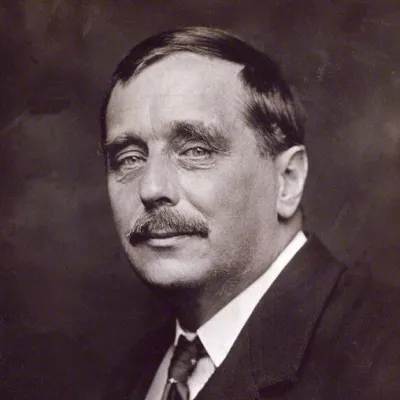
H. G. Wells
Human Design Chart
Biography
In addition to his fame as a writer, he was prominent in his lifetime as a forward-looking, even prophetic social critic who devoted his literary talents to the development of a progressive vision on a global scale. As a futurist, he wrote a number of utopian works and foresaw the advent of aircraft, tanks, space travel, nuclear weapons, satellite television and something resembling the World Wide Web. His science fiction imagined time travel, alien invasion, invisibility, and biological engineering before these subjects were common in the genre. Brian Aldiss referred to Wells as the "Shakespeare of science fiction", while Charles Fort called him a "wild talent".
Wells rendered his works convincing by instilling commonplace detail alongside a single extraordinary assumption per work – dubbed "Wells's law" – leading Joseph Conrad to hail him in 1898 with "O Realist of the Fantastic!".
H. G. Wells — Reflector with Profile 1/3
Reflector 1/3 — Design at a Glance
H. G. Wells' design showed a fundamental orientation that was more about receiving than actively shaping: none of his energy centers were fixed, there was no constant available personal power source. This configuration corresponds to the Reflector type - that Aura type which absorbs the energy of its environment particularly strongly and reflects it back like a mirror. Not only human moods but also larger rhythms of nature such as seasons, planetary positions, cosmic cycles were taken in.
From this disposition arose a dependence on time itself as a decision-making instrument. For this type, letting important decisions mature over at least one full moon cycle - roughly one month - is considered a valid strategy rather than fixing them in the moment. If this waiting period was observed, H. G. Wells likely experienced a feeling of joyful surprise: suitable people and environments found themselves naturally, and a free, unencumbered observer position towards the world became possible.
If life deviated from this disposition - if decisions were made hastily -, instead there arose a deep, lasting disappointment with oneself as well as with the state of the world. This tension between quick reaction and patient waiting thus characterized a central axis in H. G. Wells' design.
No Inner Authority
H. G. Wells' design showed a basic stance that did not require external confirmation but was nevertheless dependent on a specific path to clarity: he belonged to that very rare group without internal or physical authority. In Human Design mechanics, this concerns either mental projectors who lack any center activation below the throat center or reflectors with no centers defined at all - together these make up about 2.5 to 3 percent of people.
For this configuration, decision-making ability did not lie in a single body center but rather in exchange with other people. Wells' open centers caught foreign energies and activated latent potentials within them - thus the ability arose to view a matter from many angles and express it in various ways. This resonance capability was both potential and prerequisite: it needed the right environment and conversation partners to unfold.
The real work, however, only began afterwards, alone: out of the abundance of received information had to emerge over time a red thread - what belonged to him and what did not. Exactly this ability to filter out the essential from a mass of impressions, organize and structure it formed the actual capital for success in this configuration.
The 1/3 Profile — Investigator / Martyr
H. G. Wells' design laid down a basic stance that moved between two impulses: the desire to thoroughly understand first and the urge to actually try something out. This corresponded to Profile 1/3, which consisted of an investigative first line and an experimental third line. People with this imprint want to learn until they feel secure - and thus get into a dilemma because the shift from planning to implementation then appears premature, even though the experimental part wants to test and learn from mistakes. Only what was self-achieved and tested in practice was viable at this profile.
Added to this was a line representing dedication in secrecy: experience was sought in the moment itself without regard for external expectations, and creative effort retained its value even if it initially found no recognition. Another line described the trial-and-error process at its lower, riskier end: the tendency to choose an especially effective, sometimes extreme strategy - coupled with the ability to understand and categorize other people's strategies but also with the danger that humility would undermine itself through recognition.
No Definition — Defined & Open Centers
H. G. Wells' design showed no fixed, permanent definition in any of the nine centers - a rare constellation that seemed more perceptive than controlling: themes were not lived from a stable inner source but rather adopted situationally from the environment and amplified back.
Most prominently, this was evident in the open Head Center (status: open), home to mental pressure, inspiration, and doubt. Without a consistent way of processing thoughts, such a design tended to take up foreign questions as if they were their own and get lost in endless contemplation - until exhaustion set in from feeling the need to understand everything. The directly underlying Ajna Center (open) - responsible for conceptual thinking and opinion formation - amplified this dynamic: a flexible, receptive mind that reflected and propagated foreign concepts with the temptation to adopt ideas as supposedly one's own secure beliefs to avoid appearing ignorant.
The G Center (open), seat of identity and direction, also lacked a fixed expression. Such a constellation meant having no consistent sense of who one is or where one belongs - instead, it involved collecting changing roles, places, and relationships from which an awareness of the right direction crystallized over time.
Additionally, Throat, Sacral, Solar Plexus, Spleen, Heart, and Root remained open: communication, life force, feelings, fears, willpower, and stress were not generated from one's own constancy but taken up from the environment, amplified, and fed back - a constitution whose strength lay in reflecting many perspectives without ultimately identifying with any of them.
Channels & Gates
260 words (actual ~256), well below the limit. Here is the completed chapter:
H. G. Wells' design established a fundamental disposition where full devotion to the present moment, a pronounced sense of individuality, and deeply rooted, barely changeable behavior patterns came together. This combination drew from four key gates in his design.
Gate 46 stood for determination and the process of experience: success thus arose through full involvement in events rather than favorable circumstances alone - happiness was the result of engagement and devotion, coupled with a love for one's body as a kind of temple. From this disposition, opportunities seemed to arise more often than they were planned: a tendency that almost inevitably led to being at the right place at the right time.
Gate 25 brought a spiritual stance of innocence and individuation: access to unconditional love through a mystical process, coupled with self-love and inner centering - closely related to Gate 10.
Gate 10, the most complex gate in the center of identity, acted both inwardly and outwardly and counted among the central role gates that shape one's profile - one of the so-called love gates. It strongly influenced life through deeply rooted behaviors that seemed hardly negotiable.
Gate 15 rounded out the picture on collective behavior: a logical gate that established flow within a community and was essential for organizing societies; the associated modesty arose from adapting to natural rhythms.
Together, these four gates formed a life theme where personal devotion, individual centering, and an awareness of collective rhythms intertwined.
Circuit Signature
H. G. Wells' design appeared consistently open and unbound - no fixed, constant basic equipment but rather an arrangement that continuously adapted to what was happening around him. Human Design calls this constellation 'No Definition': in his chart, none of the nine centers were permanently connected through a channel; all remained open. This meant he had no consistent energy type available - unlike people with defined centers whose characteristics showed day after day. Instead, he took up whatever moods, themes, and energies his environment offered and fed them back amplified or filtered. This openness made him receptive to very different influences and perspectives without an inner fixed point dictating a constant reaction pattern. Since neither circuits nor channels were active in H. G. Wells, no groups of mutually connected centers emerged - each center stood alone, separate from the others, without a continuous energy flow between them. This complete openness belonged to the rarer constellations in Human Design mechanics: it described a strength not rooted in a fixed inner equipment but in the ability to particularly clearly take in and reflect the immediate environment without holding up against any single fixed core.
Right Angle Cross of the Vessel of Love 3
H. G. Wells' design pointed towards a personal and inwardly directed life theme, not towards a role he should fulfill for others or as their example. This orientation corresponded to the basic nature of what is called the right cross in his design: Such a cross describes in Human Design language a way of living that first concerned one's own experience - one's own experiencing was at the center, from there it acted into the environment, not vice versa. The theme of this cross carried for Wells the name 'Vessel of Love' - an image suggesting that his life path was connected with the ability to take something in, preserve it and pass it on again, just as a vessel does what it contains without changing or losing it. The addition '3' in the name indicated which of several possible expressions of this cross theme actually applied to him - each variant of the same cross name combined the underlying activations differently but remained committed to the same overarching theme. Overall, this showed a way of living in which love played a supporting role that ran through the entire design as something to be taken in and passed on.
Saturn Return · Uranus Opposition · Chiron Return · 2nd Saturn Return — Life Cycles
H. G. Wells' design tended towards reorienting oneself in recurring maturation phases and sharpening one's own direction rather than maintaining once found paths unchanged.
At 27 years old, in 1893, he published his first significant work, the non-fiction book A Textbook of Biology - a typical moment for his design: the first Saturn Return, when years of groundwork often condense into a first solid result and an initial firm structure emerges in one's own creation.
In 1906, at age 40, he left the Fabian Society, joined the Independent Labour Party, and traveled to the USA for the first time - during his Uranus Opposition, a cycle around midlife when previous ties often prove too confining and breaking with familiar structures is necessary to make room for a more independent direction.
In 1915, at age 49, he published The Text-Book of Zoology, an event in his Chiron Return - the cycle in which, if one has lived according to their own strategy and authority up until then, the life theme set out in the incarnation cross increasingly unfolds in everyday life and one's own purpose becomes experiential.
In 1923, at age 57, Socialism and the Scientific Motive was published - during his second Saturn Return, which tests the structure laid down in the first and brings it to a more mature, consolidated form.
Reflector · No Inner Authority — Synthesis
The red thread in H. G. Wells' design lay in fundamental openness towards the environment: as a Reflector he had no defined centers at all and thus relied entirely on what surrounded him – people, places, cycles of time. The same basic attitude of taking in rather than holding fast was evident in Profile 1/3, which made him a researcher who acquired knowledge through study (Line 1) and then through practical experimentation, trial and error (Line 3) - never through pre-fabricated certainty. Even the prioritized Gates underscored this pattern: dedication to experience here and now, combined with the need to immerse oneself in something or a process entirely to learn from it. Thus emerged a character that less sprang from firm inner convictions than from continuous contact with the outside world and its rhythms.
The central paradox lay in the tension between deepest receptivity and an inner drive for personal insight. As a Reflector without defined centers, he had no constant, reliable internal authority - his decision-making was dependent on waiting times and harmony with external cycles, not on consistent certainty. At the same time, Profile 1/3 relentlessly drove him to research himself, test himself, and judge from personal experience. So stood an entity structurally designed to reflect its environment and drift along in opposition to a drive demanding independently worked out, tested insight - a life between surrendering to what comes and the persistent will to penetrate it.
Incarnation Cross - Right Angle Cross of the Vessel of Love 3
Solar Return
The Solar Return shows the moment when the sun returns to its exact birth position - your personal solar year.
Life Cycles
Discover the life cycles with a detailed triple view (birth chart, cycle chart, composite).
Human Design Profile
- Type
- Reflector
- Strategy
- Wait a lunar cycle (approx. 28 days)
- Authority
- No inner authority - learn more
- Profile
- 1/3 - Investigator / Martyr
- Definition
- No Definition
- Incarnation Cross
- Right Angle Cross of the Vessel of Love 3
- Date of Birth
- 21.09.1866 16:30
- Place of Birth
- Bromley, England, United Kingdom
Frequently Asked Questions
What was H. G. Wells' Human Design type?
What Profile did H. G. Wells have?
What Authority did H. G. Wells have?
What incarnation cross did H. G. Wells have?
When was H. G. Wells born?
Discover your own Human Design
Are you also a Reflector? Find out in a personal reading how to find the right environment and understand your unique mirror effect.
More Personalities
Back to overviewAlain-Fournier

Angeli

Baekhyun

Jihyo

Juninho
Martial