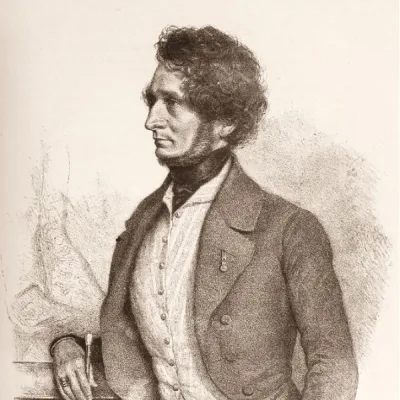
Hector Berlioz
Human Design Chart
Biography
The son of a country doctor who rebelled against his dad, he went to Paris with no musical training and within eight years had written one of the world's greatest symphonies, the "Symphonie fantastique" which mirrored his passion for the Irish actress Harriet Smithson and which can always fill a modern concert hall.
Berlioz often complained of French bureaucratic interference in musical life. When he was commissioned in 1837 to write a requiem for the 1830 revolution, he said he had to camp out in the government offices to get paid. A man full of contradictions, he was an idealist but also extremely practical. As a composer he was concerned with every detail, the layout of the orchestra, how to organize a concert, how to publicize it.
Life was always a struggle for Berlioz. He could not make his music pay and his love affairs were not very successful. Whenever he met a woman who seemed to be ideal, he would go overboard and then find that reality was a cold lesson. He found it difficult to find a woman to feel as passionately about him as he was about her.
Admired for his musicianship, he also wrote two volumes of "Memoirs," which were published in 1870.
He died on 8 March 1869, 12:30 PM, Paris.
The Human Design of Hector Berlioz: Generator 2/5
Generator 2/5 — Design at a Glance
Hector Berlioz possessed enormous endurance and sacral power, making him a powerful force in his work. His design determined that this energy would only be activated through responding to external impulses rather than initiating on his own. As a Generator, he relied on waiting for signals from his environment and then answering with an inner "yes." This strategy of reacting instead of pushing forward formed the key to his deep fulfillment.
His design featured two central risks: wasting energy on tasks without internal resonance quickly led to exhaustion, while holding back from his heart's project—even when still full of power—also proved obstructive. Only by responding to impulses and following his gut could he unleash his materialization power. If he did not live by this principle, especially through constant initiating against the flow, frustration or a lack of energy would ensue. Successfully utilizing his architecture therefore required patience until the signal came and then consistent action from it, which brought him deep satisfaction when adhering to this dynamic.
Emotional Authority
Hector Berlioz's inner authority was the Defined Emotional Center. This meant that his decision-making always followed a wave pattern: feelings swung between enthusiasm and rejection, with the momentary impulse being only a fleeting snapshot, not the deeper truth. Quick reactions from this emotional heat were risky as they were based on incomplete information.
The mechanics of his authority required strategy: waiting. Instead of acting immediately, it was necessary to exercise patience and let decisions "sleep on." This process of digestion allowed the initial emotional intensity to subside, leading to clarity and calmness. Only when this calm arrived was the true answer available. This approach held regardless of other defined centers; the Emotional Center always took precedence for orientation. Thus, Hector Berlioz showed himself as someone who had to hesitate and ask himself multiple times before choosing a path. Only through savoring the emotional wave could he recognize his true direction rather than falling into short-term moods. This structure shaped his inner world: an ongoing up-and-down that only led to clear insight through time and distance.
The 2/5 Profile — Hermit / Heretic
Hector Berlioz showed a fundamental tension between the deep need for withdrawal and the external expectation to function as a problem solver. His Profile 2/5, the Natural Talent/Hero and Rescuer, established this dynamic: Line 2 presented him as an hermit who needed isolation, while Line 5 caused others to see in him an instance of crisis management.
This configuration required strict prioritization. Hector Berlioz had to carefully manage his energy and first orient himself towards withdrawal to gain clarity. Without this "alone time", there was a risk of being burned out by the demands of his environment or falling into unconscious manipulation and exaggeration – tendencies linked with Line 2 and Gate 26. There, he learned from painful experiences and used his memory to draw lessons from the past.
The strength of his design lay in using this inner work to later act authentically. Line 5, influenced by Gate 47, gave him the ability to offer practical solutions during crises without being personally affected. He sought meaning in his experiences and could rely on his own insights. His path involved selectively reaching out from the safety of solitude rather than acting out of duty. Only through this conscious boundary setting could he fulfill his role as a "Hero" without forgetting himself or losing his inner alignment.
Triple Split Definition — Defined & Open Centers
Hector Berlioz's design shows a tendency towards constant mental activity and deep emotional processing. His defined Head and Ajna centers created an ongoing internal pressure to question and form concepts, without providing the direct energy needed for implementation. This required patience, as fighting against this state only led to frustration; instead, his mental work served to inspire others. His stable identity came from his defined G Center, which gave him a clear self-worth and inner direction independent of external expectations.
As a Generator, he had a defined Sacral center, meaning that his vital energy was released in response to external stimuli, not through initiation. Only when he responded with an internal 'yes' to questions or offers did the strength for sustained action become available. Simultaneously, his defined Solar Plexus center acted as emotional authority: He needed to wait out the ups and downs of his feelings until clarity emerged before making decisions. Impulsive actions in emotional highs or lows led to chaos; calm only came after riding the wave. His defined Spleen Center also provided an intuitive, momentary perception of safety and health that helped him navigate the present.
In contrast, his Throat, Heart, and Root centers were open. The open Throat center made him vulnerable to the pressure to force attention through constant speaking rather than waiting for natural invitations. His open Heart center tended towards proving himself in competition with others and making promises he couldn't keep, undermining his self-worth. The open Root Center absorbed external stress from the environment, making him susceptible to overburdening by foreign pressures instead of using this as personal drive. These open areas were fields of conditioning where he had to learn not to fight against the nature of his energy.
Channels for intimacy, intuitive elegance and mental clarity.
Hector Berlioz was characterized by a strong urge towards merging driven by emotional waves. The Channel of Union 59-6 connected his sacral sexuality with emotional friction, making relationships personal and penetrating; here, the inner authority of Solar Plexus required waiting for clarity. Simultaneously, the Channel of Perfect Form 57-10 allowed intuitive, self-loving behavior without a need for external recognition. Through the intuitive insight of Spleen, he perfected his existence form in the present moment guided by an acoustic sensitivity to the environment. His active mind sought narrative meaning often accompanied by mental confusion. The Channel of Abstraction 64-47 drove him to sift through every experience through a kaleidoscope of images to find a story, needing patience until clarity emerged. These mechanisms stood in tension with his dominant personality Sun at Gate 26. This gate in the Heart Center focused on continuity and innovation. It helped him overcome resistance to new things through dedication and focus but also required rest periods not to exhaust the energy of weak ego. Thus, his ability to convince the conservative clan to accept innovations directly stemmed from this configuration.
Individual Circuitry — Circuit Signature
Hector Berlioz was marked by a combination of separate energetic poles. His design contained three independent circuits that did not appear as a continuous flow but rather as parallel, distinct forces.
The Meaning Seeker Circuit connected his Head and Ajna centers through the Channel of Abstraction (Gates 64-47). This created a cyclical processing of emotional content from the past. Instead of applying cool logic, he reflected on past events in waves to grasp their meaning and share these insights visually with others.
Parallel to this, the Protector Circuit connected his Sacral and Solar Plexus centers (Channel Union, Gates 59-6). Here emerged a timeless, primordial urge for protecting one's own genetics. This energy focused on themes of pairing, nutrition, and preserving family driven by instinctive needs for security and propagation.
Independently, the Integration Circuit manifested high individuality through the connection between Identity and Spleen centers (Channel Perfect Form, Gates 10-57). This allowed him to draw strength from reacting to life, guide it with intuitive knowledge, and make this personal strength effective in the present moment.
As there was no Sun Gate activation, a dominant focus was lacking. Instead, his personality arose from the tension between wave-like emotional processing of the past, instinctive protection needs, and the ability for individual self-empowerment in the current moment. These three areas existed alongside each other without direct energetic connection.
Right Angle Cross of Rulership 4
Hector Berlioz's design was characterized by the right authority cross. This configuration created an inner architecture oriented towards leadership and structuring. It endowed him with the ability to create clarity in complex situations and guide others.
The right authority cross describes a specific archetypal structure in Human Design. It defines not just individual traits but an entire behavioral pattern. People with this cross tend to take responsibility and actively shape processes. Their energy often stabilizes their environment, as they are capable of creating order from chaos.
For Hector Berlioz, this meant that his actions were marked by a deep need for control and direction. He did not just seek solutions but also established them sustainably. This structure helped him become a reliable point of reference for others in uncertain times. His influence was based less on charismatic presence than on the reliability of his decisions and the consistency of his demeanor.
The mechanics of this cross promoted an attitude of steadfastness. Hector Berlioz thus showed himself to be someone capable of pursuing long-term goals while overcoming obstacles. His style of leadership was pragmatic and results-oriented. He understood how to use resources efficiently and coordinate teams or groups effectively. This made him a central figure in his social and professional networks, providing the necessary stability for successful completion of joint projects.
Saturn Return · Uranus Opposition · Chiron Return · 2nd Saturn Return — Life Cycles
Hector Berlioz’s Human Design structure organized his life through four planetary cycles, marking archetypal turning points. The first Saturn return brought discipline and disappointment: in 1831 he traveled to Rome, yet the performances in Florence deeply disappointed him – a moment when years of hard work often revealed harsh realities. The Uranus opposition around age forty triggered sudden change; in 1843 he met Felix Mendelssohn Bartholdy again in Leipzig and met Robert Schumann. These encounters signaled new connections and an abrupt shift in his social fabric.
The Chiron return, beginning at the age of forty-nine, was a fulfillment cycle during which his incarnation purpose unfolded increasingly – provided he followed his strategy. In 1852 this culminated in the great success of "Benvenuto Cellini" through Franz Liszt in Weimar. Here meaning and purpose became tangible; it was not about healing old wounds but about the blossoming of his life’s task. The second Saturn return finally demanded coping with loss: in 1860, his sister Adèle died. This cycle concluded with facing final separation and the necessity to reorder inner structures without external support. Each phase shaped Hector Berlioz’s development through specific challenges and affirmations of his inner mechanics.
Generator · Emotional Authority — Synthesis
Berlioz lived deeply in reaction – a Generator whose sacral energy was activated through life itself. This impulse to respond shaped his essence and the way he interacted with the world, especially in conjunction with his emotional authority. The necessity of waiting for the emotional wave to ebb to gain clarity created an inner dynamic that marked him but also placed him in a constant flow between enthusiasm and restraint. His defined G-Center identity, coupled with the ability to develop complex ideas through his defined Head and Ajna Centers, points to a strong inner world constantly seeking expression – a creative drive that unfolded in reaction to external impulses.
A central paradox lay in the tension between his need for inner clarity and the pressure to react spontaneously. The emotional wave demanded time to mature while his Sacral Center waited immediately for stimuli. This discrepancy manifested as a deep ability to recognize patterns and abstract experiences (Channel 48), paired with the challenge of expressing these insights without impulsivity. His undefined Heart Center further amplified this ambivalence by putting him in the position of choosing between staying true to himself or meeting others' expectations.
3 Defined Channels
Incarnation Cross - Right Angle Cross of Rulership 4
Solar Return
The Solar Return shows the moment when the sun returns to its exact birth position - your personal solar year.
Life Cycles
Discover the life cycles with a detailed triple view (birth chart, cycle chart, composite).
Human Design Profile
- Type
- Generator
- Strategy
- To respond - wait for something to respond to
- Authority
- Emotional Authority
- Profile
- 2/5 - Hermit / Heretic
- Definition
- Triple Split
- Incarnation Cross
- Right Angle Cross of Rulership 4
- Date of Birth
- 11.12.1803 17:00
- Place of Birth
- La Cote Saint Andre, France
Frequently Asked Questions
What was Hector Berlioz's Human Design type?
What Profile did Hector Berlioz have in Human Design?
What Authority guided Hector Berlioz in Human Design?
What incarnation cross did Hector Berlioz have in Human Design?
When was Hector Berlioz born?
Discover your own Human Design
Are you also a Generator? Find out in a personal reading how to use your sacral energy correctly and discover deep satisfaction.
More Personalities
Back to overviewAaliyah

Alexia

Alizée

Angèle

Anne-Marie

Arcángel