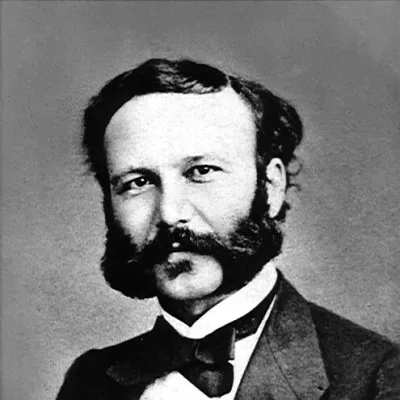
Henry Dunant
Human Design Chart
Biography
Dunant was born in Geneva to a devout Calvinist family and had business interests in French Algeria and Tunisia. In 1859, while on his way to petition Napoleon III, he witnessed the aftermath of the Battle of Solferino in northern Italy. Horrified by the suffering of the wounded and the lack of care they received, Dunant took the initiative to organize the local population in providing aid for the soldiers. After returning to Geneva, he recorded his experiences in the book A Memory of Solferino, in which he advocated the formation of an organization that would provide relief for the wounded without discrimination in times of war. In February 1863, Dunant was a member of a five-person committee that sought to put his plan into action, which in effect founded the organization that would become the International Committee of the Red Cross. A year later, he took part in a diplomatic conference organized by the Swiss government that led to the signing of the First Geneva Convention.
Dunant became embroiled in a business scandal in 1867 which resulted in his bankruptcy and expulsion from the International Committee.
Henry Dunant — Generator with Profile 6/2
Generator 6/2 — Design at a Glance
Henry Dunant's design indicated a tendency towards high endurance and materialization power. His core energy was defined by the sacral center, marking him as someone who generated energy – comparable to a workhorse that is extremely strong if it has purposeful strength for its task. The central mechanics of his character lay in reacting rather than initiating. Satisfaction arose only when he responded to internal impulses, when his inner self shouted, “Yes! Let’s get started!”
This design contained two specific pitfalls. One was burnout through forced activity without an internal signal; doing things without desire wasted his energy. The other trap was frustration if external circumstances prevented him from working on his heart project, despite wanting to continue with power. Successful action required waiting for the signal and consequent action thereafter. If Henry Dunant lived in harmony with this design, it rewarded him with deep satisfaction and fulfillment. However, initiating without an internal signal led to persistent frustration and energy deficiency. His path to effectiveness thus lay not in anticipation but in reacting from his gut to life as it presented itself.
Emotional Authority
Henry Dunant's design indicated a tendency towards emotional maturity when making decisions; immediate impulses were misleading here. He was someone who needed patience and multiple reflections on questions to gain clarity and calm after emotional waves.
This was an expression of his emotional authority. Whenever the Emotional Center is activated, it also functions as inner authority, regardless of what else is defined in the chart. Henry Dunant experienced a constant up-and-down emotional wave. The world appeared colored by his current mood: one moment totally excited about something, and the next seeing the same thing entirely negatively.
However, the feeling in the moment was only a snapshot, an initial impression that did not necessarily represent its truth yet. Quick, spontaneous decisions based on emotion could therefore have very negative consequences. The more time Henry Dunant took to let a decision mature, the deeper and broader he could perceive something. This required patience and conscious hesitation. Over time, intense feelings subsided, emotional distance set in, followed by clarity and calmness. Only then had he gone through the process. This mechanism was primarily relevant for long-term decisions with significant influence on life's course.
The 6/2 Profile — Role Model / Hermit
Henry Dunant's design followed a clear two-phase pattern. In his first half of life, before the Saturn return around age 30, he acted as a natural talent: He learned through active experimentation and direct experience. Mistakes here were not failure but necessary steps in the process of trial and error. After each setback, he withdrew to reassess the situation before acting again. This phase served to gather a broad palette of life experiences through personal action.
Around age 30, line 6 energy kicked in and fundamentally changed his approach. Henry Dunant metaphorically retreated into a “hole,” looking back at his earlier experiments with greater distance. This period was marked by intense reflection and healing. He no longer analyzed the accumulated experiences solely from immediate involvement but with wise overview. This withdrawal allowed deep self-awareness and integration of earlier mistakes.
The result of this long process was his development into an authoritative figure. Henry Dunant eventually appeared as a sage, whose introspection served as an example to others. People sought him out to partake in his life wisdom and learn the ability for deep self-reflection. His path showed how initial uncertainty and constant experimentation through distancing could lead to stable, instructive authority that offers guidance to others.
Split Definition — Defined & Open Centers
Henry Dunant's design established a tendency towards constant inner authority and energy basis. Six defined centers – Head, Ajna, Sacral, Solar Plexus, Spleen, and Root – created a persistent mental pressure for inspiration as well as vital endurance, emotional depth, and instinctive clarity. This generated an autonomous foundation: mental questions and answers (Head/Ajna), generative power (Sacral), emotional wave movement to clarity (Solar Plexus), spontaneous intuition in the present moment (Spleen) along with the drive to move forward (Root).
In contrast, the open centers Throat, G, and Heart reflected their environment. The open Throat tended to suffer under pressure to force attention through speaking rather than waiting for invitations to express itself. The open G Center lacked a firm identity; Henry Dunant relied on others to initiate him in direction and love instead of seeking a fixed self-image himself. The open Heart Center lacked consistent willpower; here there was the danger of wanting to prove oneself through promises or competition, leading to exhaustion as this energy was not sustainably available.
The mechanics showed up as tension between the strong inner source and situational adaptability. Defined centers offered the power for reaction and endurance while open areas required avoiding conditioning: Not speaking proactively (Throat), not chasing identity (G) and not making promises (Heart). Instead, it was about waiting on life to react appropriately. This configuration shaped a stance of patient waiting with high inner density and instability in communication, identity, and will, which could only be stabilized through trust in one's own strategy.
Channels for maturation, change, logic, intuition and ambition.
Henry Dunant's design established a fundamental attitude of passive reception: he reacted to external impulses rather than initiating them proactively. This receptivity was the basis for his reactions and allowed him to reshape change into new directions.
This dynamic was marked by Channel of Mutation 60-3. This channel connects Root with Sacral center, bringing evolutionary change through acceptance of limitation (Gate 60) as well as the order principle after the chaos of a fresh start (Gate 3). The energy was pulsing, often accompanied by melancholy, and required patience until new mutations became visible. Parallel to this, Channel of Ripening 53-42 worked, connecting Root with Sacral center. It drove the process of fully experiencing experiences (Gate 53) and gaining wisdom for future cycles from them (Gate 42), thereby translating his life experience into collective history.
His mind operated through Channel of Logic 63-4. Here, the doubting Head (Gate 63) connected with the formulaing Ajna Center (Gate 4). This configuration filtered patterns permanently for their consistency; only what was practically verifiable counted as logically true. Doubt here was not an obstacle but essential for formulating sustainable answers.
Emotionally and instinctively, Henry Dunant was driven by Channel of Recognition 30-41. The drive towards new experiences (Gate 41) heated the emotional wave in Solar Plexus (Gate 30), creating a deep need for profound meaning-making and turning unfamiliarity into experience.
Additionally, Channel of Transformation 54-32 was active. It connected the ambition for social advancement (Gate 54) with the instinctive continuity security of the tribe (Gate 32). This promoted dedication to service in order to gain recognition and security through consistent effort.
Individual Gates like Gate 2 (Receptivity), Gate 1 (Creativity), and Gate 49 (Overturning) underscored this ability to embrace change without needing to control it.
Collective Circuitry — Circuit Signature
Henry Dunant's design presented two separate, unconnected energy clusters. The first cluster, the Knowledge Circuit, connected his Sacral with Root Center through Channel 3-60 'Mutation'. This configuration generated a driving force for individual transformation and unique path marked by deviation from the known. The second cluster, the Understanding Circuit, linked Head to Ajna Center via Channel 4-63 'Logic'. Here rational, emotionless strategy focused on the future was at work. Between these systems there was no direct connection; energy was polarized between impulsive renewal and cool planning.
Additionally, the Meaning-Finding Circuit showed with Channels 42-53 'Ripening' and 30-41 'Recognition'. This connected Sacral, Root, and Solar Plexus Centers into a group, enabling cyclical emotional waves and reflecting on the past. Finally, in the Ego Circuit Channel 32-54 'Transformation' was active, connecting Spleen with Root Center. This promoted cooperation and resource creation within the tribe but required pauses due to lack of Sacral connection in this specific circuit. The divided definition thus emphasized parallel forces: transformative impulses and logical strategies existed side by side without merging into an integrated whole.
Left Angle Cross of Defiance 1
Henry Dunant's Human Design profile set a tendency towards a dynamic and often externally driven life architecture. His energy did not draw from an internal static source but was shaped through dealing with external resistances and changes. This led to behavior that was flexible and reactive, especially in the context of crises or necessary reorientations.
The structure of the 'left cross of challenge' implies a path defined by friction and adaptation. Henry Dunant navigated unpredictable environments where his effectiveness was strongest when he had to respond to situational demands. This configuration does not describe a calm, predictable existence but rather a life task that requires constant interaction with the outside world. The challenge lay in not binding oneself to fixed structures but adapting to changing circumstances.
Henry Dunant showed himself as someone who found his strength in movement and dealing with resistances. His architecture was designed to manage uncertainties by flexibly responding to new information and external pressures. This did not mean that his path was easy; rather, the constant need for adaptation was the central driver of his development. The mechanics of this cross emphasized that true competence is acquired through navigating complex, changing situations, not through isolated reflection. Henry Dunant's design thus shaped a practical resilience towards external upheavals.
Saturn Return · Uranus Opposition · Chiron Return · 2nd Saturn Return — Life Cycles
Henry Dunant's life unfolded in marked phases of structuring and transformation. His first Saturn return around the age of 30 often marked the transition from education to solid social anchoring. In 1859, at 31 years old, Henry Dunant witnessed the conditions among the wounded after a battle in Solferino. This moment served as a catalyst for his later career-relevant orientation.
The Uranus opposition around age 40 often brought destabilizing forces and the necessity to break with old structures. In 1868, he was convicted of fraudulent bankruptcy, a deep crisis that shook his previous foundation.
The Chiron return, a cycle of fulfilling the incarnation purpose, occurred for Henry Dunant at about 46 years old. Instead of being a phase of external confirmation, this period proved to be one of internal friction and transformation: in 1874 he lived in material poverty and moved between various places like Stuttgart, Rome, Corfu, Basel, and Karlsruhe. This cycle demanded the full expression of his strategy under extremely difficult conditions.
The second Saturn return around age 60 finally brought a new, more stable form of structuring. In 1887, at 59 years old, Henry Dunant received small monthly financial support from relatives. This allowed him to live securely and ended the long phase of instability by providing a reliable foundation for his final years.
Generator · Emotional Authority — Synthesis
Henry Dunant was a Generator with emotional authority whose life was marked by a deep rhythm between activation and withdrawal. The sacral energy (Generator type) seemed to draw him irresistibly towards tasks that were truly close to his heart – an energy, however, that was always filtered and matured through the emotional wave (emotional authority). This process required time and patience as immediate impulses often did not reflect deeper truths. The profile as a role model/natural talent suggests he had to accumulate many experiences initially before developing wisdom later on to pass it forward.
A central paradox in his design lay in the interplay of Mutation (Channel 3-60) and the need for emotional clarity. The channel created a drive towards change and breaking existing patterns, while emotional authority required a thorough confrontation with the consequences of these changes. This led to a tension field between impulsive action and reflective approach that was evident in cycles: moments of engagement (such as witnessing a battle) alternated with phases of deepest crisis and material poverty before ultimately achieving recognition and stability.
5 Defined Channels
Incarnation Cross - Left Angle Cross of Defiance 1
Solar Return
The Solar Return shows the moment when the sun returns to its exact birth position - your personal solar year.
Life Cycles
Discover the life cycles with a detailed triple view (birth chart, cycle chart, composite).
Human Design Profile
- Type
- Generator
- Strategy
- To respond - wait for something to respond to
- Authority
- Emotional Authority
- Profile
- 6/2 - Role Model / Hermit
- Definition
- Split Definition
- Incarnation Cross
- Left Angle Cross of Defiance 1
- Date of Birth
- 08.05.1828 20:30
- Place of Birth
- Geneva, Switzerland
Frequently Asked Questions
What was Henry Dunant's Human Design type?
What profile did Henry Dunant have?
Which authority guided Henry Dunant?
What incarnation cross did Henry Dunant have?
When was Henry Dunant born?
Discover your own Human Design
Are you also a Generator? Find out in a personal reading how to use your sacral energy correctly and discover deep satisfaction.
More Personalities
Back to overviewAaliyah

Alexia

Angèle

Anne-Marie

Arcángel
Arno