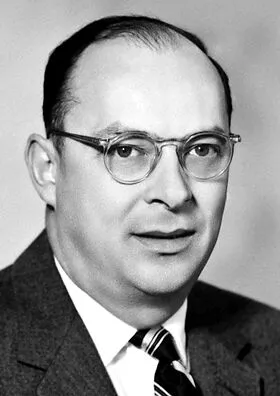
John Bardeen
Human Design Chart
Biography
Bardeen is also responsible for a theory of superconductivity, the property of some metals to lose all electrical resistance at very low temperatures, and for a theory explaining certain properties of semiconductors. Bardeen received many honorary degrees, honors and awards.
Bardeen was the son of Charles Russell Bardeen, the first graduate of the Johns Hopkins Medical School and founder of the Medical School at the University of Wisconsin. His mother, Althea Harmer, studied oriental art at the Pratt Institute and practiced interior design in Chicago. He was one of five children.
Bardeen obtained his PhD in 1936 in mathematics and physics from Princeton University. A staff member of the University of Minnesota, Minneapolis, from 1938 to 1941, he served as principal physicist at the U.S. Naval Ordinance Laboratory in Washington, D.C.
In the fall of 1945, he joined the newly formed research group in solid state physics at the Bell Telephone Laboratories, Murray Hill, New Jersey. It was there that he became interested in semiconductors and with W.H. Brattain discovered the transistor effect in late 1947. He left Bell Labs in 1951 to become Professor of Electrical Engineering and of Physics at the University of Illinois, Urbana, where he was Professor and Emeritus Professor.
John Bardeen as a Manifesting Generator 2/5 in Human Design
Manifesting Generator 2/5 — Design at a Glance
John Bardeen revealed himself as a person with a hybrid nature: He combined the lightning-fast action capability of a Manifestor with the constant, deep energy source of a Generator. His design tended to skip steps and take on multiple projects simultaneously. This speed was, however, a double-edged sword. Without the right filter, his rapid push often led to important intermediate steps being overlooked, which inevitably resulted in backlogs and frustration – his specific non-self-experience. Additionally, he tended to react to many different impulses at once, fragmenting his attention and diminishing inner satisfaction.
The solution lay in his strategy: Instead of initiating himself, he reacted to life. Only when his Sacral Center – his motor center for energy and resonance – gave a clear "yes," did he begin to act. This internal feedback served as a filter against hasty action. Only through this reaction to real impulses could he channel his immense creative power without burning himself out. With correct application of this dynamic, a state of "play mode" emerged. In this mode, the parallel handling of various tasks was not an obstacle but a source of deep satisfaction and joy in creation, as long as inner authority consented.
Emotional Authority
John Bardeen was influenced by emotional waves that significantly shaped his perception and decision-making. His defined Solar Plexus Center served as his inner authority – a mechanism that always took precedence over other defined centers. This configuration meant he experienced the world through the filter of his current mood; enthusiasm could quickly turn to rejection, since immediate feelings often only represented a fleeting snapshot.
Quick, spontaneous reactions to these emotional impulses proved risky, as they did not necessarily reflect his deeper truth. Instead, his design required patience and time. By letting decisions rest – ideally overnight – he allowed intense emotions to subside. This process of waiting was essential for gaining emotional distance. Only when the waves had subsided did clarity and calmness emerge. John Bardeen utilized this natural dynamic to distinguish momentary snapshots from lasting insight. Through consciously waiting for his inner response to mature, he secured a solid foundation for long-term steps rather than succumbing to the treacherous fluctuations of his immediate mood.
The 2/5 Profile — Hermit / Heretic
John Bardeen exhibited a pronounced tension between the deep need for withdrawal and the external expectation to be immediately available as a problem solver. His design required strict selectivity: time and energy were only allocated for consciously chosen aspects in the here and now.
This Profile 2/5, known as "Natural Talent" or "Hero", carries the polarity of Hermit (Line 2) and Hero Line (Line 5). While others sought solutions and expected help, John Bardeen needed intensive phases of isolation to prepare. Line 2 promoted ascetic withdrawal and inner clarity about what to say "yes" and "no" to. Without this boundary, exhaustion threatened from the illusion of always being available.
The energy did not flow continuously but had to be selectively released. The withdrawal served to find his own alignment before entering the "called state" of Line 5. Only after this inner preparation could he effectively use his unusual abilities in accepting and implementing advice. This shift between intense inwardness and explosive engagement defined his work. He used alone time to not forget, amidst constant demands from his environment, what he truly wanted to commit himself to. This discipline protected him from the influence of emotions on his mind and allowed him to deliver practical solutions at the right moment without sacrificing himself.
Split Definition — Defined & Open Centers
John Bardeen revealed himself as someone whose inner architecture was marked by a robust willpower and a constant energy source. His defined Heart Center provided the driving force of ego and the ability to keep promises, while his defined Sacral Center supplied an enormous vital energy. However, this energy was only available through reaction; initiatives without prior questioning often led to resistance or exhaustion. His decisions were guided by his defined Solar Plexus Center, which required patiently waiting for emotional waves to clear before acting impulsively on highs and lows of mood. The defined Throat Center allowed him to carry these inner processes as clear communication and action outward, supported by the existential pressure of the defined Root Center, driving him forward.
At the same time, his design served as a mirror for the environment. His open Head Center made him vulnerable to mental stress and confusion when trying to find answers that were not coming from within; he tended to get entangled in others' questions. Similarly, his open Ajna Center led to concepts and opinions often being misinterpreted as personal truth instead of transient thoughts. The open G Center meant a lack of firm identity; he sought direction through interaction with others and could easily feel lost in false environments. Finally, the open Spleen Center made him sensitive to survival fears and spontaneous impulses that were often conditioned by the environment. The challenge was not to identify with these open centers but to use them as tools for perceiving the world while relying on his defined authority.
Channels for powerful action, authority and emotional depth.
John Bardeen showed a basic disposition marked by raw, physiological energy that immediately radiated into the world. This dynamic came from Channel Charisma 34-20, connecting Sacral Center with Throat Center. Here, generative power was directed through reaction to external stimuli and expressed in the moment of occurrence. This generated a strong urge for immediate implementation of ideas; sitting still was difficult as energy pushed him to move and act. The effectiveness of this power depended on alignment between consciousness and action. When he listened to his inner guidance rather than mental compulsions, this energy was inspiring and served self-empowerment. However, when steered by 'shoulds', it led to exhaustion or chaotic outbursts.
Alongside this manifesting power, the structure of Channel Line of Money 21-45 worked in the background. This channel connected Heart with Throat Center, emphasizing the will to control material resources and hierarchies. It was about taking responsibility for asserting one's authority to maintain independence and set one's own rhythm. In contrast to this stood Channel Feelings Released 39-55, connecting Root Center with Solar Plexus. Here, moods pulsed between joy and melancholy, an emotional wave that had to be lived authentically to enable spiritual depth and creativity.
Additionally, individual Gates shaped his profile: Gate 59 pursued a genetic strategy of binding, while Gate 52 required pauses for concentration. Gate 58 drove experiments, Gate 37 sought organic community, and Gate 33 reflected experiences. In the design, Gates like 38 (Resistance), 3 (Mutation), and 31 (Leadership) also played a role. This combination formed a person who acted through direct reaction, sought material control, and lived emotional waves authentically.
Individual Circuitry — Circuit Signature
John Bardeen showed a divided energetic structure with two parallel, not directly connected force fields. On one side was the field of the Circuit of Knowledge. Here, his Solar Plexus and Root Center were linked via Channel Feelings Released. This configuration generated a pulsing acoustic energy aimed at using emotional waves to initiate change. It wasn't about constant knowledge but expressing a unique identity through releasing feelings serving as an impulse for transformation.
Parallel to this existed the field of the Circuit of Ego. In John Bardeen, this circuit connected exclusively Throat Center with Heart Center via the 'Money Line'. This concerned the material side of cooperation and exchange of resources within the tribe. Since there was no connection to Sacral Center, this energetic line was timeless and conservative; it required necessary pauses as no constant life force flowed through. The focus lay on material well-being and mutual support through giving and taking.
A third element formed the integration. Here, John Bardeen linked Throat Center with Sacral Center via Channel Charisma. This allowed him to intuitively channel power from reaction to life (Root) and express it in the present moment. This connection secured his own survival through high individuality and the ability to translate power directly into the present. The dynamics between the pulsing drive for individual transformation and the traditional necessity of tribe-based cooperation shaped his energetic profile.
Right Angle Cross of the Sleeping Phoenix 2
John Bardeen's design carried the marking of the right cross of the sleeping Phoenix 2. This configuration established a specific inner orientation that relied less on external validation and more on deep, often unconscious resonance with certain archetypal patterns. It was not an active search for meaning in the traditional sense but rather a passive identification with an underlying structure of existence.
In Human Design, this cross describes a connection between the emotional center and the solar plexus, symbolized by the right leg of the Phoenix. This points to a life energy that runs in cycles of rest and sudden awakening. The 'sleeping' nature implies that this power is not constantly active but rests during periods of collection and inner condensation before discharging or revealing itself in short, intense phases. For John Bardeen, this meant a tendency towards restraint and observation until the internal tension reached a certain point. Identifying with this pattern created an inner stillness that allowed him to search beneath the surface of everyday life for true driving forces without being distracted by superficial stimuli. It was a stance of waiting for the right moment when the hidden truth could not only be recognized but also felt.
Saturn Return · Uranus Opposition · Chiron Return · 2nd Saturn Return — Life Cycles
John Bardeen experienced two crucial phases of his life structure, marked by astronomical return cycles. The first Saturn Return, a phase of professional consolidation, occurred in 1936. At age 28, Bardeen earned his doctorate in mathematics and physics from Princeton University. This milestone condensed years of groundwork into a solid academic foundation.
Later came the Chiron Return, an achievement cycle where the incarnation cross unfolds and meaning becomes experiential. This happened in 1956 when Bardeen, at age 48, received the Nobel Prize in Physics – jointly with William B. Shockley and Walter Brattain. This recognition was not just a reward but late confirmation of long-term development according to his strategy and authority. The mechanics here are clear: while Saturn Return established structure, Chiron Return enabled the acknowledgment of this work at the highest level. Both events underscore how cyclical processes worked in John Bardeen's design – first through consolidation, then through the realization of the deepest purpose.
Manifesting Generator · Emotional Authority — Synthesis
John Bardeen lived a life marked by profound inner dynamics: the interplay between quick action and the necessity for emotional maturity. His design as an Expressing Generator with emotional authority points to someone who not only had the ability to initiate things quickly but also the wisdom not to rush decisions. This combination manifested in a work style characterized by impulsive energy and the need for thorough reflection – a constant balancing act between the urge for immediate manifestation and the inner necessity of gaining clarity through emotional waves. The connection of the defined Heart Center with the Throat Center further strengthened this trait, giving him strong willpower that always had to be expressed authentically.
A central paradox in John Bardeen's design lies in the tension field between his ability for quick reaction and emotional authority requiring waiting time. He was destined to respond to impulses but simultaneously needed time to process these emotionally and ensure they aligned with his inner compass. This tension might have led to phases of frustration when the speed of action did not match emotional clarity, yet also to deep satisfaction once he learned to transform his energy into a 'play mode' and use variety as driving force.
3 Defined Channels
Incarnation Cross - Right Angle Cross of the Sleeping Phoenix 2
Solar Return
The Solar Return shows the moment when the sun returns to its exact birth position - your personal solar year.
Life Cycles
Discover the life cycles with a detailed triple view (birth chart, cycle chart, composite).
Human Design Profile
- Strategy
- To respond - wait for something to respond to
- Authority
- Emotional Authority
- Profile
- 2/5 - Hermit / Heretic
- Definition
- Split Definition
- Incarnation Cross
- Right Angle Cross of the Sleeping Phoenix 2
- Date of Birth
- 23.05.1908 05:00
- Place of Birth
- Madison, WI, United States
Frequently Asked Questions
What was John Bardeen's Human Design type?
What profile did John Bardeen have in Human Design?
Which authority guided John Bardeen?
What incarnation cross did John Bardeen have?
When was John Bardeen born?
Discover your own Human Design
Are you also a Manifesting Generator? Find out in a personal reading how to unfold your multi-talents and direct your energy wisely.
More Personalities
Back to overviewAldair

Alizée

Angeli

Arletty

Artus

Balthus