
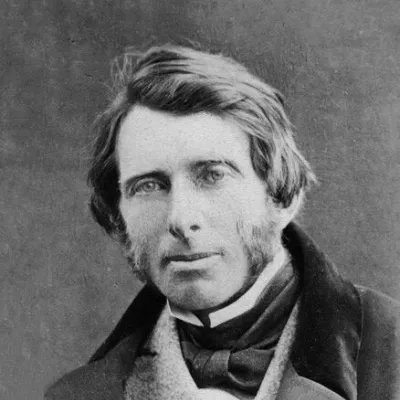
John Ruskin
Human Design Chart
Biography
Ruskin's writing styles and literary forms were equally varied. He wrote essays and treatises, poetry and lectures, travel guides and manuals, letters and even a fairy tale. He also made detailed sketches and paintings of rocks, plants, birds, landscapes, architectural structures and ornamentation. The elaborate style that characterised his earliest writing on art gave way in time to plainer language designed to communicate his ideas more effectively. In all of his writing, he emphasised the connections between nature, art and society.
Ruskin was hugely influential in the latter half of the 19th century and up to the First World War. After a period of relative decline, his reputation has steadily improved since the 1960s with the publication of numerous academic studies of his work. Today, his ideas and concerns are widely recognised as having anticipated interest in environmentalism, sustainability, ethical consumerism, and craft.
Ruskin first came to widespread attention with the first volume of Modern Painters (1843), an extended essay in defence of the work of J. M. W.
John Ruskin as a Generator 6/3 in Human Design
Generator 6/3 — Design at a Glance
John Ruskin possessed enormous and enduring strength, which made him appear like a workhorse – strong and steady as long as he found energy for his tasks. As a Generator, he had plenty of sacral energy, but it was released not through self-initiative, but rather in response to external signals. His strategy involved waiting until life presented an offer, and then responding from the gut once his inner voice gave a clear “yes.”
This mechanism carried two specific risks for him: He suffered frustration or energy loss when doing things he did not like, or if he was kept away from his heart project while still full of drive. Living in alignment with this design, John Ruskin found deep satisfaction and fulfillment. Deviating from it, such as by constantly initiating instead of responding, led to persistent frustration. His strength lay not in pushing forward but in powerfully answering impulses that resonated with him internally.
Sacral Authority
John Ruskin revealed himself as a Generator whose decision-making was shaped by sacral authority. This internal leadership is unique to this type and simplified his process since strategy and authority were identical. A prerequisite for this was an open emotional center, meaning he could not or should not make decisions on the level of feelings but rather on a physical level. His responses came as direct reactions to external stimuli: gut instincts, bursts of energy, or loud exclamations like grunts or hums. When his sacral motor engaged, he felt vital and alive, possessing inexhaustible energy and tackling his work with great enthusiasm. He was born to walk through life joyfully and dissolve into activities without a specific goal in mind. Additionally, his activated spleen center acted as supportive authority. This connection allowed him quick, spontaneous reactions and immediate access to his instinctive perception and physical well-being. He could reliably guide himself by these inner signals, further strengthening his ability to make swift decisions in the present moment.
The 6/3 Profile — Role Model / Martyr
John Ruskin showed himself to be someone who sought extraordinary standards throughout his life, far from everyday norms. His design presented the Profile 6/3 – Role Model and Experimenter. In the first three decades of his life, he primarily lived the energy of the Pioneer Line: through numerous self-experiments and the principle of trial and error, he learned to adapt and form connections, regardless of their nature or whether they were met with criticism.
This early period was marked by a strong drive for renewal. Even after his first Saturn return around age 30, this experimental attitude did not fully end; the Experimenter Line remained permanently present. Internally, he often felt restless, as if an extremely old soul was eternally searching for something perfect and right but never quite grasping it.
At the same time, his design carried the wisdom of the sixth line in Gate 13. This position combined pessimistic insights with unwavering hope for openness and better relationships. He learned to accept every interaction as a necessary step towards greater unity. The tension between knowing one's own insights and the necessity of tolerating criticism shaped his development. Ultimately, he used his unusual experiences to develop responsibility and foresight – characteristics that could make him a humorous role model speaking from personal practice.
Split Definition — Defined & Open Centers
John Ruskin's design showed a tendency towards consequent, conceptual work. His defined Ajna Center ensured constant mental activity; he processed data and creativity in a specific way that protected him from superficial external influences. These thoughts flowed directly into his defined Throat Center, allowing him to express what he thought reliably. His communication was thus a structured expression of his concepts, not impulsive but methodical.
As a Generator with a defined Sacral Center, Ruskin had an enormous source of vital energy. However, this power manifested only through reaction to external initiatives. If he followed the inner 'yes' tone, enduring energy for deep satisfaction was available; if he initiated himself, frustration and exhaustion were risks as his sacral wellspring wasn't properly engaged. His defined Root Center also provided a steady push to move forward in the world, underpinning his actions with persistent existential intensity.
At the same time, his chart revealed specific vulnerabilities. The open Head Center made him susceptible to foreign inspirations or mental confusion that he couldn't identify as his own truth. His open G Center meant that his identity and direction were often shaped by context and people around him; he found his place by waiting for the environment to initiate him rather than seeking it out himself. An open Heart Center led to a lack of consistent willpower, making him vulnerable to proving himself through promises – a trap undermining self-worth if not fulfilled. Additionally, his open Solar Plexus absorbed foreign emotions, exposing him to emotional waves from the environment without recognizing them as his own. Finally, his open Spleen variant required caution with spontaneous decisions, often based on conditioned fear or false security rather than genuine intuition.
Channels for change, curiosity and structured insight.
John Ruskin's energy was characterized by a deep, often melancholic unpredictability, stemming from Channel of Mutation 60-3 connecting the Root Center to the Sacral Center. Through Gate 60, the fulcrum of evolutionary possibilities, and Gate 3, which seeks order, emerged a pulsating rhythm of chaos and structure. This channel generated internal tension in phases of silence felt as melancholy until new impulses arose suddenly. Ruskin had to learn to accept this limitation without fighting against his energy's whims but waiting patiently for change to occur naturally.
Parallel to this, he possessed a marked ability to tell stories and convey abstract ideas. Channel of Curiosity 11-56 connected his Ajna Center with the Throat Center, driving him constantly to seek new perspectives. Through Gate 11, which generates ideas, and Gate 56, fascinated by stimulation, he formed information not as dry facts but as living stories. These narrative structures served to inspire others and stimulate their imagination, focusing less on finding truths than on the magical act of retelling and sharing.
Furthermore, Ruskin had the ability to translate complex insights into clear, efficient structures. Channel of Structuring 43-23 also connected Ajna and Throat Centers. Gate 43 received spontaneous breakthroughs while Gate 23 assimilated and expressed them. This allowed him to communicate innovative thinking in a way others could absorb, provided he waited for the right moment to express himself. Supported by gates like Gate 13, which fosters continuity and reflection, as well as Gate 7, projecting a leading stance, his identity found expression through Gate 8 seeking affirmation for his individual contribution while Gate 38 helped set boundaries and defend his integrity against opposition.
Individual Circuitry — Circuit Signature
John Ruskin's design inclined towards structured communication and profound innovation. He was someone who not only received new insights but also brought them into clear forms while breaking existing patterns simultaneously. This attitude resulted from his split definition: two energetic streams existed parallel without directly flowing into each other.
The first stream connected the Ajna with the Throat Center, where the Knowledge Circuit operated through Channel 'Structuring'. John Ruskin had the ability to translate inner thoughts into orderly speech. Simultaneously, mutations from Channel 3-60 activated a force of deviation from the known. This combination allowed him to question established conventions and formulate new ideas. A second aspect of this stream lay in the Meaning Circuit: Channel 'Curiosity' (11-56) also connected Ajna and Throat Center, promoting visual learning based on past experiences that he could share with others.
Independently, a second, separate stream existed between Sacral and Root Centers. This area provided fundamental life energy and endurance but did not directly exchange with the mental processes of Head or Voice. John Ruskin used this isolated energy source for his action capability while intellectual work occurred in another part of his design. Both systems shaped his life side by side: on one hand, powerful endurance; on the other, structured, mutative knowledge transmission.
Left Angle Cross of Masks 1
John Ruskin's Human Design profile suggests a tendency towards deep, often painful introspection into his own identity and societal roles. This configuration, known as the left mask cross 1, describes an internal conflict between the desire for true authenticity and the pressure to meet certain expectations. It was a dynamic tension that pushed him to seek genuine values behind the facade of daily life while simultaneously struggling with the burden of public perception. This mechanism fostered a strong awareness of the discrepancy between inner experience and outer presentation. For John Ruskin, this meant his life was often marked by the struggle to reconcile these two poles or at least openly acknowledge their contradictions. The energy of this cross drove him to engage with themes like honesty, integrity, and the nature of self not out of abstract curiosity but as an existential necessity. It was a configuration that did not allow for easy adaptation but rather demanded constant, sometimes arduous reflection on his being in the context of a frequently superficial world.
Saturn Return · Uranus Opposition · Chiron Return · 2nd Saturn Return — Life Cycles
John Ruskin's Human Design profile indicated a tendency towards deep structural formations that manifested as firm commitments and clear institutional frameworks. This mechanism became active in 1848 when he was 29 years old: He married Euphemia "Effie" Chalmers Gray. This first Saturn Return often marked the point where years of inner preparation crystallized into a viable external outcome – here, in the form of a marital union that fundamentally shaped his life structure.
Later, in 1871 at age 52, he established an art school in Oxford for ordinary men and women. This fell during his Chiron Return cycle, a period when one's incarnation cross unfolds and meaning becomes experiential. Rather than mere healing, this was a blooming phase where his life task – here the democratization of artistic education – took concrete form in his life and fulfilled its purpose.
His second Saturn Return occurred in 1875 when he was 56 years old. In that year, Rose La Touche died at age 27 in an asylum. This cycle often brings final clarification or closure to older structures. The death of a central figure acted here as a catalytic event that questioned the previously established life structures and introduced new, significant realities into his design, not merely as a biographical note but as part of his ongoing energetic development.
Generator · Sacral Authority — Synthesis
John Ruskin lived as a Generator, driven by his sacral energy and endurance to delve deeply into activities that elicited an inner response (sacral authority). This drive was particularly evident in experimenting and seeking extraordinary life designs – a pattern reinforced by his Profile as Role Model/Experimentor. The ability to develop and process concepts (defined Ajna Center) enabled him to generate knowledge and send transformative impulses through his individual expression (Knowledge Circuit). He drew strength from accepting limitations and leaving familiar paths (Channel 3-60), which was reflected in his pursuit of innovation and change.
Ruskin's life was marked by a paradox between deep engagement and melancholy. On one hand, he found joy and energy in immersing himself in his work, especially when it was confirmed by an immediate bodily reaction. On the other hand, cycles pointed to recurring experiences with loss and disappointment – one event marking the beginning of a relationship (1848), while another signalled the death of a close person (1875) – nourishing a melancholic undercurrent in his creative process. This tension between creative power and melancholy seems to have prompted him repeatedly to seek new paths and express his individuality.
3 Defined Channels
Incarnation Cross - Left Angle Cross of Masks 1
Solar Return
The Solar Return shows the moment when the sun returns to its exact birth position - your personal solar year.
Life Cycles
Discover the life cycles with a detailed triple view (birth chart, cycle chart, composite).
Human Design Profile
- Type
- Generator
- Strategy
- To respond - wait for something to respond to
- Authority
- Sacral Authority
- Profile
- 6/3 - Role Model / Martyr
- Definition
- Split Definition
- Incarnation Cross
- Left Angle Cross of Masks 1
- Date of Birth
- 08.02.1819 07:30
- Place of Birth
- London, England, United Kingdom
Frequently Asked Questions
What is John Ruskin's Human Design type?
Which Profile did John Ruskin have in Human Design?
What Authority did John Ruskin have?
What incarnation cross did John Ruskin have?
When was John Ruskin born?
Discover your own Human Design
Are you also a Generator? Find out in a personal reading how to use your sacral energy correctly and discover deep satisfaction.
More Personalities
Back to overviewAaliyah

Alexia

Angèle

Anne-Marie

Arcángel

Arno
