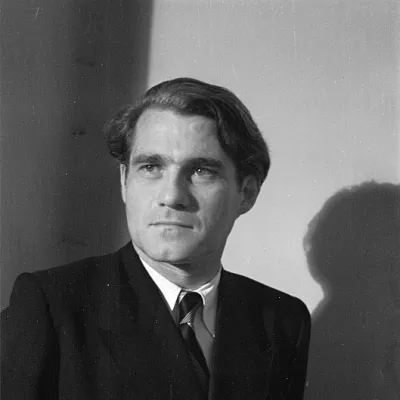
Josef Keilberth
Human Design Chart
Biography
Keilberth started his career in the State Theatre of his native city,Karlsruhe. In 1940 he became director of the German Philharmonic Orchestra of Prague. Near the end of World War II he became principal conductor of the Dresden Staatskapelle. In 1949 he became chief conductor of the Bamberg Symphony, formed mainly of Germans expelled from post-war Czechoslovakia under the Beneš decrees.
He died in Munich on 20 July 1968 after collapsing while conducting Wagner's opera Tristan und Isolde in exactly the same place as Felix Mottl had done in 1911.
Josef Keilberth — Manifesting Generator with Profile 4/6
Manifesting Generator 4/6 — Design at a Glance
Josef Keilberth's design inclined towards hybrid work methods. As an Manifesting Generator, he had constant sacral energy, which gave him the power to react to impulses and skip steps in the process. This configuration allowed him to quickly draw things into his life and push projects forward simultaneously.
The challenge lay in the speed. Often these movements were so rapid that important intermediate steps were skipped. In such cases, he had to backtrack to make up for missing stages, which could cause frustration if internal confirmation was lacking. Additionally, his design tended to pursue multiple tasks at once, driven by different impulses.
The strategy involved initially reacting to life and then proceeding only when the sacral center gave a clear 'yes'. Regular project reviews were necessary to ensure that his inner authority continued to agree. When these conditions were met, Josef Keilberth found deep satisfaction in his work. Parallel working then became a strength rather than an obstacle. His design promoted a play-mode where variety and fun nourished the creative force instead of being stifled by linear progression.
Emotional Authority
Josef Keilberth's design inclined towards emotional decision-making, where patience and temporal distance were crucial. As someone with Emotional Authority, he was subject to an internal wave of constant ups and downs in his feelings. His perception of the world was always colored by his current mood; what seemed inspiring at one moment could be perceived as negative the next. This emotional fluctuation did not mean that the first impression was true. On the contrary: quick, spontaneous decisions based on a temporary emotional state often proved problematic or misleading.
The mechanics of his inner authority required him to let decisions rest and consider them multiple times over. Only when intense feelings subsided and an emotional distance was gained would clarity and calmness set in. This process of maturation was crucial for long-term life decisions. Since the Emotional Center carried his inner authority – regardless of which other centers were defined – this emotional logic always took precedence over other defined areas of his design. Thus, Josef Keilberth emerged as someone who found true insight through navigating these internal wave movements rather than relying on initial impulses.
The 4/6 Profile — Opportunist / Role Model
Josef Keilberth's design inclined towards a tension-filled alternation between the urge for connection and the need for distanced wisdom. In the first three decades of his life, he was experimental, especially in relationships, as the sixth line still acted as the third. This created a phase of open exploration before his inner compass stabilized.
With Saturn's return, a characteristic conflict came to light: the heart seeking belonging (Line 4) stood in opposition to the head striving for higher meaning and solitude (Line 6). This tension between community need and the desire to stand above as a wise role model shaped his later years. He was expected to excel through cooperation with others, yet his large heart remained cautious to avoid opening up to false people and getting hurt.
His energy also showed a magnetic attraction for external guidance (Guidance). The elevated Neptune position in Gate 3 made him physically attuned like an instrument that attracted confusing but supernatural forces. Simultaneously, Line 60 demanded unyielding toughness as a prerequisite for deep mutations. Only through strict acceptance of limitations without compromise could he undergo these internal transformations, sharpening his intuitive judgment and making him a figure of rigor and order.
Single Definition — Defined & Open Centers
Josef Keilberth's design indicated a tendency towards constant, powerful expression coupled with deep emotional processing. His defined Throat Center gave him the ability to carry messages from various inner sources—such as Heart or Mind—clearly and reliably into the world. This voice was not an accidental product but rather a structured channel for his truth.
This expressiveness was driven by his defined Sacral energy. As a Generator, Josef Keilberth possessed an enormous vital energy source that could manifest as constant humming or restlessness. His strategy involved not initiating actions himself but waiting for stimuli and then responding from the gut with either a 'yes' or 'no'. Only in this way did he have access to the energy needed for sustainable action; false initiations quickly led to resistance and exhaustion.
His defined Solar Plexus Center functioned as an inner authority. Josef Keilberth was designed not to make decisions in the moment but to wait out emotional waves. Clarity emerged only after traversing emotional cycles—often overnight. Impulsive actions at the peaks or troughs of his feelings were a sign of non-self; true wisdom arose through patience and allowing the emotional truth to reveal itself.
Additionally, his defined Root Center shaped a set way of dealing with stress and pressure to move forward. This existential drive helped him survive in the material world and overcome challenges as long as he was guided by his strategy.
In contrast, Head, Ajna, and G Centers were open. Josef Keilberth had no consistent mental inspiration or fixed identity. He tended to blend with his environment and was vulnerable to the pressure of finding answers for others' questions (open Head/Ajna). His open G Center meant he could not initiate direction and love himself but had to wait for the right environment to do so. False places or relationships led him to feel lost; at the correct place, however, he flourished as he reflected his surroundings' energy.
Channels for focus, change, crises and emotional release.
Josef Keilberth's design was characterized by a fundamental disposition of deep inwardness paired with a strong drive for emotional experience. This tension arose from two format channels in the Root-Sacral area: The Channel of Mutation 60-3 connected Root Energy to the Sacral Center through Gate of Limitation (60) and Gate of Order (3). This created a pulsating, often melancholic energy that pressed for evolutionary change but required patience due to the unpredictable rhythm of this change. Parallel to this, the Channel of Concentration 52-9 linked Gate of Non-action (52) with Gate of Focusing (9). This channel promoted logical, detailed orientation and the ability to quietly focus on patterns to perfect them—a process that needed calmness and clear reaction from the Sacral Center.
In emotional expression, Josef Keilberth was shown through the Channel of Transience 36-35 connecting Solar Plexus with Throat. Through Gate of Crisis (36) and Gate of Change (35), he sought new experiences to gain emotional depth, often leading to restless longing. Additionally, the Channel of Emotion Release 39-55 between Root and Solar Plexus through Gate of Provocation (39) and Gate of Mind (55) set a moody, emotional wave in motion that oscillated between joy and melancholy, serving to provoke or sense others' minds.
Additional Gates like 50 (Protection Reflex), 76 (Storytelling), and 58 (Experiment/Perfection) in the Personality as well as 38 (Resistance/Limits) and 41 (Evolution/Crisis) in the design underscored a profile oscillating between protecting traditional values and the urge for individual evolution. Gate 33 (Reflection) and Gate 12 (Reserve/Poetry) rounded this off by creating space for inner reflection and poetic expression, necessary to integrate intense emotional and mutative streams.
Collective Circuitry — Circuit Signature
Josef Keilberth's design featured a simple, coherent structure. Energy flowed directly from the Sacral Center through Root and Solar Plexus Centers to Throat Center. This created a clear, unobstructed flow of life force over emotional resonance to expression.
In the Knowledge Circuit, two specific channels were active in him. The Channel 3-60 connected Sacral with Root Center, promoting mutations and deviation from the status quo. Parallel to this, Channel 55-39 linked Solar Plexus with Throat Center, translating emotional waves directly into expression. This configuration supported a pulsating, acoustic expression of unique identity and transformation of new knowledge.
The Understanding Circuit was shown through the Channel 9-52 between Sacral and Root Centers. This provided focused energy for logical strategies and structural improvement. Here it was about sharing rational insights free from emotional influence aimed at future developments.
In the Meaning Circuit, the Channel 35-36 between Throat and Solar Plexus Centers acted. This channel addressed transience and the cyclical nature of experiences. It allowed reflecting on past emotional insights and sharing felt truths with the collective to learn together from them.
All these circuits were energetically connected in Josef Keilberth. The power from the Sacral Center flowed seamlessly through Root, Solar Plexus, and culminated at Throat Center. This resulted in an integrated system where inner motivation, emotional depth, and logical clarity collectively shaped external expression without energetic breaks or separate streams.
Right Angle Cross of Laws 1
Josef Keilberth's design carried the signature of the right cross of laws. This configuration established a fundamental disposition characterized by a deep connection to the laws of life. In Human Design, this cross represents a specific way of integrating authority and truth. It described more than mere intuition; it was a structural ability to align inner wisdom with external realities.
For Josef Keilberth, this meant that his actions were often guided by a strong internal compass based on deeply rooted principles. He showed himself as someone who did not act arbitrarily but whose decisions sprang from a clear, though complex, inner logic. The right cross of laws implies a dynamic where personal experience and universal patterns merge. This shaped the way he dealt with challenges: not through mere adaptation to circumstances, but by seeking solutions that were both personally authentic and universally valid.
His life was thus marked by this structural tendency to recognize truth and actively anchor it in the world. It involved a constant movement between the inner and outer worlds, using the laws of the system as a guide. Josef Keilberth lived this mechanism by aligning his actions with these deep structures, which gave him a special stability and clarity in his decisions.
Saturn Return · Uranus Opposition · Chiron Return · 2nd Saturn Return — Life Cycles
Josef Keilberth's design leaned towards structural anchoring and proving oneself within established institutions. This orientation was evident in his career, defined by clear milestones. In 1949, at the age of 41, he took over as director of the Bamberg Symphony Orchestra. This step coincided with a Uranus opposition cycle, often bringing unexpected turns or breaking old patterns, but here leading to a firm position.
Ten years later, in 1959 at the age of 51, Keilberth moved to Munich as Bavarian General Music Director for the Bavarian State Opera. This marked his Chiron return, a fulfillment cycle where one's incarnation cross unfolds and the meaning of life becomes tangible. For Keilberth, this did not mean healing old wounds but rather a blooming period in which he lived out his deeper purpose in a leading role at a prestigious place.
The second Saturn return in 1967 at the age of 59 brought further consolidation. The opening of Würzburg Cathedral by the Bamberg Symphony Orchestra under his leadership symbolized the condensation of years of work into a solid, public result. His path was marked by integration into large cultural structures, with each cycle signifying a new level of responsibility and visibility within these systems.
Manifesting Generator · Emotional Authority — Synthesis
Josef Keilberth lived a life characterized by the dynamic connection between sacral energy and emotional depth. As an Manifesting Generator, he had a constant source of inner power (sacral center), yet his decisions were always subject to longer emotional maturation (emotional authority). This combination led to a life where he could quickly recognize and implement opportunities—driven by the mutation of his design (Channel 3-60)—but also felt the need to filter these impulses through thorough emotional engagement. The profile as Networker/Role Model suggests that throughout his life, he oscillated between the desire for community and an inner calling towards independent reflection.
A central paradox in his design lay in the tension between the impulsive action of a Manifesting Generator and the emotional wave requiring deep evaluation. On one hand, his defined Throat Center (Communication/Manifestation) allowed direct expression of his inner world; on the other, his emotional center demanded patience and time for clear decisions. The documented career events—taking over leadership roles and moving to the State Opera—seem to arise from this dynamic: quick seizing of opportunities followed by a phase of consolidation and deep engagement with new tasks.
4 Defined Channels
Incarnation Cross - Right Angle Cross of Laws 1
Solar Return
The Solar Return shows the moment when the sun returns to its exact birth position - your personal solar year.
Life Cycles
Discover the life cycles with a detailed triple view (birth chart, cycle chart, composite).
Human Design Profile
- Strategy
- To respond - wait for something to respond to
- Authority
- Emotional Authority
- Profile
- 4/6 - Opportunist / Role Model
- Definition
- Single Definition
- Incarnation Cross
- Right Angle Cross of Laws 1
- Date of Birth
- 19.04.1908 21:00
- Place of Birth
- Karlsruhe, Germany
Frequently Asked Questions
What was Josef Keilberth's Human Design type?
What Profile did Josef Keilberth have in Human Design?
What Authority did Josef Keilberth have?
What incarnation cross did Josef Keilberth have?
When was Josef Keilberth born?
Discover your own Human Design
Are you also a Manifesting Generator? Find out in a personal reading how to unfold your multi-talents and direct your energy wisely.
More Personalities
Back to overviewAaliyah

Aldair

Alexia

Alizée

Angèle

Angeli