
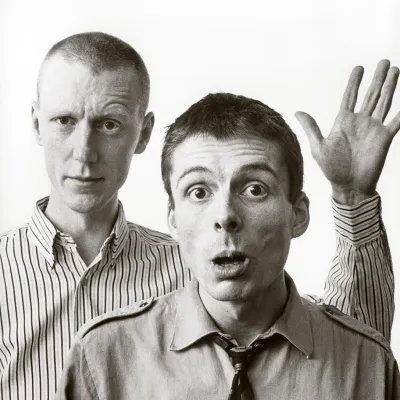
Kamagurka
Human Design Chart
Biography
Kamagurka is the artist name of of Luc Charles Zeebroek. At age 17, he visited the satirical monthly Hara-Kiri (1960-1993) in Paris, that was affiliated with the weekly Hara-Kiri Hebdo (1969- Nov 1970), the predecessor of Charlie Hebdo. Here he met Georges Blondeau (GéBé), whilst his schoolmates visited the Louvre. He showed GéBé some cartoons, and was encouraged to come back with even more weird drawings. Meanwhile he published cartoons in the newspaper De Zeewacht (since 1972) and the Humo magazine (since 1975) under Guy Mortier.
He studied Art in Brugge and the Royal Academy of Fine Arts in Ghent, but he left the academy before graduating. At age 20 he went regularly back to Charly Hebdo in Paris to find inspiration and had his first cartoons published in Hara Kiri.
Together with Peter van Heirseele (aka Herr Seele), he set up the absurdist strip Cowboy Henk (24 Sept 1981 - End 2011). Kamagurka wrote the script; Peter did the illustrations. Both were inspired by the cartoons of the anti-hero strips of the American underground artists. Both men met much resistance (annoyed readers writing letters to the editors) in the beginning with their in sex, drugs and rock and roll believing anti-hero's.
Kamagurka's absurdist cartoons would later be published in major papers and magazines in Holland (NRC Handelsblad, Vrij Nederland, Haagse Post, Playboy, Esquire), France (Charlie Hebdo, Hara Kiri), the UK (Squib, The Spectator, Deadpan),Germany (Titanic, Suddeutsche Zeitung, Zitty, Eulenspiegel), Austria (Die Presse) and the USA (The New Yorker, National Lampoon, RAW). He wrote more than 25 comics.
He also produced Dutch and Flemish radio, television and theatre shows. He worked to together with Herrn Seele, pseudonym of Peter van Heirseele (13 April 1959, Torhout), who he met in Ghent in the late seventies.
The Human Design of Kamagurka: Manifesting Generator 2/4
Manifesting Generator 2/4 — Design at a Glance
Kamagurka's design sets a tendency towards unusual speed: He could skip steps and achieve results quickly without following the conventional path. This ability stems from his configuration as an Manifesting Generator – a hybrid type that combines the constant sacral energy of a Generator with the direct projection of a Manifestor.
Although he possesses this powerful energy source, his strategy is not to initiate but to react to impulses from life. He acts effectively only when his Sacral Center responds with a clear "yes." The danger lies in his own speed: Kamagurka tends to skip important stages or get distracted by multitasking, which often leads to frustration – his specific Non-Self theme.
Deep satisfaction does not come from linear focus but from a "play mode." Here he can work on multiple projects simultaneously as long as there is variety and he regularly checks if the inner resonance with each task remains positive. As long as he practices this constant checking of sacral approval, his potential restlessness transforms into productive creative power. His path lies in not fighting against his speed but channeling it through conscious reaction and playful attitude rather than blindly rushing forward.
Emotional Authority
Kamagurkas design inclines towards emotional wave motion: His inner authority stems from the defined Solar Plexus Center. This means that his feelings are in constant fluctuation, and perception of the world is always colored by mood. What appears inspiring at one moment could seem negative the next. However, this initial impression is not a final truth but merely a fleeting snapshot.
The mechanics of this authority dictate that it takes precedence regardless of which other centers are defined. Quick, spontaneous decisions based on current emotion often had negative consequences as a result. Instead, his design required patience and time. It was important to let decisions ripen – ideally several times overnight sleep – in order to navigate through the emotional process.
Over time, intense feelings subsided, an emotional distance set in, clarity emerged, and calmness followed. Only then had he gone through the process and could make a well-founded decision. This strategy of delay was particularly crucial for long-term life decisions as it ensured that not just fleeting mood but deeper inner truth came into play.
The 2/4 Profile — Hermit / Opportunist
Kamagurka's design sets up a fundamental tension: the switch between isolated self-discovery and attachment to social networks. As Profile 2/4 (Natural Talent / Networker), he constantly fluctuated between the desire for solitude and the longing to spend time with his favorite people. This configuration required a clear rhythm: withdrawal into internal reflection, followed by re-emerging into community.
Line 2 (Hermit) gave him a natural talent for direction without conscious control; it had to be called correctly, not interfered with. At the same time, Line 4 acted as an "exhaust zone." It absorbed emotional burdens and stories of others, leading to exhaustion and forcing withdrawal for reflection. Gate 13 amplified this dynamic: Pluto in Gate 33 promoted a renewal after a ceasefire, followed by exhaustion and a desire for silence. Venus in Fall meant further emotional burden.
For Kamagurka, it was crucial to create a safe environment where he could communicate clearly: "Now I would like your company" versus "I need quiet now." During his "Me-Time," he immersed himself in internal processes, creating clarity and processing network information. Once the need for rest was satisfied, he emerged from his "cave" to reflect on his knowledge and develop ideas from it. The ability to carry these needs outward prevented misunderstandings and used the energy oscillation constructively.
Split Definition — Defined & Open Centers
Kamagurka's design created a constant mental pressure: an ongoing questioning and understanding that could not be directly implemented. This energy source in the Head and Ajna centers generated inspiration and concepts, but did not provide a motor for action. The attempt to immediately transform this purely conceptual impulse into actions inevitably led to frustration; instead, this mental pressure served to inspire others to think deeply. His defined Throat allowed him to reliably express these thoughts and concepts, yet only with full force when supported by his inner source.
This source was his defined Sacral center, a motor of vital energy that was available exclusively through reaction. Kamagurka lacked an internal drive for initiation; his energy only awakened in response to external stimuli. A confirming sacral reaction secured the power for persistence and satisfaction, while a denial set clear boundaries. Initiated actions broke this connection and led to exhaustion.
As inner authority, his defined Solar Plexus served as the need to wait out emotional waves. Immediate decisions were often impulsive and influenced by current mood; true clarity only emerged after an emotional wave had reached its peak and trough. Patience was not a lack here but a mechanical prerequisite for accurate judgment.
In contrast stood his open centers, which did not provide internal sources of identity or will but reflected the environment. His open G center meant situational identity; he tended to lose himself in relationships and environments or seek a fixed direction instead of receiving it from outside through correct initiations. The open Heart lacked consistent willpower; he was vulnerable to proving his worth through promises or competitive behavior, often ending in cycles of overburdening and self-doubt. Additionally, his open Root absorbed external stress, which could lead him to rush unnecessarily or feel pressured to escape this adrenalized feeling.
Channel 63-4: Logic — Channels & Gates
Kamagurka's design inclined towards healthy skepticism and logical clarity. His mind constantly filtered patterns to check if they were consistent or not. This attitude served the collective through verifiable evidence rather than unfounded belief.
The Logic Channel 63-4 connects the Head Center with the Ajna Center via the Gate of Doubt (63) and the Gate of Formulation (4). This doubting mind intensifies pressure whenever a pattern appears inconsistent, until a question arises demanding an answer. Logic can be correctly formulated yet still false; therefore, skepticism must arise from logical experimentation. An answer is only valid if it produces a consistent, practical, and verifiable pattern. Kamagurka was skilled at asking questions, incorporating current data, and making well-founded predictions to serve others. He often felt compelled to share both the question and the answer regardless of whether others showed interest. If his busy mind could not resolve a question and mental pressure was released without resistance, this could trigger anxiety. The Logic Channel is a collective channel; the pressure to understand patterns served best by being useful to others since this mind is not designed to answer doubts about one's own life.
Additionally, the Charisma Channel 34-20 connected his Sacral Center through the Gate of Power (34) with his Throat Center via the Gate of Now (20). This energy allowed sustained activity over longer periods and immediate action provided it was guided by sacral reaction. Without this inner guidance, however, the driving energy could turn into obsession or chaotic outburst.
The Transience Channel 36-35 connected his Solar Plexus with his Throat Center via the Gate of Crisis (36) and the Gate of Change (35). This emotional channel drove the search for new experiences often by resisting restrictive patterns. Through the need of Gate 35 to manifest change and the emotional inexperience of Gate 36, a quest for adventures was sought to set things into motion. This promoted species development through experiential knowledge but also led to wisdom only gained retrospectively from experiencing emotional depths.
Individual Gates like Gate 13 (Memory/Continuity) and Gate 7 (Leadership/Hierarchy) complemented this profile by the ability to reflect stories in the context of time and project patterns for the future.
Collective Circuitry — Circuit Signature
Kamagurka's design inclined towards an inner duality that manifested as two separate, parallel energy fields. On one side was a cool, forward-looking logic; on the other, a wave-like emotional reflective capacity from the past. These two poles were not energetically directly connected but existed as independent streams alongside each other.
The Understanding Circuit in Kamagurka linked his Head Center with his Ajna Center via the Logic Channel. This created focused energy for strategic analysis and structuring of information, free from emotional influence. The aim of this configuration was to develop rational insights that could lead society towards a better future. This insight work primarily served sharing with others to promote collective understanding.
Parallel to this, the Meaning Circuit connected his Throat Center with his Solar Plexus. Here emotions and experiences from the past flowed into a cyclical process of reflection. This energy was less logical but rather emotionally based and followed natural wave movements from beginning through middle to end. Sharing also stood at the forefront here: The emotional insights gained from the past should be shared with the collective to enable joint learning.
A third aspect was integration via the Charisma Channel between Throat and Sacral Centers. This connected expression with physical strength and survival instincts. It was about making intuitive reactions in the present effective so as to secure one's own existence. Overall, these three circuits shaped a profile that united strategic clarity, emotional depth, and vital presence as separate yet simultaneously acting forces.
Right Angle Cross of the Sphinx 2
Kamagurka's design showed a tendency towards sharp criticism of established structures whenever they were perceived as inadequate or wrong. This manifests in deep unease at the obvious imperfections and chaos of the world. The internal tension between the desire for order and the reality of human failure did not paralyze but rather became the driving force for change.
This attitude stems from the configuration 'The Right Cross of the Sphinx 2'. It describes a specific kind of rebellion: Not out of blind defiance, but from a clear perception of errors in the system. Those who carry this energy fundamentally question the status quo when it proves inconsistent or harmful. The frustration over others' or society's failure is not suppressed but transformed into critical distance.
It is less about destroying the old itself than recognizing and rejecting false foundations. Kamagurka thus showed himself to be someone who does not simply accept established truths that contradict observable reality. This mechanism promotes a clear, often unvarnished view of things ignored or glossed over by others. The energy urges one not to accept chaos but rather interpret it as a sign that something is fundamentally wrong and needs correction.
Saturn Return · Uranus Opposition · Chiron Return · 2nd Saturn Return — Life Cycles
Kamagurka's life path was structured by four classical astrological cycles which served as turning points. These phases did not define his daily essence, but the framework of his maturation processes. The first Saturn return marked a phase of consolidation and demarcation, where earlier impulses condensed into viable structures. This was followed by the Uranus opposition, a period of rebellion and liberation that dissolved old bonds and released new identity aspects.
The Chiron return appeared as a fulfillment cycle. During this phase, typically between the ages of 49 to 51, his own incarnation cross increasingly unfolds in life. If he follows his strategy and authority, meaning and purpose become experiential; it is a flowering time for self-realization, not merely healing wounds. Finally, the second Saturn return closed this sequence by integrating previously gained insights into a stable, mature life order.
These cycles acted as gatekeepers between life stages. They enforced structuring and identity formation at specific transitions. For Kamagurka, this meant that his life was not a straight line but marked by these archetypal developmental stations, each demanding and enabling a new quality of existence. The mechanics of these cycles described universal stations which found their specific expression in his chart.
Manifesting Generator · Emotional Authority — Synthesis
Kamagurka's design reveals a central thread of dynamic adaptation. As a Projecting Generator with an open G Center and several undefined centers, he is not bound to a fixed identity or direction. Instead, he takes on the energy of his environment, filters it through his defined sacral authority, and manifests something new – a process amplified by channels like Logic (63/4) and Transience (35/36). This ability to adapt, coupled with a strong inner reaction to life, allows him to learn from experiences and develop wisdom for himself and others. He is a catalyst who grows and transforms through interaction with his environment.
A central paradox in Kamagurka's design lies in the tension between his projecting aspect and his open centers. On one hand, he has the ability to quickly initiate things and manifest them (Gate 34), on the other hand, he relies on responding to external impulses and adapting to his surroundings. This duality challenges him to find inner clarity through his emotional authority and avoid impulsive actions that could lead to frustration or exhaustion. The balance between the urge to manifest and the need to engage with others' energy shapes his individual path.
3 Defined Channels
Incarnation Cross - Right Angle Cross of the Sphinx 2
Solar Return
The Solar Return shows the moment when the sun returns to its exact birth position - your personal solar year.
Life Cycles
Discover the life cycles with a detailed triple view (birth chart, cycle chart, composite).
Human Design Profile
- Strategy
- To respond - wait for something to respond to
- Authority
- Emotional Authority
- Profile
- 2/4 - Hermit / Opportunist
- Definition
- Split Definition
- Incarnation Cross
- Right Angle Cross of the Sphinx 2
- Date of Birth
- 05.05.1956 13:50
- Place of Birth
- Nieuwpoort, Belgium
Frequently Asked Questions
What is Kamagurka's Human Design type?
What Profiles does Kamagurka have?
What Authority does Kamagurka have?
What is Kamagurka's incarnation cross?
When was Kamagurka born?
Discover your own Human Design
Are you also a Manifesting Generator? Find out in a personal reading how to unfold your multi-talents and direct your energy wisely.
More Personalities
Back to overviewAaliyah

Aldair

Alexia

Alizée

Angèle

Angeli
