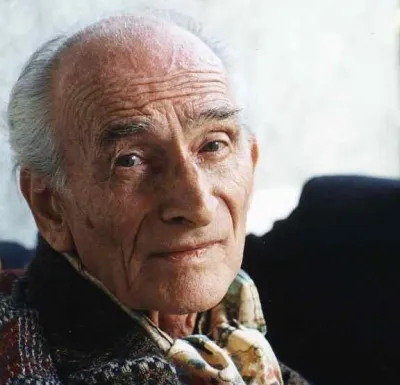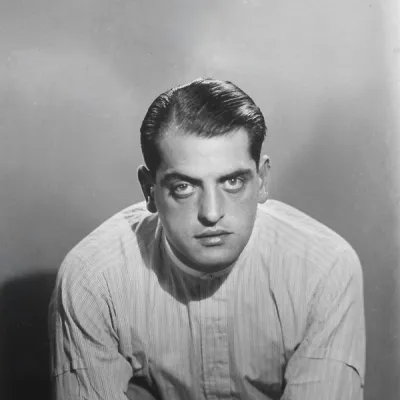
Luis Buñuel
Human Design Chart
Biography
In a speech he once said, "In the hands of a free spirit, the cinema is a magnificent and dangerous weapon." It was a weapon the great Spanish director wielded with mischievous and mysterious humor. Preoccupied with sexual aberrations and far-out fetishes, he assaulted the church, the establishment and middle-class morality with equal fervor, eliciting a public outcry from the beginning of his career.
Bunuel was given a Catholic education, served in the Mass and became fluent in Latin. In his teen year, he lost his faith in the church. The obsessions that drove him included communism, fetishism, hatred of the Franco regime that had forced him into exile in 1936 and his equal loathing of the Catholic Church.
At 17, he went to Madrid where he cultivated the banjo, the bosing ring and the brothel. His studies were widely eclectic and his friendships brimmed with the writers and thinkers of his day, including Lorca and Dali. After leaving Spain in 1925, cinema was a natural medium for his voice.
Working in France, Spain, Mexico and the U.S. Bunuel created films that included "Diary of a Chambermaid," 1964 "Belle De Jour," 1967 and "The Milky Way," 1969. He published his autobiography, "My Last Sigh," in 1983, a delightful book, filled with typically sly, iconoclastic observations. When he first went to Hollywood, his proudest moment was being thrown off the set by Garbo. Nonetheless, he spent most of WW II in that film capital. In 1946, he moved to Mexico for close to 15 years. His American Oscar was awarded in 1973 for "The Discreet Charm of the Bourgeoisie."
His French wife, Jeanne, wrote a book about their long and happy marriage, published in Spanish in 1990.
Luis Buñuel — Manifesting Generator with Profile 4/6
Manifesting Generator 4/6 — Design at a Glance
Luis Buñuel's design shows a tendency for lightning-fast implementation. As an Manifesting Generator, he had constant sacral energy that allowed him to quickly pull things into his life while skipping steps. This hybrid nature combined the perseverance of a Generator with the initiative of a Manifestor.
However, this speed was a double-edged sword. Often Buñuel was too quick and skipped important phases, leading him to have to return later to make up for missing steps. This could cause frustration as his non-self theme precisely lay in fighting against this natural rhythm. Additionally, he tended to pursue multiple projects simultaneously, driven by various impulses.
Buñuel's strategy involved not initiating himself but reacting to life. Only when his sacral center responded with a clear "yes" should he act. Regular checks to see if the inner agreement held were crucial. When these conditions were met, Buñuel drew deep satisfaction from his work. Parallel working was then no obstacle for him but rather a source of variety and fun. He entered into a play mode where the diversity of projects nourished his creative power instead of overwhelming it. His energy worked best when he followed this inner resonance rather than forcing himself to a linear completion of individual tasks.
Sacral Authority
Luis Buñuel did not react to external stimuli through careful thought but rather with an immediate physical response. His Generator design linked the strategy of waiting with sacral authority, simplifying his decision-making process: he acted only when his inner self responded. This inner voice manifested as gut feelings or bursts of energy – often audible as grunts, hums, or a silent "Mhm." Such signals marked moments of vital energy and inexhaustible enthusiasm.
A prerequisite for this clear guidance was his open Emotional Center. This meant that he had to wait out emotional waves to avoid mistaking the sacral response with passing moods. When his Sacral Motor latched onto something, he immersed himself in his activities driven by joy and satisfaction without rigid purposefulness.
Additionally, his activated Spleen Center acted as a supportive authority. It gave him the ability for quick, spontaneous reactions and an instinctive access to physical well-being. This combination allowed Luis Buñuel to reliably guide himself from his inner perception. He did not live up to external expectations but followed the rhythm of his own energy, which immersed him in his projects and granted him deep satisfaction as long as he listened to these bodily signals.
The 4/6 Profile — Opportunist / Role Model
Luis Buñuels Design was characterized by a Profile 4/6, defining him as "Networker and Role Model." In the first three decades of his life, Line 6 still acted like Line 3; he therefore experimented intensely in relationships and friendships. This early phase was marked by seeking happiness through others, since the fourth line emphasized being fixed to stronger forces. Emotional balance depended heavily on the environment.
After his first Saturn return, Line 6 became fully activated. Luis Buñuel experienced thereafter the inner conflict between the desire for community (Line 4) and the need to reflect distantly on the meaning of life (Line 6). This contradiction between heart and head could be confusing. The sixth line brought common sense; it recognized early that pure power was not enough. Authenticity became more important than constantly demonstrating strength.
In his later years, his design expected him to meet the demands of a wise role model. His emergence happened mainly through cooperation with others. The large heart of Line 4 remained cautiously open; it only partially opened to avoid being hurt by false people. Luis Buñuel thus integrated common sense into his circuitry and learned to let go rather than blindly orienting himself towards external forces.
Single Definition — Defined & Open Centers
Luis Buñuel revealed himself as someone with a reliable, established identity and a clear sense of direction. His defined G Center gave him the ability to love others without becoming dependent on them, along with a deep sense of connection. This inner security was linked to his willpower: Through his defined Heart Center, he enjoyed determining his life for himself and keeping promises, which strengthened his self-esteem. He had an enormous vital energy source; his defined Sacral Center generated daily power that he could correctly use by responding to life to find satisfaction. His communication was steady, as his defined Throat Center translated information from the body into clear actions and words.
At the same time, Buñuel was vulnerable to external influences in areas without personal definition. His open Head Center made him easily overwhelmed by doubts or others' inspirations; he tended to question whether he had found the right answers instead of mentally discharging pressure. The open Ajna Center made his mind flexible but tempted him to treat concepts as personal truths or pretend to be sure where no constancy existed. Emotionally, he was vulnerable through the open Solar Plexus Center; he absorbed the moods of his environment and could identify with foreign feelings, leading to inner unrest if he did not let these waves go. His open Spleen Center brought a fundamental survival fear that made him tend to cling to uncertain situations to gain a sense of well-being from others rather than making spontaneous decisions. Additionally, his open Root Center took on external stress; he amplified the pressure of the environment and risked exhaustion if he tried to permanently satisfy this adrenalized drive instead of recognizing it as non-self and letting go.
Channels for presence, authentic action and shared success.
Luis Buñuel showed a fundamental stance of radical self-affirmation: He lived from the belief of loving and accepting himself, independent of external expectations. This inner security worked on his environment as quiet leadership that inspired others to recognize their own uniqueness without him actively preaching it.
This dynamic arose through the Awakening Channel 10-20. It connected the G Center with the Throat Center and allowed Luis Buñuel to be awake in every moment. Through Gate 10 (Self Behavior) he initiated actions from deepest inner truth, while Gate 20 (Now) articulated these as authentic expressions here and now. The result was a clear presence: “I am,” spoken through life itself.
This attitude was supported by the Exploration Channel 34-10. Here, Gate 34 from the Sacral Center provided powerful energy to hold onto personal convictions. This sacral reaction served not aggression but perfection of behavior. Luis Buñuel followed his inner compass, allowing him to go even unusual paths without being swayed by collective norms. His aura radiated an independent strength that minimized resistance as long as he patiently waited for genuine reactions.
The connection of these energies created the Charisma Channel 34-20. The generative power of the Sacral Center (Gate 7) drove directly into the Throat Center (Gate 19). This gave Luis Buñuel a charismatic presence, but it was only effective when guided by inner leadership. Without this centering, the energy could have chaotically erupted; with it, it became an inspiring force that strengthened others in their self-love.
Alongside these central channels, other gates shaped his design: Gate 55 at the Solar Plexus brought emotional mood swings and genetic mutations, while Gate 59 in the Sacral Center promoted strategic bonding without personal preferences. Gate 5 set the rhythm for habits, and Gate 26 in the Heart Center allowed integrating innovations into a conservative environment. Gate 35 sought change through experience, Gate 9 focused on precise perfectionism, and Gate 12 in the Throat Center added a poetic, reserved quality to communication.
Individual Circuitry — Circuit Signature
Luis Buñuel's design was characterized by deep, individual anchoring. The Centering Circuit connected his Sacral with the Identity Center through the Exploration Channel (10-34). This created a pulsating creative power that focused strongly on personal identity and inner convictions. Without connection to the Throat Center, these firm internal stances often remained unspoken or hard to put into words, corresponding to a melancholic, inward-facing expression.
Parallel to this, the Ego Circuit worked through the “Money Line” (21-45), directly linking the Throat Center with the Heart Center. This promoted a traditional understanding of resources and material well-being based on clear giving and taking. Without Sacral connection, this energy required regular rest periods for regeneration.
Finally, the Integration Circuit linked Throat, Sacral, and Identity Centers through the Awakening (20-10) and Charisma (20-34) Channels. Here it was about intuitive knowledge to draw power from reacting to life and make it effective in the now moment. Together these three circuits shaped a personality of highest individuality: bold in inner stance, traditional in resource handling, strong in intuitive action of the present moment, even if the outer articulation of this complex inner world remained challenging.
Right Angle Cross of the Sleeping Phoenix 1
Luis Buñuel's Human Design profile bore the signature of the right cross of the sleeping phoenix. This configuration set a specific internal tension that arose from the interplay between deep faith and radical skepticism. It was not simple dissonance but rather a dynamic process: The design challenged established dogmas and societal norms without sliding into nihilistic emptiness. Instead, there was a strong impulse to move towards a more authentic truth through the deconstruction of illusions.
The mechanics of this pattern described a life task where Luis Buñuel acted as a catalyst for shifts in consciousness. He lived in a permanent dialogue between what was considered sacred or untouchable and the critical mind that tested these structures for their validity. This created a unique aura: The ability to reveal deeper truths through provocation and irony, which remained hidden under conventional approaches. His inner world was not a static place of peace but a laboratory of transformation where old structures were broken down to make way for new insights. This energy shaped his entire existence as an ongoing act of liberation from mental chains, driven by the urge to separate truth from illusion.
Saturn Return · Uranus Opposition · Chiron Return · 2nd Saturn Return — Life Cycles
Luis Buñuel's Human Design profile marked a dynamic development that condensed into clear cyclical phases. His first Saturn Return around 1928 signaled an attempt to bring internal structures outward. At this age, he received offers for directing smaller films, which were never realized. This moment was typical of this cycle: The expectations from the environment met with not yet fully stabilized personal resources, leading to a temporary blockage before the foundation became stable enough.
The Uranus Opposition around 1940 acted as a catalyst for necessary changes. At age 40, Buñuel was appointed at the Museum of Modern Art in New York. This change broke old patterns and created new space by freeing him from known structures and placing him in an environment that broadened his perspective. It was a moment of detachment that allowed him to reorient himself.
The Chiron Return around 1949 marked the beginning of a phase of fulfillment. At age 49, he directed *El gran calavera* and became a Mexican citizen. This was not a healing process in an emotional sense but the concrete realization of his incarnation purpose: The integration of his identity into a new context that sustained his work.
The second Saturn Return around 1958 crowned this development with visible confirmation. At age 58, Buñuel directed *Nazarín* and received the Grand International Film Prize at Cannes. Here, years of groundwork condensed into a solid, recognized result. The cycle showed how inner discipline and external recognition finally aligned after completing previous phases of structuring and realignment.
Manifesting Generator · Sacral Authority — Synthesis
Luis Buñuel lived a life path marked by an internal dynamic between initiation and reaction. As a Manifesting Generator (MG), he possessed the ability to generate energy through his defined sacral center while simultaneously connecting to his throat center, quickly initiating things. This combination led him to recognize and seize opportunities - a process evident in career turns such as accepting film offers (1928) or an appointment (1940). The Awakening Channel connected his G Center with the Throat Center, indicating a strong presence in the present moment and the ability to turn principles into action. This correlated with his creative achievements and the realization of projects like *El gran calavera* (1949) and *Nazarín* (1958).
A central paradox in his design lay in the interplay between a desire for connection and a drive towards individuality. The Profile as Networker/Role Model points to a longing to be part of a community and stand out through cooperation, while the Centering Circuit emphasizes strengthening oneself and holding onto personal convictions. This tension was evident in his life cycles where professional successes (1958) coincided with phases of personal reorientation - an ongoing balance between the need for recognition and maintaining an unmistakable identity.
4 Defined Channels
Incarnation Cross - Right Angle Cross of the Sleeping Phoenix 1
Solar Return
The Solar Return shows the moment when the sun returns to its exact birth position - your personal solar year.
Life Cycles
Discover the life cycles with a detailed triple view (birth chart, cycle chart, composite).
Human Design Profile
- Strategy
- To respond - wait for something to respond to
- Authority
- Sacral Authority
- Profile
- 4/6 - Opportunist / Role Model
- Definition
- Single Definition
- Incarnation Cross
- Right Angle Cross of the Sleeping Phoenix 1
- Date of Birth
- 22.02.1900 12:00
- Place of Birth
- Calanda, Spain
Frequently Asked Questions
What is Luis Buñuel's Human Design type?
What Profile did Luis Buñuel have in Human Design?
What Authority did Luis Buñuel have?
Which incarnation cross was active for Luis Buñuel?
When was Luis Buñuel born?
Discover your own Human Design
Are you also a Manifesting Generator? Find out in a personal reading how to unfold your multi-talents and direct your energy wisely.
More Personalities
Back to overviewAldair

Alizée

Angeli
Arletty
Artus
Balthus