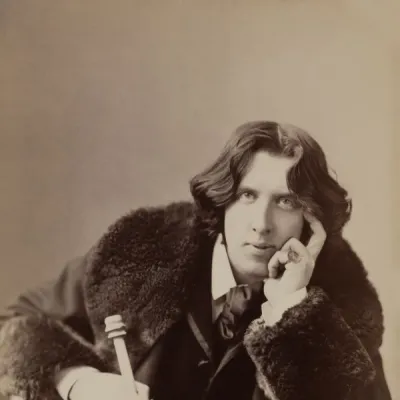
Oscar Wilde
Human Design Chart
Biography
Wilde's parents were Anglo-Irish intellectuals in Dublin. In his youth, Wilde became conversant in French and German. At university, he read Greats; he demonstrated himself to be an exceptional classicist, first at Trinity College Dublin, then at Magdalen College, Oxford. He became associated with the emerging philosophy of aestheticism during this time, led by two of his tutors, Walter Pater and John Ruskin. After university, Wilde moved to London into fashionable cultural and social circles.
Wilde tried his hand at various literary activities: he wrote a play, published a book of poems, lectured in the United States and Canada on "The English Renaissance" in art and interior decoration, and then returned to London where he lectured on his American travels and wrote reviews for various periodicals.
The Human Design of Oscar Wilde: Manifesting Generator 2/4
Manifesting Generator 2/4 — Design at a Glance
Oscar Wilde's design inclined him to act extremely quickly out of an already existing, evenly flowing creative power, skipping intermediate steps in the process. This disposition corresponds to the type of Manifesting Generator: a hybrid form combining Generator and Manifestor traits, where one of the four energy centers that generate action impulses is directly connected to the Throat Center, the place on the chart responsible for speech and visible actions. His Sacral Center, the seat of his life force, was permanently active and constantly available to him - as with every Generator: do not initiate yourself but react to what comes from outside, and only start when this inner power gives a clear yes. The additional connection to the Throat Center allowed him to translate responses into visible actions immediately without taking the usual detours that pure Generators take. This speed brought two characteristic friction points according to the type mechanics: skipping important intermediate steps, forcing a return later on, and the tendency to start several projects simultaneously when multiple impulses were triggered at once. If his inner reaction remained tied to the Sacral yes for such undertakings, deep satisfaction with his own work could arise from this multiplicity; if it was bypassed, frustration followed instead - the typical signal that something is against one's alignment.
Sacral Authority
Oscar Wilde's design showed a decision-making process that did not rely on weighing in the head but rather on a physical reaction to what came from outside. The basis for this was an open emotional center: Because he had no fixed emotional wave defined, his Sacral Center could take over this role - known as sacral authority. This manifested not as thought but as immediate bodily response: gut feeling or a palpable surge of energy reacting to a concrete external stimulus such as a question or offer. When this sacral motor kicked in, vitality and an almost inexhaustible energy followed, coupled with the ability to immerse oneself fully in an activity without needing an external purpose. If his Spleen Center was additionally activated and directly connected to the Sacral Center, a supportive component came into play: immediate access to instinctive physical well-being, enabling particularly quick and spontaneous reactions. For Oscar Wilde this meant: reliable orientation did not lie in weighing arguments but in waiting for the bodily response to what life presented him - an authority based on reaction rather than initiative.
The 2/4 Profile — Hermit / Opportunist
Oscar Wilde's design set a constant movement between two needs: withdrawal into oneself and the desire for company with familiar people. This tension corresponds to Profile 2/4, where a withdrawn basic nature (line 2) meets an orientation towards a close circle of trusted individuals (line 4). For him this meant alternating phases of being alone, in which internal processes calmed down, clarity formed, and knowledge taken from his environment was reflected upon and further developed into personal ideas, with phases seeking the closeness of familiar people. The withdrawn side carried an inclination towards control, focusing on questions of power over finances and their management - without sufficient maturity this could result in projecting outwardly, creating effort and frustration because the other perspective remained unconsidered. The socially oriented side, meanwhile, waited for the right moment to express details and showed two faces: a tendency toward harmony and simplicity on one hand, a penchant for withdrawal and renunciation on the other. If this side was pulled out of its withdrawal too early before the details were organized, questions arose and corrections became necessary. Clear communication about which need was currently relevant formed the central task for this profile.
Split Definition — Defined & Open Centers
Oscar Wilde's Design laid a tendency towards mental clarity, paired with a reliable and hardly shaken way of self-presentation: firm convictions that were strongly advocated without easily wavering under the opinions of others.
The basis for this was a defined Ajna Center, responsible for conceptual thinking. In this configuration, mental processing always ran in the same consistent manner; external influences had little impact on one's own concepts, and they could inspire others to think or even put them under pressure. Linked with this was a defined Throat Center, the center of communication: what was thought or felt found a reliable yet limited path outward—a firm, recognizable voice. Additionally, there was a defined G Center, carrying a stabilized identity and an inner compass: a sure sense of who one was and where they were headed, coupled with the ability to show others new directions.
These stable areas contrasted with open centers. The open Heart Center did not bring consistent willpower but rather the vulnerability to feel pressured to continuously prove one's worth—leading to a tendency to escalate into ever-new promises and efforts to gain recognition. The open Solar Plexus Center absorbed emotions from the environment and amplified them without reliably categorizing them; this typically came with an inclination to avoid confrontation out of fear of angering others. Similarly, the open Head Center felt pressured: the constant search for inspiration and answers to questions that were not actually one's own.
Channel 43-23: Structuring — Channels & Gates
Oscar Wilde's Design set a tendency to influence through the mere existence of his individuality without needing explanations. This disposition matched Channel 1-8, which connected the G Center (Identity, Direction) with the Throat Center (Expression). Gate 1 stood for the courage to openly show a unique, transformative perspective, while Gate 8 represented the contribution of inspiring others through this example to develop their own unmistakable stance. Here, impact was not achieved through arguments but by presenting an individual who became publicly visible.
This was complemented by a powerful driving force: Channel 14-2, which linked the Sacral Center (Life Force) with the G Center. Gate 14 provided material means and competencies, while Gate 2 acted as "driver" setting direction. Together they formed one of the individual's tantric channels, setting new directions not through planning but impulsively when a reaction from the Sacral emerged.
In his thinking, Channel 43-23 was evident, connecting the Ajna Center (Mind) with the Throat Center. Gate 43 delivered sudden, untraceable insights, while Gate 23 translated them into an idiosyncratic and often unfamiliar expression form. Such knowledge required proper timing to be understood rather than dismissed as strange by others.
The picture was further enhanced by Channel 54-32, which connected the Root Center (Drive) with the Spleen Center (Instinct): Gate 54, representing ambition to achieve recognition and a higher position through effort, paired with Gate 32, constantly seeking talents and sustainable continuity out of fear of stagnation. Additional Gates rounded out the picture: Gate 42 for the ability to conclude processes, Gate 62 for an eye for facts and details, and Gate 61 for a drive towards self-explanatory knowledge.
Individual Circuitry — Circuit Signature
Oscar Wilde's design features a double track: a continuous active line for his unique and unmistakable expression—and alongside it, an independent driving force separated energetically from the first one. This separation corresponds to his "Split Definition": two power fields in the chart that are not directly connected but work parallel to each other.
The first power, the circuit of knowledge, connects continuously Wilde's Understanding Center, Expression Center, Identity Center, and Sacral Center, the seat of physical life force. The Channel of Structuring brings personal insights into a form others can follow. The Inspiration Channel gives self-expression an exemplary effect outwardly. The Beat Channel gave his Identity Center the ability to set direction and target the use of sacral power. Together they shaped an expression style that was pulsing, immediate, and moment-bound—creativity born in the present.
Separately from this, the Ego Circuit worked thematically not for the individual but for the collective, supportive realm. Its Channel of Transformation connects the Spleen Center, seat of instinct and perception in the moment, with the Root Center, seat of drive: an instinctive power aimed at proven and lasting things that acts more in spurts than in a steady pulse, standing alone without merging with the first power.
Right Angle Cross of Maya 3
Oscar Wilde’s Design laid out a life course that was oriented towards his own person and self-set goals—a higher theme that framed all of his work without being a single character trait itself. Human Design calls this overarching line an Incarnation Cross: the connection of four Gates from Sun and Earth in Personality and Body design, which together do not dictate how someone acts but rather what they stand for in this life. For Oscar Wilde, this cross was named "The Right Angle Maya 3". The term "right angle" describes precisely this orientation: his overarching life theme was aligned with his own person and the path he chose for himself. For Oscar Wilde, it meant that the fundamental course of his life was primarily oriented towards his own person—a higher alignment that gave overall direction to all of his work.
Saturn Return · Uranus Opposition — Life Cycles
Oscar Wilde's life reached a turning point in 1884 at the age of thirty with his marriage to Constance Lloyd, marking what corresponds to his first Saturn return in his design—the cycle where what had been built up as life plans and designs over previous years became binding and viable rather than merely provisional. Where before options could remain open, this period demanded a commitment: structures that were previously experimental turned into actual responsibility. The marriage fell precisely within this timeframe, symbolizing a phase when commitments could no longer be postponed but had to be entered into.
Eleven years later in 1895 at the age of forty-one, he faced another kind of upheaval: he was sentenced to two years' hard labor for homosexual offenses. This interruption occurred during his Uranus opposition cycle—a period that typically occurs around age forty and signifies an external breaking down of established life structures—often suddenly and without warning. What had previously been hidden or kept under control surfaced in this phase, forcing a confrontation that the individual did not choose. For Wilde's design, this moment marked less of a random setback than a structural turning point where his previous life framework was fundamentally questioned from its roots.
Manifesting Generator · Sacral Authority — Synthesis
Due to Oscar Wilde's design, there was a need to be seen and recognized for his individuality – coupled with the dependence on the right moment rather than personal initiative. As an Manifesting Generator, he reacted to impulses instead of taking action himself; his sacral authority allowed him to make decisions from the gut rather than the head. In his Profile, he alternated between withdrawing into his own clarity and the desire for his favorite people, to whom he communicated what had ripened in silence. The same dynamics shaped his expression: His individual, mutable perspective relied on being recognized and praised, just as his unique knowledge could only come into effect when invited. Recognition by others remained the recurring condition of his unfolding.
At the same time, there was a paradox: A constantly active, expressive side stood opposite an authority that could only react. Throat and Head Centers were firmly defined, speaking and concept formation were always at his disposal, and as a Manifesting Generator he could skip steps and quickly set something in motion. This was countered by the rule of his sacral authority, never to initiate himself but to wait for an opportunity from outside. His unique knowledge also had to be organized and await the right moment – otherwise rejection threatened. So within him lived someone who could speak and act at any time, and someone else who could only express this as a response to life.
4 Defined Channels
Incarnation Cross - Right Angle Cross of Maya 3
Solar Return
The Solar Return shows the moment when the sun returns to its exact birth position - your personal solar year.
Life Cycles
Discover the life cycles with a detailed triple view (birth chart, cycle chart, composite).
Human Design Profile
- Strategy
- To respond - wait for something to respond to
- Authority
- Sacral Authority
- Profile
- 2/4 - Hermit / Opportunist
- Definition
- Split Definition
- Incarnation Cross
- Right Angle Cross of Maya 3
- Date of Birth
- 16.10.1854 03:00
- Place of Birth
- Dublin, Ireland
Frequently Asked Questions
What was Oscar Wilde's Human Design type?
What profile did Oscar Wilde have?
What authority did Oscar Wilde have?
What incarnation cross did Oscar Wilde carry?
When was Oscar Wilde born?
Discover your own Human Design
Are you also a Manifesting Generator? Find out in a personal reading how to unfold your multi-talents and direct your energy wisely.
More Personalities
Back to overviewAlain-Fournier

Aldair
Alizée

Angeli
Arletty
Artus