
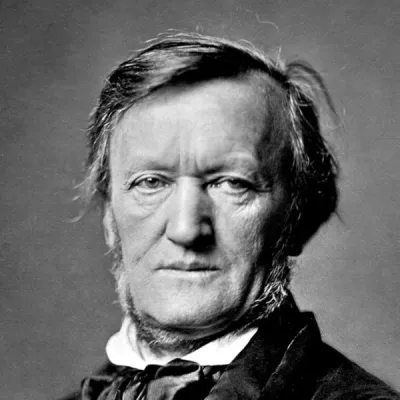
Richard Wagner
Human Design Chart
Biography
The Human Design of Richard Wagner: Manifesting Generator 1/3
Manifesting Generator 1/3 — Design at a Glance
Richard Wagner's design points to a tendency towards hybrid work methods: He had the constant, sacral energy of a Generator but was also capable of rapid implementation due to additional connections in his chart. This configuration combined endurance with the ability to skip steps and quickly bring things into his life.
As an Manifestor Generator, Richard Wagner showed himself as someone who did not initiate but reacted to impulses. The danger lay in this speed leading to skipping important stages or pursuing multiple projects simultaneously without internal consent. Such actions could quickly lead to frustration, the non-self theme of this type. Conversely, deep satisfaction and fulfillment arose when he responded to life and his sacral center gave a clear 'yes'.
Under these conditions, it was even beneficial for Richard Wagner to work on various tasks at once. The advice to finish one thing before starting another did not suit his nature. Instead, he gained creative power from variety and a 'play mode'. As long as strategy and inner authority were 'on board', his potential restlessness transformed into productive dynamics. Constantly checking whether the projects were still fun was the key to avoiding frustration and effectively using his energy.
Emotional Authority
Richard Wagner's design points to a tendency towards premature, impulsive judgments that often proved misleading. He showed himself as someone who could not make decisions in the first emotional impulse but needed time to gain clarity. This resulted from his emotional authority: With his emotional center defined, he was subject to constant waves of presence and absence in his feelings. The world appeared colored by the current mood; what excited him one moment could turn negative the next. His immediate feeling was only a snapshot, not yet his truth. Quick, spontaneous decisions based on this emotional excitement often had negative consequences.
The mechanics of his inner authority required patience and conscious 'sleeping over' decision options. The longer he waited, the deeper he could understand the situation. Intense feelings subsided with time, an emotional distance emerged, and calmness set in. Only then, after the process was complete, true clarity arose. This necessity for cycle-distance served to distinguish momentary snapshots from lasting insight. Richard Wagner therefore had to take his time and ask questions until the emotional wave had passed. This was especially important for long-term decisions with significant influence on his life course. Only through this waiting could he avoid that transient moods determined his direction.
The 1/3 Profile — Investigator / Martyr
Richard Wagner's design set a basic stance as an Explorer-Experimenter. His life unfolded in the tension field between deep theoretical research drive and impulsive action through trial and error. As someone with Profile 1/3, he showed himself in constant balance between the need for complete preparation and the natural urge to simply do.
Line 1 conveyed a tendency towards 'superficiality' as a survival strategy. This did not mean a lack of depth but served the ability to perceive peripherally and act in the here and now. Simultaneously, Line 3 demanded authenticity through adaptability established. Failure was not seen as personal failure but as an essential learning process.
For Richard Wagner, life was a process of learning through practical testing. His inner conflict arose when the theoretical drive took control and triggered fear of implementation because he felt he did not know enough yet. But his Line 3 wanted to try out. Therefore, self-earned and tested insights were his central theme. When he judged something as right or good, he had previously examined it intellectually and empirically on heart and soul. His judgment thus rested on double validation: theoretical knowledge and practical experience. This combination of scientist and adventurer shaped the way he perceived and designed the world.
Split Definition — Defined & Open Centers
Richard Wagner's Design established a constant energy foundation: defined G-, Sacral-, Solar Plexus-, and Root Centers created a reliable identity, generative power through reaction rather than initiation, emotional authority by waiting for the wave to pass, and persistent existential pressure. This dictated his operational strategy: waiting on life, waiting for emotional clarity, and trusting in inner direction.
The defined G-Center gave him a firm sense of self-identity and purpose in life's direction. The Sacral Center generated daily vital energy that was released through proper reactions to questions; initiation interrupted this flow. His emotional authority lay in the Solar Plexus: truth revealed itself only after experiencing the full wave of emotions, not in impulsive moments. The defined Root Center provided constant pressure to preserve the life impulse.
In contrast, Head-, Ajna-, Heart-, and Spleen Centers were open. These centers reflected external inspiration, concepts, willpower, and health signals without possessing them as personal truth. Richard Wagner tended to be influenced by mental noise or ego pressure since he lacked a consistent inner source for mental inspiration (Head/Ajna) or willpower (Heart). The open Spleen Center made him vulnerable to spontaneous survival fears and the absorption of foreign well-being vibrations. Deconditioning from these external influences was essential to not overshadow his defined internal structure.
Channels & Gates
Richard Wagner's design inclined towards immediate, vital expressive strength, driven by the Channel of Charisma 34-20. This connection between Sacral and Throat Centers transformed raw physiological energy into direct impact; the urge to manifest reacted directly to external stimuli, creating an impressive, often insatiable activity. However, this individual power was in tension with the need for collective recognition as demanded by the Channel of the Alpha Animal 7-31. This channel linked the G Center with the Throat Center and defined logical leadership not as sole rule but as service to the community. Wagner had to gain trust and be invited by the majority to effectively play his role of Self (Gate 7); without this invitation, his leadership qualification remained unused.
The emotional foundation of this interplay was formed by the Channel of Synthesis 19-49 in his design. It connected the Root Center with the Solar Plexus and created a deep dependence on tribal connection and loyalty. Here it was about who belonged to "we"; pressure for cohesion (Gate 19) met strict principles of acceptance or rejection (Gate 49). This emotional frequency determined whether Wagner's contributions were felt as supportive to the tribe or rejected.
Additional nuances were provided by prioritized gates: Gate 55 in the Solar Plexus caused extreme mood swings and emotional awareness, while Gate 59 in the Sacral Center pursued a genetic strategy of attachment without personal preference. Gate 13 promoted reflection within the context of time and collective memory, Gate 27 brought caring warmth for the tribe. Gate 8 urged individual contribution and identity expression, Gate 41 propelled evolutionary changes through crises forward. Gate 56 enabled the figurative narration of mental processes, while gates like 14 (Power Handling), 22 (Social Openness), and 5 (Rhythm) added further layers of direction, calmness, and energetic structure.
Circuit Signature
Richard Wagner's Design created a tension between individual power in the present and collective resource building. As a Shared Definition, he consisted of two non-directly connected energetic blocks: One block linked Identity, Throat, and Sacral Centers; the other Solar Plexus and Root Centers. This separation created parallel forces without a common flow between the groups.
In the first block, the Understanding Circuit through the Alpha Animal (Channel 31-7) connected Identity and Throat Centers, promoting the transmission of logical, emotionless insights for future-oriented improvements. Parallel to this, the Integration Channel Charisma (20-34) between Sacral and Throat Centers ensured individual survival through exerting power in the present moment. Both channels met at the Throat Center, allowing for an immediate manifestation of individual intuition and rational structure.
The second block included the Ego Circuit via Synthesis (Channel 49-19). This connected Solar Plexus and Root Centers and served cooperation as well as the joint creation of resources. Since the Sacral Center was missing here, this area relied on rest periods to generate material wellbeing. While the first block emphasized individual action capability in the here and now, the second focused on traditional support and mutual giving and taking within the tribe. Richard Wagner thus showed a duality: on one hand, the ability to directly implement personal visions; on the other hand, the need for cooperative resource security in community.
Right Angle Cross of the Sleeping Phoenix 2
Richard Wagner's design established a specific inner dynamic anchored in the 'Right Phoenix Sleeping Cross 2'. This configuration did not describe an external action line but rather a deep internal process of transformation and renewal. It was shown as a constant breaking down of old structures to make way for new ones – a cycle of dying and rebirth on a personal level.
In Human Design, this cross represents the ability to rise from the ashes of one's past. It did not speak of external success or visible power but rather an inner alchemy. Richard Wagner carried this energy as a latent force that became particularly evident in moments of great personal crisis or upheaval. The mechanics of his design challenged him to let go of old identities and beliefs, so he could redefine himself. It was a path of inner purification where the old had to die for the new to be born.
This configuration shaped his life stance through a deep connection with processes of change. It conveyed not static security but dynamic unrest that pushed him to continuously renew himself. Richard Wagner's design thus contained potential for profound personal evolution, always arising from the dissolution of the known. It was an inner compass guiding him towards growth and transformation regardless of external circumstances or expectations.
Saturn Return · Uranus Opposition · Chiron Return · 2nd Saturn Return — Life Cycles
Richard Wagner's design was characterized by a strong dependence on his interpersonal bonds and artistic expression being marked by significant astrological cycles. These phases acted as deep turning points in his life. In 1841, at age 28, the first Saturn Return occurred. This cycle often condensed years of groundwork into tangible results; Wagner then strongly supported the attacked Heinrich Heine, which shaped his relationship dynamics.
In 1853, at age 40, the Uranus Opposition reached its peak. This configuration often promoted sudden breaks or new freedom levels in career. Wagner gave concerts with excerpts from his own works in Zurich, which were enthusiastically received – a moment that redefined his artistic positioning.
At age 49 in 1862, the Chiron Return began. This fulfillment cycle marked a phase of bloom and meaning-making for the incarnation cross. During this time, Wagner met Minna in Dresden for the last time. The event signaled the end of one life stage and preparation for the next step of his personal unfolding.
The second Saturn Return followed in 1870 when he was 57 years old. This cycle often stabilized previously gained insights into lasting structures. Wagner married Cosima at the Matthäuskirche in Lucerne. This wedding anchored his relationship on a new, binding level and concluded the arc of previous cyclical developments.
Manifesting Generator · Emotional Authority — Synthesis
Richard Wagner was an Manifesting Generator whose life was marked by a dynamic interaction between the drive for rapid implementation and the necessity of emotional maturation. The defined sacral energy (Sacral Center) provided him with constant driving force, which through connection to the Throat Center (Communication & Manifestation) tended towards immediate expression – skipping steps that constantly forced him to reassess. This pattern was evident in his readiness to take public positions and embark on new paths (Channel of Alpha Animal), followed by phases of reflection and adaptation.
A central paradox lay in Wagner's tendency both to develop logical structures (Understanding Circuit) and pursue deep emotional experiences (Emotional Authority). The Profile of the Researcher/Experimentator reinforced this trait, as he was always eager to theoretically penetrate ideas and practically test them. Cycles confirm this: relationships and career decisions were often made during phases of intense activity (Uranus Opposition), followed by times of grappling with consequences (Saturn Return, Chiron Return), indicating a life style marked by constant movement between action and reflection.
3 Defined Channels
Incarnation Cross - Right Angle Cross of the Sleeping Phoenix 2
Solar Return
The Solar Return shows the moment when the sun returns to its exact birth position - your personal solar year.
Life Cycles
Discover the life cycles with a detailed triple view (birth chart, cycle chart, composite).
Human Design Profile
- Strategy
- To respond - wait for something to respond to
- Authority
- Emotional Authority
- Profile
- 1/3 - Investigator / Martyr
- Definition
- Split Definition
- Incarnation Cross
- Right Angle Cross of the Sleeping Phoenix 2
- Date of Birth
- 22.05.1813 04:00
- Place of Birth
- Leipzig, Germany
Frequently Asked Questions
What was Richard Wagner's Human Design type?
Which Profile did Richard Wagner have?
What Authority did Richard Wagner possess?
What incarnation cross did Richard Wagner have?
When was Richard Wagner born?
Discover your own Human Design
Are you also a Manifesting Generator? Find out in a personal reading how to unfold your multi-talents and direct your energy wisely.
More Personalities
Back to overviewAaliyah

Aldair

Alexia

Alizée

Angèle

Angeli
