
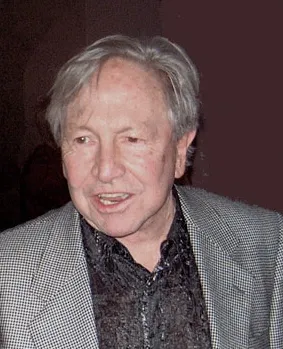
Robert Rauschenberg
Human Design Chart
Biography
Born Milton Rauschenberg and one-quarter Cherokee Indian, he grew up in a small oil industry town on Texas' Gulf Coast. A loner as a child, he thought he would become a preacher, influenced by his very religious mother. Drafted into the Navy in 1943, he was stationed in San Diego, serving as a neuropsychiatric technician. While in San Diego, a trip to Huntington Gardens Library was his first experience of being exposed to art and made him think that perhaps he too could be a painter.
After he completed his tour of duty, he moved to Los Angeles in 1945, and got a job in the Ballerina Bathing Suit Factory. A friend whom he met there encouraged him to go to the Kansas City Art Institute. Later he went to Paris, where he attended the Academie Julian on the GI Bill. In Paris, he met artist Susan Weil, who led him to Black Mountain College in North Carolina, where much of America's mid-century avant-garde art was instigated. While at Black Mountain, he studied under legendary Bauhaus alumnus Josef Albers who taught his students to scavenge for "objets trouves" ("junk" in English) and incorporate them into their art. Rauschenberg loved this and even took the garbage man's job at Black Mountain so he could scavenge for rubbish.
He married Weil in June 1950, and attended Black Mountain off and on from 1948 to 1952. By 1949, he was spending most of his time in New York, taking classes at the Art Students League. In 1951, he was featured in a group show that included many of Manhattan's Abstract Expressionists. He and Susan and their son, Christopher, then moved back to Black Mountain.
By 1952, he was divorced, brought on by his friendship with a young artist from Virginia, Cy Twombly. The friendship left little time for his family, with at least one published report stating that his sexuality was changing at this time.
Robert Rauschenberg — Generator with Profile 3/5
Generator 3/5 — Design at a Glance
Robert Rauschenberg revealed himself as someone with immense inner endurance who primarily released his strength through reactions to external impulses. As a Generator, he had an enormous amount of sacral energy that made him an extremely strong and enduring 'workhorse' – provided he found tasks for which he felt intrinsic motivation. His design dictated that this energy would only become effective in response to signals from life rather than through self-initiative. The motto was clear: not initiate but react.
When Robert Rauschenberg responded to such a signal and his gut feeling sent him a clear 'yes', nothing could stop him. In these moments of resonance, life rewarded him with a deep sense of fulfillment and satisfaction. However, if he stood in opposition to this mechanism – for example by doing things that did not resonate internally or when someone prevented him from pursuing his heart project while he was still full of energy – frustration quickly set in, threatening a noticeable lack of energy up to burnout. His strategy consisted of acting from the gut and only becoming active if the internal response was clearly positive. Thus, he transformed his immense endurance into sustainable creative power rather than wasting it through false initiatives.
Sacral Authority
Robert Rauschenberg showed himself as someone whose decision-making relied on direct physical resonance. His design placed sacral authority, meaning that he did not act based on mental analysis but responded to internal signals. This mechanism manifested in the form of gut feelings or sudden bursts of energy whenever an external stimulus hit him. His reaction often appeared as spontaneous grunts, hums, or a loud 'Mhm', confirming whether something was engaging his energy.
Since his emotional center was open, he could not overlay these decisions with emotional waves; sacral authority remained clear and unadulterated. When his sacral motor engaged in an activity, he felt vital and possessed seemingly inexhaustible energy. He accomplished his work with great enthusiasm and immersed himself entirely without needing to seek a specific purpose. The joy of the task itself was his motivation.
Furthermore, supportive authority through his active spleen center gave him the ability to react particularly quickly and spontaneously. He had immediate access to his instinctive well-being and reliably followed this physical perception. This combination allowed him to make decisions in the moment based on deep intuitive certainty rather than post hoc rationalization.
The 3/5 Profile — Martyr / Heretic
Robert Rauschenberg matched the profile of an experimenter and hero. His design established a basic attitude: he believed nothing given knowledge but had to test everything himself. This inclination towards experimental appropriation of experience shaped his life path. Only through these practical trials, including associated failures, did he accumulate a fund of insights that he made accessible to others.
The mechanics of this profile connect the line of adventurer with the hero's line. Robert Rauschenberg learned from his own tests and transformed self-acquired knowledge into solutions for other people's problems. This knowledge from direct practice was attractive in his environment; people sought contact with him to benefit from his experiences. This role as an exemplar flattered his nature but also carried the risk of public failure if experiments before the community failed.
Additionally, there was a tendency towards attention-grabbing through storytelling skills. His way of conveying stories or concepts served to highlight unusual and innovative elements. The world projected expectations on him to be stimulating. Parallel to this, there was a need for adaptability. Support from others proved necessary if he wanted to adhere to his own values. Laws or rigid structures sometimes had to be broken to release or change bonds. This process occurred in collective contexts, where mental constraints and irritations were part of the adaptation.
Split Definition — Defined & Open Centers
Robert Rauschenberg revealed himself as someone with a fixed, reliable self-identity and a clear sense of direction. His defined G Center gave him the ability to love others without becoming dependent, along with a deep sense of connection. This inner security shaped his work: He spoke from his personal identity, which was channeled through his defined Throat Center. The throat served as a pivot point that transformed information from the body into communication and action; because it was connected to the G Center, he articulated his truth with ease and honesty, rather than impulsively or excessively speaking.
As a Generator, Rauschenberg had an enormous power source in his defined Sacral Center. This vital energy generated a daily constant supply that, however, could only be correctly available through reacting to external stimuli. His strategy was not to take the first step but to wait until life asked him, then react from the gut with a yes or no answer. This protected him from exhaustion and frustration that arise when mental decisions override the sacral response.
Additionally, his defined Spleen Center – responsible for spontaneous intuition and well-being in the present moment – as well as his defined Root Center, which delivered pressure towards material existence and survival, supported this foundational structure. The Root Center provided the necessary endurance while the Spleen made intuitive judgments.
In contrast, he was open in mental and emotional areas. His open Head and Ajna Centers meant that he did not have a consistent way of processing information; he tended to identify with foreign doubts or inspirations rather than observing them as transient mental activity. Similarly, his open Solar Plexus absorbed the emotions of his environment, making him vulnerable to emotional conditioning if he could not recognize these as non-self. His open Heart Center lacked persistent willpower; he tended to want to prove his worth through promises or competition instead of trusting his inner authority and only taking on commitments that were correct for him.
Channels for intuitive elegance, change and logical leadership.
Robert Rauschenberg showed himself as someone who brought evolutionary change into the world not through deliberate action but by accepting limitation and waiting for the right impulse. This attitude stemmed from Channel 60-3, which connected the Root Center with the Sacral Center. This channel generated a pulsing energy between chaos and order; in the pauses between impulses, he often felt melancholy or inner tension. His design required patience: He had to endure the confusion of starting anew until a new mutation could set through him rather than rationalizing it.
Parallel to this, he possessed the ability for logical, collective leadership as described by Channel 7-31 of Alpha Animal. This channel connected the G Center with the Throat Center and gave him a voice that inspired trust. He did not seek absolute authority but an influence area where he could act as a recognized leader. His leadership was based on tested patterns and the ability to understand trends; it became effective when others invited him to represent them.
His creative behavior was marked by intuitive insight, carried through Channel 10-57 of Perfect Form. This channel connected the Spleen Center with the G Center and allowed him to move spontaneously and appropriately in the here and now. He did not act out of future fears but let his conduct be guided by deep intuitive impulses, which helped secure his survival in society through a unique, self-referential way of creating.
Additionally, other Gates influenced him: Gate 50 promoted awareness and traditions as protective reflexes; Gate 56 enabled the abstraction of mental processes into pictorial narratives. In his personality, Gates like 5 with its focus on rhythm and habits and 1 with its emphasis on individual creativity played a role. In his design, Gate 41 contributed to evolutionary development through experience, while Gate 29 demanded persistent yes-saying to challenges; gates such as 44 (vigilance), 54 (worldly-spiritual connection) and 39 (provocative analysis) completed his complexity.
Individual Circuitry — Circuit Signature
Robert Rauschenberg's design laid a tendency towards dynamic, mutating energy that connected with strategic focus and intuitive presence. As a person of split definition, his inner self consisted of two parallel, not directly connected power fields: an impulsive drive and a rational-intuitive structure.
The first field, the Knowledge Circuit, in him linked the Sacral to the Root Center through Channel 'Mutation'. This generated a pulsing, acoustic energy that pushed for creating new things and initiating change. It was about expressing a unique identity through deviation from the known.
The second field united Throat, Identity, and Spleen Centers. Here two circuits worked side by side: The Understanding Circuit connected via 'Alpha Animal' Throat with Identity Center, thereby sharing logical, rational insights without emotion – a visually focused look at the future. Parallel to this, the Integration Circuit linked via 'Perfect Form' Identity with Spleen Center. This channeled power from reacting correctly to life through intuitive knowledge into the present moment.
Although both fields were defined, they did not flow into each other; they existed as separate pieces. Robert Rauschenberg lived this duality: on one hand, the raw, mutating creative force of the Sacral-Root stream, and on the other, the precise, strategic processing through the Head-Spleen complex. His energy thus showed itself as a combination of impulsive transformation and clear intuitive strategy without these poles forming a single, cohesive experience.
Right Angle Cross of Laws 3
Robert Rauschenbergs Human-Design trug die Signatur des rechten Kreuzes der Gesetze 3. Diese Konfiguration prägte eine Grundhaltung, in der das Leben nicht als lineare Abfolge, sondern als zyklischer Prozess verstanden wurde. Es ging dabei um die Annahme von Verantwortung für eigene Entscheidungen und deren Konsequenzen innerhalb eines größeren, oft gesellschaftlichen oder kulturellen Rahmens.
Im Human-Design markiert dieses Kreuz spezifische energetische Muster, die mit Themen der Integrität, des Gesetzes und der sozialen Ordnung verbunden sind. Der Aspekt „Gesetze 3“ deutet auf eine Dynamik hin, bei der innere Werte mit äußeren Strukturen in Einklang gebracht werden müssen. Robert Rauschenberg zeigte sich durch diese Mechanik als jemand, der sich mit Fragen auseinandersetzte, wie individuelle Freiheit mit kollektiven Normen vereinbar ist. Sein Weg war geprägt von der Notwendigkeit, eigene Maßstäbe zu setzen und gleichzeitig die Auswirkungen dieser Setzungen auf das Umfeld zu betrachten. Dies erzeugte eine Spannung zwischen persönlichem Ausdruck und gesellschaftlicher Einordnung, die sein Handeln maßgeblich beeinflusste. Die Energie dieses Kreuzes forderte eine ständige Prüfung dessen, was als richtig oder falsch definiert wird, nicht aus dogmatischer Starrheit, sondern aus dem Bedürfnis heraus, authentisch zu leben und dabei Verantwortung für die eigenen Taten zu übernehmen. Diese Haltung prägte seine gesamte Lebensführung und sein Schaffen, ohne dass er sich dabei an starre Regeln binden musste. Stattdessen suchte er nach einer persönlichen Ethik, die im Fluss der Zeit bestand.
Saturn Return · Uranus Opposition · Chiron Return · 2nd Saturn Return — Life Cycles
Robert Rauschenbergs Human-Design zeigte eine Tendenz zur zyklischen Rückbesinnung und strukturellen Verdichtung. Der erste Saturn-Return um das 27. Lebensjahr markierte oft den Übergang von der Experimentierphase zur festen Formgebung; 1952 ließ er sich von Susan Weil scheiden, ein Schritt, der diese innere Neuausrichtung nach außen trug.
Später, im Alter von 37 Jahren (1962), traf die Uranus-Opposition auf sein Design. Dieser Aspekt fordert oft radikale Innovationen oder den Bruch mit etablierten Mustern. Rauschenberg reagierte darauf durch die Entdeckung und Anwendung der Siebdrucktechnik, was seine künstlerische Praxis technisch fundamental erweiterte.
Der Chiron-Return um das 49. bis 51. Lebensjahr ist ein Erfüllungszyklus, in dem sich das Inkarnationskreuz entfaltet und Sinn erfahrbar wird – nicht als Heilung, sondern als Blüte des eigenen Zwecks. 1971, mit 46 Jahren (kurz vor diesem Höhepunkt), entstand das Werk „Mud-Muse“, ein Ausdruck dieser vertieften Selbstentfaltung und der zunehmenden Klarheit seines kreativen Kerns.
Der zweite Saturn-Return um das 58. Lebensjahr bringt oft eine Synthese früherer Erfahrungen. 1983 besann sich Rauschenberg auf Techniken, die er zwei Jahrzehnte zuvor angewendet hatte. Diese Rückkehr zu bewährten Methoden unterstreicht die zyklische Natur seines Designs: Innovation und Tradition wechseln sich ab, wobei frühere Errungenschaften später als fundierte Basis für neue Werke dienen.
Generator · Sacral Authority — Synthesis
Robert Rauschenberg war ein Generator, dessen Leben von einem unaufhaltsamen Fluss sakraler Energie geprägt war. Diese Kraft, verbunden mit dem Profil eines Experimentierers und Helden (3/5), trieb ihn zu stetiger Erforschung und zum Ausprobieren neuer Wege. Die Fähigkeit, durch praktische Erfahrung Wissen anzusammeln und dieses weiterzugeben, schuf eine natürliche Anziehungskraft auf andere – er war ein Katalysator für Veränderung, der sich in den Zyklen des Uranus und Chiron immer wieder neu erfand und etablierte Techniken erneut aufgriff. Der Kanal der Mutation (3-60) verstärkte die Tendenz, Konventionen zu hinterfragen und durch kreative Prozesse evolutionären Wandel anzustoßen, wobei das Akzeptieren von Begrenzungen ein wesentlicher Bestandteil des Schaffens war.
Gleichzeitig lebte Robert Rauschenberg in einem Spannungsfeld zwischen dem Drang zur ständigen Innovation und der Notwendigkeit, die eigene Energie auf sinnvolle Weise einzusetzen. Die sakrale Autorität forderte ihn heraus, auf innere Impulse zu achten und sich nicht in Tätigkeiten zu verlieren, die seine Lebenskraft raubten – eine Herausforderung angesichts des experimentellen Profils, das zum Ausprobieren einlud. Dieses Wechselspiel zwischen dem pulsierenden Wunsch nach Neuem (Wissens-Schaltkreis) und der Notwendigkeit, Begrenzungen anzuerkennen, prägte seinen Weg und führte zu Werken, die sowohl von Melancholie als auch von kreativer Energie durchdrungen waren.
3 Defined Channels
Incarnation Cross - Right Angle Cross of Laws 3
Solar Return
The Solar Return shows the moment when the sun returns to its exact birth position - your personal solar year.
Life Cycles
Discover the life cycles with a detailed triple view (birth chart, cycle chart, composite).
Human Design Profile
- Type
- Generator
- Strategy
- To respond - wait for something to respond to
- Authority
- Sacral Authority
- Profile
- 3/5 - Martyr / Heretic
- Definition
- Split Definition
- Incarnation Cross
- Right Angle Cross of Laws 3
- Date of Birth
- 22.10.1925 11:30
- Place of Birth
- Port Arthur, TX, United States
Frequently Asked Questions
What was Robert Rauschenberg's Human Design type?
Which Profile did Robert Rauschenberg have in Human Design?
What Authority guided Robert Rauschenberg?
What incarnation cross did Robert Rauschenberg have?
When was Robert Rauschenberg born?
Discover your own Human Design
Are you also a Generator? Find out in a personal reading how to use your sacral energy correctly and discover deep satisfaction.
More Personalities
Back to overviewAaliyah

Alexia

Angèle

Anne-Marie

Arcángel

Arno
