
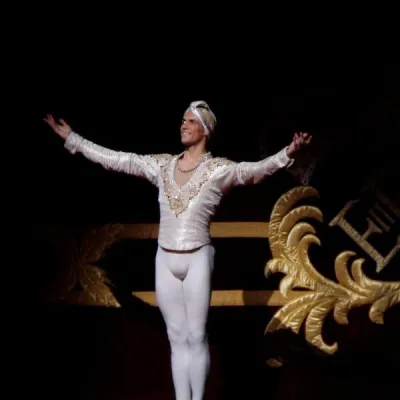
Roberto Bolle
Human Design Chart
Biography
What does Manifesting Generator 2/4 mean for Roberto Bolle?
Manifesting Generator 2/4 — Design at a Glance
Roberto Bolle's design inclined towards achieving rapid results paired with the ability to skip conventional intermediate steps. As a Manifesting Generator, he combined the constant sacral energy of a Generator with the direct projection of a Manifestor. This hybrid configuration allowed him to quickly attract things into his life but also carried the risk of overlooking important stages and thus experiencing frustration – his specific non-self theme.
His high speed also promoted a tendency towards multitasking: He responded to numerous impulses and started several projects simultaneously. Without inner consent, this creative enthusiasm quickly turned into exhaustion. Therefore, the strategy was not in initiating but reacting to life. Only when his sacral center continuously agreed – signaling a clear “yes” – could he effectively utilize his energy.
With proper application of this reactive tactic, Roberto Bolle reached deep satisfaction. In this state, parallel working was no obstacle but rather a source of his strength. He entered into a „Play Mode“, where variety and fun were in the foreground. The pressure to complete one thing before starting another worked counterproductively. His design showed: Speed was only beneficial when guided by continuous inner confirmation, thereby avoiding frustration and enabling sustainable satisfaction in creation.
Sacral Authority
Roberto Bolle displayed a decision-making structure based on Sacral Authority. His design suggested that he did not progress through initiated action or intellectual analysis but rather by waiting for internal resonance as a reaction to external stimuli. This mechanism is specific to the Generator type, where strategy and inner authority are identical: Responding instead of initiating simplifies the process significantly.
Sacral Authority manifested in Roberto Bolle through physical signals – a „gut feeling“, a grunt or a noticeable surge of energy. These reactions only occurred when the Emotional Center was open and thus did not overlay clear physical responses with disruptive waves. When his sacral motor kicked in, he felt vital and alive. This state of inexhaustible energy allowed him to accomplish tasks with great enthusiasm.
This process was free from purposefulness; joy and satisfaction in doing were the true indicators for the right path. The qualitative experience of this vitality differed distinctly from mere energy or effort. Roberto Bolle's design foresaw that he fully immersed himself precisely during these moments of resonant response, filling his work with a natural inner confirmation serving as a reliable compass.
The 2/4 Profile — Hermit / Opportunist
Roberto Bolle's design inclined towards a constant alternation between deep withdrawal and active community engagement. He was someone who regulated his energy through this polarity: Phases of intense introspection alternated with the desire to spend time with selected individuals. This configuration of Profile 2/4, often referred to as „Natural Talent / Networker“, precisely describes this tension between Line 2 (the Hermit) and Line 4 (the Community).
Therefore, it was structurally necessary for Roberto Bolle to create a safe environment in which he could communicate clearly: When he sought company and when he needed solitude. In his „Me-Time“ he immersed himself into internal processes to calm down and gain clarity. Only after this need for alone time was satisfied did he emerge from his “cave” to tend to his network.
This mechanism allowed him to reflect, evaluate, and develop new ideas on the knowledge of his network in solitude. Line 2 projects discernment outward while Line 4 requires focus to stay healthy. Roberto Bolle's design utilized this dynamic: The withdrawal served not isolation but preparation for conscious exchange. By clearly signaling his needs – „Now company“ versus „Please do not disturb“ – he could constructively use the polarity between shyness and projection as well as receptivity and focus, rather than being overwhelmed by it.
Single Definition — Defined & Open Centers
Roberto Bolle revealed himself through a massive, constant vital energy that is only correctly activated by reacting to external impulses. His design was characterized by four defined centers: Sacral (Motor), Spleen (Instinct), Root (Pressure) and Throat (Expression). This configuration allowed for reliable, direct communication and manifestation that always emerged from these inner sources.
The mechanics of the Generator lie in waiting for the impulse and the subsequent reaction. The strength of Roberto Bolle's lay in the constancy of his sacral energy when responding correctly as well as the integrity of his Spleen intuition at the moment. Through his defined Throat Center, he could express his messages clearly and authentically without being distracted by mental fixation. His open Head, Ajna, G, Heart, and Solar Plexus Centers did not indicate deficits but situational openness. He was free from constant willpower or emotional identification, which gave him flexibility to reflect environmental energies without binding himself to them. The avoidance of initiation through the Heart or Head Center served to preserve his energy and prevent frustration. Thus, he could express his truth with ease and honesty while open centers allowed him to act as a mirror for others without personalizing their pressure or emotions.
Channels for powerful action, focus and sharp analysis.
Roberto Bolle's design tended towards absolute focus paired with a calm inner pressure to hold still. This configuration shows someone who consciously quiets the physical body and external senses to channel energy precisely – similar to a yoga pose.
This stance is determined by the Channel of Concentration 52-9, connecting Gate of Non-action (52) with Gate of Focusing (9). The result is a format-energy driving logic and step-by-step analysis. It forces one to evaluate details and perfect patterns through concentrated attention. Without worthy focus, this energy can lead to restlessness; with it, deep precision arises.
Additionally, the Channel of Judgment 58-18 acts. It links aliveness (Gate 58) with correcting (Gate 18). This generates an insatiable drive to question and improve patterns to establish the 'better' in the collective. It is a watchtower judging what is healthy or correct, thus nurturing the art of mastery.
In the background stand further Gates: Gate 17 brings logical teaching and succession, while Gate 53 represents a desire for freedom and new cycles. Gate 38 sets boundaries to defend individual integrity, and Gate 54 connects worldly success with mystical insight. This combination underscores the necessity to dedicate oneself only to activities that find deep resonance to effectively utilize the intensive energy of these channels.
Collective Circuitry — Circuit Signature
Roberto Bolle showed a basic stance combining rational structuring with intuitive survival strength. His design suggested logically improving things while securing his own survival through reacting to life. This combination stems from his Simple Definition, where all defined centers – Sacral, Root, Spleen and Throat – formed one continuous energetic flow.
This flow manifested concretely in the Understanding Circuit. Here, channels Concentration (Gates 9-52) and Judgment (Gates 18-58) connected the Sacral, Root, and Spleen Centers. This connection fostered an 'emotionless ratio', sharing logical insights to strategically shape the future. The energy was focused on visual clarity and structured improvement, free from conditioned emotions.
Parallelly, the Integration Circuit worked. Channel Charisma (Gates 20-34) connected the Throat with the Sacral Center. This allowed Roberto Bolle to draw strength from reacting to life and express it in the present through intuitive knowledge and correct behavior. It was about highest individuality and acoustic presence.
Since both circuits shared the same group via the common Sacral Center, they did not work isolated but as an integrated system. The rational future shaping of the Understanding Circuit flowed directly into the immediate, charismatic implementation of Integration. Thus, a dynamic emerged where strategic thinking was immediately translated into effective, life-preserving action in the here and now.
Right Angle Cross of Service 1
Roberto Bolle's Human Design shows a tendency towards a deep, almost fateful dedication to the common good. His inner compass did not point towards personal glory or isolated success but rather toward how he could best serve a greater whole. This attitude shapes his life work as a contribution that goes beyond the individual and enriches communities.
This pattern is described in Human Design as the Right Cross of Service, marking a specific spiritual orientation where identity and purpose are inseparable from the act of giving. Those who carry this cross find their true validation not in the accumulation of goods or status but in working for others. The focus lies on supporting collective goals and promoting the well-being of all involved.
For Roberto Bolle, this means that his drive was always relational: he sought ways to use his skills so they would provide a tangible benefit to the community. It's about an ethical stance where egoism is set aside in favor of a serving role. This configuration underscores that his greatest success lay in building bridges and bringing resources where they were most urgently needed. His design thus shows a clear path: meaning arises through selfless service for the good of many.
Saturn Return · Uranus Opposition · Chiron Return — Life Cycles
Roberto Bolle's life journey was marked by clear cycles of structuring and transformation. His Human Design points to a tendency to confront deep inner shifts at certain age phases, not as disruptions but as necessary steps toward unfolding his purpose.
The first Saturn Return marked a decisive point of condensation. During this phase, years of groundwork and decisions were tested for their viability. It was about building a stable foundation that allowed him to focus his energy rather than scattering it in unclear directions. This cycle fostered an attitude of responsibility and perseverance toward self-chosen paths.
Simultaneously, the Uranus Opposition emerged as a phase of liberation and sudden change. It often brought unexpected transformations that dissolved old structures to make way for new developments. For Roberto Bolle, this meant that stability was not achieved through rigidity but by adapting flexibly to new circumstances and absorbing impulses from the environment.
The Chiron Return finally opened up space for the fulfillment phase. In this cycle, typically between ages 49 and 51, one's incarnation cross unfolds increasingly in life. If Roberto Bolle had lived according to his strategy and authority before, he experienced meaning and purpose during this time. It was not a process of healing old wounds but a blooming period where the deepest identity came into its own as a coherent whole. These cycles together formed a path from structuring through transformation toward full realization.
Manifesting Generator · Sacral Authority — Synthesis
A central red thread runs through his design: the dynamic balance between the impulse to tackle things quickly and the need to wait for sacral reactions. The combination of manifesting generator type and defined centers for communication, sacrality, and roots points to a person who naturally possesses energy and wants to carry it outward (sacral, throat), yet through the defined root center feels a constant urge to move forward. This inner motor is used most effectively when oriented toward the reaction of the sacral center, which requires continuous adaptation and focus (Channel 52-9). The openness in centers for emotions, identity, and consciousness points to high sensitivity to the environment, which can be inspiring but also requires careful weighing of one's own needs.
A central paradox lies in the interplay between spontaneity and the need for inner clarity. The ability to act swiftly (manifesting generator) contrasts with the need for feedback through sacral authority and the necessity of withdrawal phases (Line 2) to reflect on internal processes. This tension between a desire for activity and a need for rest shapes the design and requires conscious communication of one's boundaries (Profile 2/4) to lead a fulfilling life.
3 Defined Channels
Incarnation Cross - Right Angle Cross of Service 1
Solar Return
The Solar Return shows the moment when the sun returns to its exact birth position - your personal solar year.
Life Cycles
Discover the life cycles with a detailed triple view (birth chart, cycle chart, composite).
Human Design Profile
- Strategy
- To respond - wait for something to respond to
- Authority
- Sacral Authority
- Profile
- 2/4 - Hermit / Opportunist
- Definition
- Single Definition
- Incarnation Cross
- Right Angle Cross of Service 1
- Date of Birth
- 26.03.1975 14:50
- Place of Birth
- Casale Monferrato, Italy
Frequently Asked Questions
What is Roberto Bolle's Human Design type?
What Profile does Roberto Bolle have in Human Design?
Which Authority guides Roberto Bolle's decisions?
What incarnation cross defines the life task of Roberto Bolle?
When was Roberto Bolle born?
Discover your own Human Design
Are you also a Manifesting Generator? Find out in a personal reading how to unfold your multi-talents and direct your energy wisely.
More Personalities
Back to overviewAaliyah

Aldair

Alexia

Alizée

Angèle

Angeli
