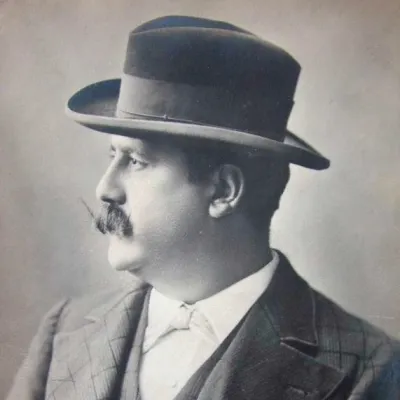
Ruggiero Leoncavallo
Human Design Chart
Biography
Leoncavallo studied at the Naples Conservatory and subsequently supported himself by giving café concerts and piano and singing lessons. His first operas, Chatterton (after Alfred de Vigny) and I Medici (first part of a projected trilogy inspired by the Italian Renaissance), failed to attract attention. He followed them with Pagliacci, composed in the verismo, or realistic, style of Mascagni. Produced in Milan in 1892, it was an immediate success. His La Bohème (1897) suffered from comparison with Giacomo Puccini’s La Bohème. Zazà (1900) was more successful, but Der Roland (1904), commissioned by Wilhelm II to glorify the Hohenzollerns, was a failure. A number of later works achieved passing success. For most of his operas Leoncavallo was his own librettist and showed a distinct literary ability and a flair for theatrical effect.
He died 9 August 1919, Montecatini Terme, near Florence.
Ruggiero Leoncavallo — Reflector with Profile 2/4
Reflector 2/4 — Design at a Glance
Ruggiero Leoncavallo's design shows a tendency towards extreme receptivity; he appeared as someone without constant, personal energy. As a Reflector without defined centers, he acted like a mirror of his surroundings. This configuration meant that he strongly perceived the energy of his environment – not just from other people but also from nature, including seasons and astronomical constellations. His inner self was thus not a fixed core but an open space that filled from the outside.
For Ruggiero Leoncavallo, it was crucial to live in harmony with these natural cycles. When making important decisions, he waited for at least a month, a complete lunar cycle. This was the ideal strategy for his design. By following this rhythm, he naturally found people and environments that suited him. In such moments, he could observe the world freely, without attachment or identification. As a reward, he experienced a feeling of joyful surprise.
If he lived against his design, against this strategy of waiting and mirroring, it likely led to deep, lasting disappointment. This disappointment was directed both at himself and the state of the world. His design did not allow for constant, independent energy projection but demanded a sensitive, cyclical adaptation to what surrounded him.
No Inner Authority
Ruggiero Leoncavallo lacked inner authority, a rare configuration that fundamentally shaped his decision-making. Without an inner voice, he sought guidance through exchanges with other people. As a mental projector, he had no defined centers below the throat. His open centers acted like mirrors, activating latent potentials through energetic interactions with his environment. This allowed him to view and express issues from numerous perspectives. This high resonance helped him find the right environment and conversation partners.
Evaluating these diverse impressions was a complex process requiring time and solitude. Ruggiero Leoncavallo had to withdraw to recognize the red thread and distinguish which information made sense and belonged to him. Through this filtering, he developed his specific intelligence: the ability to extract the essential from a mass of data and structure it meaningfully. This formed his capital for success. A central key for him was always choosing an environment where he felt comfortable. Only there, in a trusting dialogue with the right people, could he deepen his sense of what was right for him.
The 2/4 Profile — Hermit / Opportunist
Ruggiero Leoncavallo's design shows a tendency towards a pendulum rhythm: he oscillated between a deep need for withdrawal and a drive for social connection. This Profile 2/4, the 'Natural Talent/Networker', created an inner tension between Line 2, the Hermit, and Line 4, the Community. Ruggiero Leoncavallo projected a strong, caring presence outward, though he often felt unsure about the actual impact. Line 2 required him to retreat into his 'cave' to run internal processes, find peace, and gain clarity. Only when this need for self-sufficiency was satisfied did he emerge from withdrawal. Then, driven by Line 4, which is strongly socially oriented, he sought exchange with his favorite people. For him, it was crucial to share experiences, as they gained value through collective experience. Friendships were central to his success. His design required him to clearly communicate when he needed company and when he wanted to be undisturbed. During alone time, he reflected the knowledge of his network, evaluated it, and developed brilliant ideas from it. Line 4 externalized his fantasies in a fixed way, while collective processes could influence this fixation. Ruggiero Leoncavallo had to learn to set boundaries to avoid dependence on care or exploiting the strength of others. His life was marked by this constant change, allowing him to process network knowledge in isolation and later bring it into the community.
No Definition — Defined & Open Centers
Ruggiero Leoncavallo's design was characterized by the complete absence of defined centers. He operated without internal, constant energy sources for identity, will, or emotional stability. Instead, his system functioned as a highly sensitive receiver that mirrored the environment.
His open Head and Ajna Centers meant that he did not have his own constant thought processes. He tended to wonder if he had to find answers that were not actually his, and easily got lost in mental pressure to resolve confusion. With his open Heart Center, he lacked a constant willpower; he found himself in a cycle of wanting to prove his worth through promises, only to fail in keeping them and disapprove of himself.
His open G Center defined a flexible but undefined identity. Ruggiero Leoncavallo adapted to the people he interacted with and sought direction and love through initiation by others, rather than generating it himself. His open Solar Plexus absorbed the emotions of his environment, leading him to experience foreign moods as his own instability and to avoid confrontation out of fear of rejection.
Additionally, his open Sacral Center did not provide him with constant vital energy. He was prone to amplify the energy of others and overextend himself without knowing when to stop. His open Spleen Center made him sensitive to well-being but often kept him in unhealthy situations to gain a false sense of security. Finally, his open Root Center absorbed external stress, which could lead to cycles of overactivity and burnout as he tried to release pressure that was not his.
Channels & Gates
Ruggiero Leoncavallo navigated between the urge for risky change and a deep responsibility for his environment. His design inclined him to make decisions in the here and now, with Gate 28 of the Player playing a central role. This gate represented the ability to take risks or consciously refrain from them based on listening in the present. It was about the persistence to recognize one's own sense and to overcome the fear that one's life has no value. Ruggiero Leoncavallo had to learn to take risks according to his type strategy and authority, which could lead to sudden but necessary mutations.
Parallel to this, Gate 41, embodying the evolutionary development of human sense, drove him from one experience to the next and played a central role in processes of change and crisis. This gate helped him maintain a certain coolness despite emotional fluctuations by focusing on specific experiences he had to go through. The combination of the risk-taking Gate 28 and the evolutionary Gate 41 created a dynamic that kept him constantly in motion.
Furthermore, Gates 31 and 27 shaped his way of interaction. Gate 31 represented leading through energetic transmission; Ruggiero Leoncavallo had to transmit his power to others to achieve effect and find identity in the collective. Simultaneously, Gate 27 of care improved all activities through caring warmth. This gate connected self-preservation with species-preservation and was often referred to as magical due to its all-encompassing effect. It ensured that he cared for both his own children and his tribe. This configuration described a person who exercised leadership through care and evolutionary feeling, always seeking the balance between personal risk and collective responsibility.
Circuit Signature
Ruggiero Leoncavallo's design was marked by a complete absence of internal, defined connections. This means that none of his energetic centers were connected to each other through active channels. Without these internal bridges, he lacked a continuous, internally generated logical or emotional chain that automatically held his experience together. Instead, his inner space consisted of isolated, non-communicating areas. This configuration, known as 'No Definition', shaped a fundamental attitude of open receptivity. With no fixed internal routines or predetermined energetic flows, Ruggiero Leoncavallo was dependent on receiving energy and impulses from his environment and through interactions with other people. His design showed no inherent, self-sustaining structure that automatically steered decisions or reactions. Rather, he was a mirror of his environment, showing differently depending on the context and the people he encountered. This openness allowed for great adaptability, but also a dependence on external influences to receive action impulses. There was no internal compass that prescribed a fixed path; instead, his experience formed through resonance with the outside world. This structure allowed him to take in various perspectives and energies without filtering them through a rigid internal logic. His design was thus an open field defined through interaction with others, not through an internal, predetermined architecture.
Right Angle Cross of the Unexpected 1
Ruggiero Leoncavallo's Human Design profile suggests a tendency towards unexpected turns that often manifested as surprising turning points in his life. This configuration, known as the Unexpected Right Cross 1, describes a life task characterized by sudden insights or events that were not predictable. These were moments where things developed in ways that exceeded what Ruggiero Leoncavallo himself or others might have expected.
This mechanism means that his path was not always linear but was marked by surprising developments that opened up new perspectives or opportunities. Such unexpected events may have challenged him to remain flexible and embrace what came his way rather than clinging to rigid plans. Experiencing such turning points likely fostered his ability to deal with uncertainty and to benefit from unexpected situations.
Since no specific event is provided in the raw content, the description remains general, but it illustrates how this configuration could have played out in Ruggiero Leoncavallo's life. His life story was thus marked by these surprising moments that compelled him to continuously adapt and find new paths.
Saturn Return · Uranus Opposition · Chiron Return · 2nd Saturn Return — Life Cycles
Ruggiero Leoncavallo's Human Design profile indicates a tendency towards cyclical breakthroughs where inner maturation translated into tangible, public achievements. This structure did not manifest as a linear progression but as a sequence of phases where his creative potential condensed into substantial works.
In 1897, at the age of 40, he experienced the premiere of his opera 'La Bohème' in Venice. This marked a significant early success, typical of the dynamics of a Uranus opposition: a sudden, often unexpected opening that brings years of groundwork into the public eye and clears new paths.
Later, in 1904 at the age of 47, the premiere of 'Der Roland von Berlin' in Berlin followed. This event occurred during the Chiron Return period. In Human Design mechanics, this is not a healing process but a fulfillment cycle where the individual's incarnation cross unfolds. Here, his life purpose became tangible; his career stabilized through the realization of his deepest intentions.
The second Saturn Return around 1912, when he premiered 'Zingari' in London at the age of 55, confirmed this trajectory. This cycle condensed the previously gained insights into another mature result. Leoncavallo thus lived in a pattern where inner developmental steps regularly reflected in external, professional milestones, each building on the previous phase and further solidifying his artistic identity.
Reflector · No Inner Authority — Synthesis
He was a mirror of his environment, a being without firmly anchored inner energies. This openness shaped his life as he intensely absorbed and reflected the energies of nature and the people around him. The need for solitude to gain inner clarity (Line 2) alternated with the desire for community and exchange (Line 4). This rhythmic movement between withdrawal and social interaction created a foundation for the perception and processing of information, which he then expressed in his work. The ability to embrace the energy of the moment allowed him to recognize unexpected turns and opportunities, which manifested in verifiable successes when operas were performed (1897, 1904, 1912).
A central paradox lay in the tension between his lack of inner authority and the need to make decisions, particularly in the creative process (Gate 28). He was dependent on external impulses and the resonance of others to gain clarity, while simultaneously feeling the urge to take risks and find his own path. This dynamic led to a constant struggle with the meaning of life and his role within it, which was evident in his search for evolutionary development and handling crises (Gate 41).
Incarnation Cross - Right Angle Cross of the Unexpected 1
Solar Return
The Solar Return shows the moment when the sun returns to its exact birth position - your personal solar year.
Life Cycles
Discover the life cycles with a detailed triple view (birth chart, cycle chart, composite).
Human Design Profile
- Type
- Reflector
- Strategy
- Wait a lunar cycle (approx. 28 days)
- Authority
- No inner authority - learn more
- Profile
- 2/4 - Hermit / Opportunist
- Definition
- No Definition
- Incarnation Cross
- Right Angle Cross of the Unexpected 1
- Date of Birth
- 23.04.1857 16:00
- Place of Birth
- Napoli, Italy
Frequently Asked Questions
What was Ruggiero Leoncavallo's Human Design type?
What Profile did Ruggiero Leoncavallo have in Human Design?
What Authority did Ruggiero Leoncavallo have?
What incarnation cross did Ruggiero Leoncavallo have?
When was Ruggiero Leoncavallo born?
Discover your own Human Design
Are you also a Reflector? Find out in a personal reading how to find the right environment and understand your unique mirror effect.
More Personalities
Back to overviewAaliyah

Alexia

Alizée

Angèle

Anne-Marie

Arcángel