
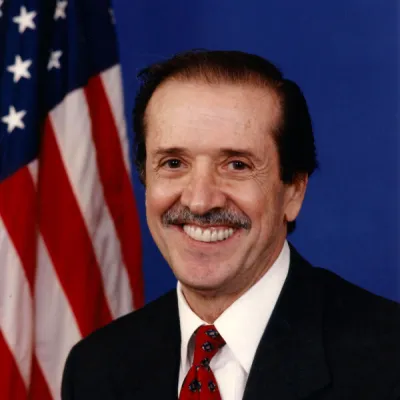
Sonny Bono
Human Design Chart
Biography
Sonny & Cher's first smash hit came out in June 1965, "I Got You, Babe." They were the trend setters of the hippie culture in their cool bell-bottom pants and vests. In early 1968, they produced a film, "Chastity," a financial blunder in which they lost a half million dollars. Not only that, but the following year the IRS hit them with a bill for $200,000 in back taxes. To get their finances in order, they put together a nightclub routine and made their debut as Pat Boone's opening act at the Flamingo in Las Vegas. The public loved their act which featured biting repartee, mostly at Sonny's expense.
When their daughter was born on 4 March 1969, they named her Chastity. When she became a young adult, Sonny had a difficult time with her announcement that she was lesbian.
Their TV series, "The Sonny and Cher Comedy Hour," was a great hit from its debut on 1 August 1971 until it closed with their separation in 1974. Their relationship had begun to unravel with the pressure of touring. In mid-November 1972, Cher told Sonny that she was in love with Bill Hamm, the guitarist in their band. For the sake of their careers, they maintained appearances. By August 1973, Connie Foreman, a cigarette girl at a nightclub, had moved in with Sonny. They were sharing the same roof but with different - and changing - lovers. Their divorce was final on 26 June 1975.
The son of Italian immigrants, a truck driver dad and beautician mom, Bono tried to break into show business after graduating from high school in Inglewood, California in 1952. Working as a delivery man, he ducked into record-company offices between stops to peddle his songs.
Human Design Analysis: Sonny Bono as Generator 4/6
Generator 4/6 — Design at a Glance
Sonny Bono had high sacral energy and was very enduring. His design worked best when he responded to impulses rather than initiating actions himself. This configuration described him as someone with great creative potential, comparable to a strong workhorse that only worked effectively when it had the necessary energy for its task.
The central mechanism of his design lay in the strategy of responding. His energy was most free when he answered signals from life and his sacral center gave a clear „yes“. In these moments, he could act upon them and materialize things. This led to a feeling of deep fulfillment and satisfaction.
At the same time, two pitfalls were anchored in his chart. The first occurred if he persistently did things that didn’t interest him. Here, he wasted his energy, which often resulted in burnout for generators with high potential. The second danger lay in being prevented from working on his heart project when he still had plenty of power to continue.
If Sonny Bono did not live by this principle of responding and instead constantly initiated actions, he would eventually encounter a feeling of persistent frustration as well as a lack of energy. Only in harmony with his design, that is, through reacting to inner impulses from the gut, could nothing stop him. His endurance was thus not an unlimited resource but dependent on whether he responded to the right signal or invested his strength into false initiatives.
Emotional Authority
Sonny Bono showed an internal structure where emotional detachment and time were crucial for clear judgments. Spontaneous impulses proved misleading in his design; true clarity only emerged after initial wave movements had subsided.
This was due to his emotional authority. The defined emotional center carried this authority, independent of other defined centers in the chart. This configuration was subject to a permanent wave of ups and downs in feelings. The world appeared colored by his current mood: a moment full of enthusiasm could quickly turn into a negative outlook.
The feeling at the moment was merely a snapshot, not a final judgment. Quick decisions stemming directly from this current emotion risked negative consequences as they did not yet reflect his deeper truth. Instead, his design required patience and consciously „sleeping on“ decisions. Only after time had passed and intense feelings subsided could he gain emotional distance. This process allowed him to distinguish between transient mood and deeper insight. Long-term life decisions needed this maturation period to establish calmness and clarity. Sonny Bono thus had to take his time, ask multiple times until the emotional wave died down, and go through the decision-making process.
The 4/6 Profile — Opportunist / Role Model
Sonny Bono showed a development line that matured from an experimental networker in early years into a wise authority. His design as Profile 4/6 determined that he was primarily shaped by emotional experiments and the quest for belonging during his first three decades of life. This phase of „burnout“ (Line 4) drove him to engage intensively in relationships and friendships, often motivated by a desire to repeat certain feelings. For him as a projector, this intense emotional involvement carried the risk of collapse if he opened his heart to the wrong people.
With the activation of Line 6, his orientation fundamentally changed. The inner conflict between the heartfelt wish for community and the head’s wish for spiritual distance became central. Sonny Bono had to learn to protect the big heart while simultaneously integrating existential humility from Line 6. This energy addressed wealth and power not as an egoistic goal but as an expression of divine will. He acted only during significant mutations or new developments, which later made him a role model. His authority was based less on individual dominance than on cooperation and the ability to recognize deeper connections. The tension between emotional risk and spiritual insight shaped his entire life path up to expected wisdom in old age.
Split Definition — Defined & Open Centers
Sonny Bono lived with an intense inner pressure that arose from defined Head and Ajna centers. This configuration created a constant mental process of inspiration and concept formation, but lacked direct energy for implementation. Instead of initiating actions himself, he had to wait for others to respond to his questions in order to avoid frustration. His immense vitality came from the defined Sacral center, which served as the motor for his personal expression. This sacral power was only available upon correct reaction; initiatives without prior questioning led to exhaustion and resistance.
As an emotional authority, his defined Solar Plexus required patience to wait out the emotional wave before gaining clarity in decisions. Impulsive actions on waves of emotion often resulted in chaos. Additionally, the defined Root center provided a firm, adrenalized pressure to cope with stress and make material progress.
At the same time, Sonny Bono was strongly dependent on four open centers from his environment. His open Throat center attracted attention when he waited; active efforts to seek recognition led to unpredictable expression and stress. His open G center had no fixed identity or direction but reflected the energy of its surroundings. He found his path through correct places and relationships, not by seeking it himself. The open Heart center lacked consistent willpower; making promises without keeping them undermined his self-esteem. Finally, his open Spleen center was vulnerable to conditioned fears and spontaneous decisions. Impulses from this center were unreliable and often harmful as they relied on absorbed fears rather than true intuition. His design required him to channel the inner pressure through waiting and reacting instead of fighting against environmental sensitivities.
Channels for change, emotional visions and mental synthesis.
Sonny Bono appeared driven by a pulsating urge for evolutionary change, coupled with an insatiable desire for new experiences. His design inclined towards accepting internal tensions and melancholic phases not as obstacles but as necessary groundwork for creative mutations.
This dynamic was significantly shaped by the Channel of Mutation 60-3. It connected the Root center to the Sacral center, generating a powerful yet unpredictable energy. Gate 60 served as a pivot point for evolutionary possibilities while Gate 3 attempted to establish new orders. This resulted in mechanical mood swings: Sonny Bono had to learn patience and trust reactions from his Sacral center rather than filling the silence between impulses with logical explanations. The change happened suddenly, often unexpectedly, like music in pauses.
Parallel to this, the Channel of Recognition 41-30 influenced him. It connected the Root center to the Solar Plexus center, creating an intense desire for experience. Gate 41 initiated longing and fantasy while Gate 30 steered emotional waves. This led to a constant oscillation between restlessness and the need to wait for emotional clarity before embarking on new adventures.
Mentally, Sonny Bono processed these impressions through the Channel of Abstraction 64-47. It linked the Head center with the Ajna center. Gate 64 brought mental confusion and a kaleidoscope of images while Gate 47 sought meaning and stories. His mind sifted experiences continuously until an inspiring perspective or narrative emerged that he could share. This combination created a person who grew in the background, felt emotions deeply, and intellectually searched for significance.
Collective Circuitry — Circuit Signature
Sonny Bono showed a tendency to emotionally process past experiences and share derived meaningfulness with others. His design featured a Shared Definition: two energetically separate groups existed parallelly. The first connected the Sacral with the Root center; the second linked the Head with the Ajna center. This separation meant that intuitive impulses and mental processes did not directly interweave but acted as distinct forces.
In the Knowledge Circuit, Sonny Bono activated the Channel of Mutation (Gates 3-60). This connected his Sacral center to the Root center and promoted deviation from the known along with the expression form of his unique identity. The energy here was pulsating and acoustically marked, supporting innovations.
The Meaning Circuit formed the second independent pole. Here, two channels were active: Abstraction (Gates 64-47) linked the Head center to the Ajna center; Recognition (Gates 30-41) connected the Solar Plexus center with the Root center. Crucial is that these two segments did not merge. Mental abstraction stood separate from emotional processing. The energy in the Meaning Circuit flowed cyclically and visually, often in descending wave movements. It served to reflect on the past, find meaning behind events, and learn these insights collectively. This wave-like dynamic required patience as emotions needed time to run their natural course from start to finish.
Right Angle Cross of Contagion 1
Sonny Bono was characterized by a profound and often unconscious dynamic of emotionally and energetically absorbing his environment. His design indicated a tendency to take on the moods, energies, or even physical states of others and process them internally. This created a strong empathic connection with the world but also always carried the risk of over-identification. The boundary between personal experience and external influence was permeable in his configuration.
This structure corresponds to the right infection cross 1. Here, the constant absorption and processing of foreign energies is not an optional trait but a central life task. Sonny Bono lived in a field that prompted him to connect with others' vibrations to understand or integrate them. This mechanism worked as a continuous background process: he absorbed what was around him and had to digest these impulses. It wasn't a conscious choice, but rather an automatic reaction of his system to the outside world. The ability to be infected – in both positive senses of inspiration and negative sense of burden – shaped how he experienced relationships and situations. He was a mirror for what surrounded him, carrying this weight as part of his inner architecture.
Saturn Return · Uranus Opposition · Chiron Return · 2nd Saturn Return — Life Cycles
Sonny Bono went through a divorce from Cher in 1975 at the age of 40. This event marked the peak of the Uranus opposition in his design. This astronomical cycle triggered deep upheavals and forced the letting go of old structures. Often, such crises occurred suddenly or were triggered by external events. For Sonny Bono, this mechanism was manifested as the end of a central life phase. The opposition acted like a catalyst that dissolved existing bonds and patterns to make way for new configurations. It wasn't a gradual development but a marked breaking point. The pressure of this phase forced him to break away from familiar relationships. This fulfilled his design's function of structural renewal through dissolution. The divorce exemplified the dynamic power of the Uranus cycle: old had to give way so that inner order could reform. Sonny Bono experienced this process as a direct consequence of his astrological constellation at this point in his life.
Generator · Emotional Authority — Synthesis
Sonny Bonos' design reveals a central red thread of dynamic reaction. As a Generator with emotional authority and defined centers for mental inspiration and sacral energy, he was not destined to initiate but rather to react to life – an impulse from the gut filtered through an emotional wave. This reactive capability was strengthened by the connection between Root and Sacral Centers, giving him immense endurance as long as he aligned himself with his inner authority. The channels of the knowledge and meaning-making circuit pointed to a deep drive to process experiences, generate knowledge, and carry this outwards through emotional expressive power – an ongoing cycle of intake, processing, and transmission.
A central paradox in Sonny Bonos' design lies in the tension between individual expression and the need for validation. The open Throat Center and G-Center pointed to a natural ability to adapt and reflect others' energy while also indicating a deep longing for identity and direction. This contradiction manifested in his search for authenticity, while he was simultaneously influenced by external factors – an ongoing navigation between his inner compass and the expectations of his environment.
3 Defined Channels
Incarnation Cross - Right Angle Cross of Contagion 1
Solar Return
The Solar Return shows the moment when the sun returns to its exact birth position - your personal solar year.
Life Cycles
Discover the life cycles with a detailed triple view (birth chart, cycle chart, composite).
Human Design Profile
- Type
- Generator
- Strategy
- To respond - wait for something to respond to
- Authority
- Emotional Authority
- Profile
- 4/6 - Opportunist / Role Model
- Definition
- Split Definition
- Incarnation Cross
- Right Angle Cross of Contagion 1
- Date of Birth
- 16.02.1935 21:21
- Place of Birth
- Detroit, MI, United States
Frequently Asked Questions
What was Sonny Bono's Human Design type?
What profile did Sonny Bono have?
Which authority guided Sonny Bono?
What incarnation cross did Sonny Bono have?
Discover your own Human Design
Are you also a Generator? Find out in a personal reading how to use your sacral energy correctly and discover deep satisfaction.
More Personalities
Back to overviewSissy Spacek

Aaliyah

Alexia

Anémone

Angèle

Ann-Margret
