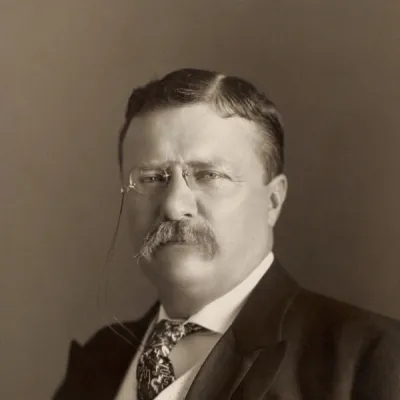
Theodore Roosevelt
Human Design Chart
Biography
A sickly child with debilitating asthma, Roosevelt overcame health problems through his strenuous life. He was homeschooled and began a lifelong naturalist avocation before attending Harvard University. His book The Naval War of 1812 established his reputation as a historian and popular writer. Roosevelt became the leader of the reform faction of Republicans in the New York State Legislature. His first wife Alice Hathaway Lee Roosevelt and mother Martha Bulloch Roosevelt died on the same night, devastating him psychologically. He recuperated by buying and operating a cattle ranch in the Dakotas. Roosevelt served as the assistant secretary of the Navy under McKinley, and in 1898 helped plan the successful naval war against Spain. He resigned to help form and lead the Rough Riders, a unit that fought the Spanish Army in Cuba to great publicity. Returning a war hero, Roosevelt was elected New York's governor in 1898.
The Human Design of Theodore Roosevelt: Manifestor 3/5
Manifestor 3/5 — Design at a Glance
Theodore Roosevelt was as a Manifestor a pioneer and visionary whose design predisposed him to lead the world into a new future. His role resembled that of an emperor in ancient Rome: He had the vision of a great empire, but he did not personally wage the necessary wars and battles; instead, he sent others to conquer foreign lands for him. This vast distance between vision and execution was a central pain point; he was often misunderstood because his thinking frequently outpaced those around him. This inevitably led to polarization: Some loved his grand dreams and followed him, while others hated him precisely because of these overwhelming ambitions. To find the right followers, it was essential for Theodore Roosevelt to inform his environment timely and precisely about his plans. This strategy of informing served to minimize resistance and attract the right supporters. When he adhered to this strategy, he was rewarded with a feeling of inner peace. However, when he lived against his design, he instead felt persistent, deep anger. His life thus became an ongoing struggle to bridge the gap between visionary leadership and acceptance in his environment through clear communication to achieve the state of inner peace that his nature required.
Emotional Authority
Theodore Roosevelt exhibited a decision-making structure that required patience and temporal distance. His design carried emotional authority, meaning that his defined Emotional Center always took precedence over all other internal mechanisms—regardless of which additional centers were active in his graph. This configuration generated a constant wave of emotional ups and downs. Roosevelt saw the world through the filter of his current mood; a topic could inspire him one moment and appear negative the next. Since this immediate feeling was only a fleeting snapshot and not his ultimate truth, spontaneous reactions from emotion often led to unfavorable outcomes.
His strategy involved letting decisions ripen. He needed time for intense feelings to subside before acting. This process of 'sleeping on it' allowed him to gain emotional distance. Only when the waves had subsided did true clarity and calmness set in. The ability to look through this emotional cycle was especially crucial for long-term life decisions. Roosevelt learned to take his time and question his first impulses to ensure that his choice was based on a stable inner truth rather than just a passing emotion.
The 3/5 Profile — Martyr / Heretic
Theodore Roosevelt's design marked him as someone who acquired knowledge not merely by listening but through active, often risky experimentation. As the carrier of Profile 3/5, the experimenter and hero, he initially believed little in preordained truths; Line 3 drove him to take adventures and risks to achieve personal goals. He learned from his own experiences and failures, amassing a rich trove of practical life experience.
This self-earned knowledge he later used to solve problems for others. Line 5, the hero line, projected an expectation onto him: Others saw in him a leader or savior who told stories with cool composure and humorous rebellion and offered solutions. This allure flattered his nature as he enjoyed presenting his experience cache. Yet this dynamic held sharpness: Failure before an audience could be painful for him since the projected role of the perfect leader clashed with the reality of the experimenting adventurer.
Over time, he learned to be more selective in dealing with risks and weigh decisions more rationally, as suggested by the development of Line 3. Although he often lacked external ambition for power, his ability to lead the collective during critical moments called him into this position. His leadership thus did not rest on theoretical claim but on the credibility of one who had walked the path of failure and learning.
Single Definition — Defined & Open Centers
Theodore Roosevelt possessed a powerful, self-determined foundation from his defined Heart, Solar Plexus, and Throat centers. His willpower was constant, allowing him to actively shape his life and reliably fulfill promises. This energy flowed through his emotional authority in the Solar Plexus; he learned to trust the waves of his feelings and make decisions only after waiting for emotional clarity. His communication was reliable as it sprang directly from these inner sources – whether as an expression of will or feeling.
This stable core stood in contrast to his open centers: Head, Ajna, G, Sacral, Spleen, and Root were undefined. Here there was no constant mental clarity or generative energy; instead, he acted as a mirror of his environment. In the Head and Ajna centers, he tended to absorb inspirations from the surroundings rather than pursuing his own constant questions, making him flexible for new ideas but vulnerable to mental overload. His open G center meant a lack of firm identity; he sought his direction through interaction with others and places, instead of declaring it internally.
Similarly, his open Sacral center meant that he did not have constant vital energy but rather took it from the environment and amplified it, warning him of exhaustion if he ignored boundaries. The open Spleen center made him sensitive to health signals in his surroundings rather than relying on spontaneous intuition, while the open Root center absorbed external stress. This openness required him not to fall into conditioning by foreign energies or mental pressures but to rely on his defined inner authority from will and emotion.
Channels for emotional transformation and communal connection.
Theodore Roosevelt showed a dialectic between restless individual experience and the need for stable community structures. Channel of Transience 36-35 drove him through emotional energy that resisted logical caution. Gate 36 (Crisis) and Gate 35 (Change) sought novelty, often by provoking crises to force movement. This promoted experiential learning rather than cautious planning; he learned through the full living of moments, which gave wisdom for future generations.
At the same time, Channel of Community 37-40 connected emotion with willpower in the context of relationships. Gate 37 (Friendship) sought recognition and belonging, while Gate 40 (Solitude) was ready to work but needed reward and breaks. This channel emphasized the necessity of correct agreements: a “good deal” had to be carefully considered to benefit all sides. He built bridges between individuals where loyalty and mutual support were central, not hierarchy or material gain.
The combination of these channels shaped his behavior: The search for new experiences (36-35) stood in tension with the necessity of emotionally clear contracts within a group (37-40). While transience could make him unstable if expectations were unmet, community required patience and direct personal invitation. His energy was directed at sharing experiences while securing stable bonds through fair agreements, which helped him navigate both individual adventures and collective cohesion.
Collective Circuitry — Circuit Signature
Theodore Roosevelt revealed himself through a close connection between emotional reflection and cooperative support. His design linked Heart, Solar Plexus, and Throat centers in one continuous flow. This configuration allowed him not only to process emotional waves from the past individually but also to directly implement them into shared insights and mutual aid for the community.
The Meaning-Finding Circuit worked through Channel 35-36 (Transience) between Solar Plexus and Throat center. This created a cyclical dynamic: emotions and experiences from the past were lived in waves, culminating in verbal expression forms to learn with others.
At the same time, the Ego Circuit over Channel 37-40 (Community) shaped the relationship between Heart and Solar Plexus centers. Here it was about traditional structures of giving and taking as well as mutual support within the collective. Since there was no connection to the Sacral center, pauses for regenerating resources were necessary for the tribe.
Through this simple definition, these two circuits did not form separate islands but an integrated power. Theodore Roosevelt used his emotional past as a foundation to build cooperative resources in the here and now. The wave movement of feelings flowed directly into timeless traditions of social exchange, making personal experience a strengthener of community.
Right Angle Cross of the Unexpected 3
Theodore Roosevelt's design carried the signature of the right cross of the Unexpected 3. This configuration shaped a fundamental attitude where the unforeseen was not seen as an interruption but rather as an integral part of life's journey. Instead of striving for strict planning, there was a natural adaptability to sudden turns and unexpected circumstances.
In Human Design, this cross describes a specific energetic alignment. It is not about creating chaos but about the ability to constructively deal with the unforeseen. Theodore Roosevelt lived in a dynamic that required flexibility. Sudden changes occurred and shaped his daily life. Rather than fighting against these currents, he used them as motivation. This set him apart from designs dependent on predictability. For Theodore Roosevelt, the unexpected was a source of energy, not a threat.
The mechanics of this cross meant that security was not found in rigid structures but in the competence to handle the new. Each surprising situation offered an opportunity for reorientation. This created an inner stability based on resilience. Theodore Roosevelt responded to the unforeseen with immediate readiness for action. There was no room for prolonged hesitation or theoretical deliberation in the face of the sudden. The energy of this design demanded a proactive engagement with circumstances as they arose. Thus, the unpredictable became a defining factor of his experiential world, keeping him constantly in motion and free from routine.
Saturn Return · Uranus Opposition · Chiron Return · 2nd Saturn Return — Life Cycles
Theodore Roosevelt's design showed a clear structure of three turning points that shaped his development. In 1898, at age 40, he was elected Governor of New York. This marked the Uranus Opposition cycle: a moment of structural break and new beginning where old patterns were abandoned to open up new political space.
Ten years later in 1907, Chiron Return occurred. At this age of 49, Oklahoma became the 46th state of the United States. This cycle stands for fulfillment and bloom; it signaled that Roosevelt's life purpose increasingly unfolded in public life and made sense if he followed his inner strategy. It was not about healing wounds but about realizing the incarnation cross.
The third point was the second Saturn Return in 1918, at age 60, when Roosevelt suffered deeply from the death of his son Quentin. This cycle brings maturity and confrontation with final life realities. It forces a distinction between what is controllable and what is not. Roosevelt's chart thus shows a path from political rebirth through the unfolding of purpose to painful but necessary maturation through loss. These three cycles defined his cyclical development as phases of change, mastery, and confrontation with reality.
Manifestor · Emotional Authority — Synthesis
He was a pioneer whose actions were always marked by a deep emotional wave. The ability to collect experiences and use them as a basis for decisions (Profile 3/5) combined with the vision of a leader (Manifestor type), who initiated changes – often independent of conventional logic (Sensing Circuit). This pattern showed in his readiness to tread new paths and draw others into his plans (Channel of Transience), even if this led to crises or unforeseen turns.
A central paradox lay in the combination of the need to manifest change and the accompanying emotional reaction. Inner authority demanded time for decision maturation, while the Manifestor type tended towards quick action and implementing visions. This led to a tension between the desire for innovation and the necessity to consider one's own feelings and their cyclical course (right cross of the Unexpected 3) – a dynamic that showed in defining moments.
2 Defined Channels
Incarnation Cross - Right Angle Cross of the Unexpected 3
Solar Return
The Solar Return shows the moment when the sun returns to its exact birth position - your personal solar year.
Life Cycles
Discover the life cycles with a detailed triple view (birth chart, cycle chart, composite).
Human Design Profile
- Type
- Manifestor
- Strategy
- To inform others before acting
- Authority
- Emotional Authority
- Profile
- 3/5 - Martyr / Heretic
- Definition
- Single Definition
- Incarnation Cross
- Right Angle Cross of the Unexpected 3
- Date of Birth
- 27.10.1858 19:45
- Place of Birth
- New York, New York, United States
Frequently Asked Questions
What was Theodore Roosevelt's Human Design type?
What Profile did Theodore Roosevelt have in Human Design?
Which Authority determined Theodore Roosevelt's decisions?
What incarnation cross did Theodore Roosevelt have?
When was Theodore Roosevelt born?
Discover your own Human Design
Are you also a Manifestor? Find out in a personal reading how to use your initiation power peacefully and dissolve resistance.
More Personalities
Back to overviewChristian-Jaque
Kesha

Lucebert
Masaccio
Nadar
Papus