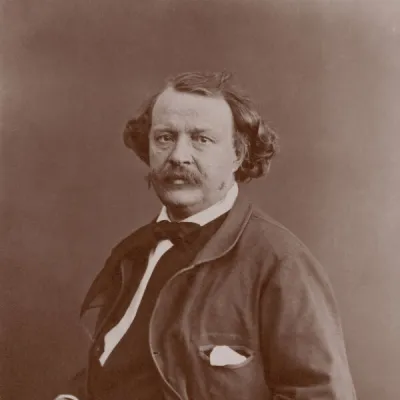
Nadar
Human Design Chart
Biography
The Human Design of Nadar: Projector 2/4
Projector 2/4 — Design at a Glance
Nadar revealed himself as someone with a focusing aura that immediately recognized system errors. His design acted like a bright flashlight, illuminating the darkness and guiding others. He quickly identified what was wrong in his counterpart's situation. However, if Nadar directly intervened and criticized these faults, he encountered resistance; his bright light was perceived as unpleasant, shining directly into others' faces.
Instead, Nadar's approach was more elegant: He shone through his own harmonious existence. This aura attracted others who then naturally sought out his insights. His strategy involved waiting for a respectful and sincere invitation rather than actively intervening. This prevented conflicts and allowed genuine influence.
Since Nadar as a projector lacked a defined Sacral Center, he did not have constant life energy. Phases of high activity alternated with necessary rest periods. These pauses were essential to prevent burnout, as the conventional system often failed to address this need. Living by this rhythm and his invitation strategy rewarded him with success. Ignoring these mechanics and acting independently or without recovery led to bitterness as an expression of his non-self.
Emotional Authority
Nadar exhibited an internal decision-making structure that required time and sleep cycles for maturation; spontaneous impulses were unreliable for him. This stemmed from his emotional authority, carried by the defined Solar Plexus Center. In Human Design mechanics, this authority always takes precedence over all other defined centers regardless of further configurations in the chart. Nadar was subject to a constant rhythm of emotional waves, an ongoing up and down of feelings. The world appeared colored by his current mood: one moment could inspire enthusiasm, the next reveal the same thing negatively. His immediate feeling was merely a snapshot, not a guaranteed truth value. Quick decisions made from this emotional heat often had negative consequences.
Through patience and repeatedly sleeping on questions, Nadar gained the necessary distance. The longer he waited, the deeper his understanding became. Intense feelings subsided over time, leading to clarity and calmness. This process was essential for long-term life decisions. Nadar's design challenged him to dress up properly and ask himself multiple times until the emotional wave had ebbed. Only then did the true inner answer emerge, free from the distortion of passing moods. This mechanism shaped his approach to significant life steps: not through quick reactions but by enduring in the emotional cycle until calmness was achieved.
The 2/4 Profile — Hermit / Opportunist
Nadar appeared as someone constantly swinging between a deep need for withdrawal and the desire for community. His design required him not just to live these two poles side by side, but to balance them in an ongoing tension. This corresponded with his Profile 2/4, known as the Natural Talent-Networker type, where Line 2 represented the recluse and Line 4 the network.
For Nadar, it was crucial to create a safe environment where he could clearly communicate when he sought company and when he needed solitude. During his alone time, he immersed himself in internal processes to find peace and clarity. This phase of withdrawal served not only for recovery but was essential for his development. Only once the need for isolation was satisfied did he return from
Triple Split Definition — Defined & Open Centers
Nadar's design showed a tendency towards constant mental creation and a clear, strong-willed identity. He was someone who not only thought concepts but also directly spoke them into the world through his defined throat. This connection between Ajna (mental consciousness) and Throat (communication) meant that Nadar could always express what he conceptualized; his mind was always active and provided content for his voice.
This foundation was strengthened by a defined G Center, which gave him a reliable self-identity and a sense of direction. Nadar knew who he was and could support others in their orientation without being dependent on them. His defined Heart Center also provided constant willpower; he could make promises and keep them, strengthening his self-esteem. However, he had to learn not to project this strength onto others with less capacity.
Emotionally, Nadar moved in a wave. His defined Solar Plexus was his inner authority: truth revealed itself to him over time. He learned to wait for the emotional wave before making decisions to avoid impulsiveness. His intuition came from the defined Spleen Center, which gave him spontaneous, momentary warning signals – a knowledge of the 'now' that could not be rationalized. The physical pressure of his defined Root Center propelled him forward and helped him process stress.
In contrast, Head and Sacral Centers were open. His open Head Center made Nadar vulnerable to mental confusion and the pressure to find answers for others' questions; he tended to get caught up in non-self thoughts. His open Sacral Center had no constant energy flow. Nadar relied on feeling the vital energy of his environment without identifying it as his own. He had to learn to set boundaries and not run on 'borrowed' energy to avoid exhaustion. This openness required continuous deconditioning: he could not try to work like a generator or solve mental problems that were not his.
Channels for pioneering spirit, intuitive elegance, search, logic and principles.
Nadar showed himself to be someone whose life path was strongly marked by the urge towards individuation, often driven by competition and the courage for radical changes. This impulse came from the Initiation Channel 51-25 in his personality. Here, the competing energy of the ego (Gate 51), which always wanted to be first, connected with universal love and the ability to see the beauty in all things (Gate 25). Since Gate 51 also functioned as a Sun Gate, this channel formed the absolute energy focus of his design. Nadar lived this dynamic by acting authentically from his strategy and authority; thus, he endured the shocks of initiation without dragging others into this process uninvited. His example served to encourage others to follow their own unique path rather than controlling them.
This deep search for uniqueness stood in contrast to other aspects of his design. The Perfect Form Channel 57-10 connected intuitive insight with self-behavior and promoted spontaneous, intuitive survival in the here and now. Nadar moved existentially through the world guided by a profound love for himself, which helped him let go of unfounded future fears. Parallel to this, the Curiosity Channel 11-56 marked him as a storyteller. It linked ideas into magical stories that taught or entertained others, driven by an insatiable search for new perspectives rather than fixed facts.
The Acceptance Channel 17-62 ensured he visually translated patterns logically into language and communicated them in detail while the Synthesis Channel 19-49 strengthened his emotional bond to clan and family. Here, he sought belonging and balance between feasibility and fairness. Additional facets were shown through Gate 54, which linked worldly success with mystical insight, as well as Gate 53, which drove him as a pioneer for new cycles. Gate 46 promoted his dedication in the physical body while Gate 38 set boundaries to defend his identity. Gate 8 urged an individual contribution and leadership, Gate 37 connected him with organic community structures. In the design, Gate 18 acted as a corrective instance for the collective, Gate 50 as a conservative reflex of values protection, and Gate 36 allowed him to experience emotional crises as transformative movement.
Individual Circuitry — Circuit Signature
Nadar showed a fortified, brave personality with strong inner convictions. His design connected Identity and Heart Center through the Centering Circuit (Channel 25-51). This promoted individual self-determination: 'I am who I am.' Since there was no connection to Throat Center, these firm standpoints often remained unspoken.
Parallel to this, Nadar had two separate groups for knowledge transmission. The Understanding Circuit (Channel 17-62) connected Ajna and Throat Center for logical, future-oriented strategies. Independently, the Meaning-Finding Circuit (Channel 11-56), also between Ajna and Throat, reflected on and shared emotional experiences from the past. These two channels allowed Nadar to express both rational and felt insights verbally, though they were energetically separate.
A third, isolated group formed Solar Plexus and Root Center in the Ego Circuit (Channel 49-19). Here it was about emotional waves and the need for rest pauses for communal creation without direct connection to the life force of Sacral Center.
Finally, the Integration Circuit (Channel 10-57) connected Identity Center with Spleen Center. This supported Nadar in drawing strength from reacting to life and acting through intuitive knowledge in the now. Overall, these three separate definitions shaped a complex picture: inner firmness, the ability for logical as well as emotional communication, and a sensitive intuition for what is essential – all coexisting side by side without a single continuous energy flow.
Right Angle Cross of Penetration 1
Nadar revealed himself through an energy that was profound and often unconscious. His design marked him as someone who created clarity through direct confrontation with resistances or illusions. It was a force of penetrating to the essence, not by detours but through radical penetration.
This attitude stemmed from his right cross of Penetration 1 in his Human Design. This configuration did not describe a gentle approach but an impulsive, penetrating impulse. It acted like a drill that did not circumvent obstacles but broke through them to reach the truth. For Nadar, this meant that his greatest impact often occurred when he faced obvious resistances head-on and addressed them directly.
The mechanics of this cross suggested that avoidance or diplomatic evasion contradicted his natural energy. Instead, his design promoted a kind of clarity that emerged from breaking through appearances. It was an energy that did not ask for permission but simply acted to reveal the essence. This shaped his interactions and decisions: he sought not the easiest path but the most direct access to the reality of a situation. His strength lay in this ability to penetrate illusions, even if the process was unpleasant or confrontational. This direct approach was not a character flaw but the specific expression form of his inner architecture, aimed at radical authenticity and uncovering hidden structures.
Saturn Return · Uranus Opposition · Chiron Return · 2nd Saturn Return — Life Cycles
Nadar's design showed a clear development line from individual innovation to structural anchoring. In 1863, at the age of 43, he ascended in the giant balloon "Le Géant" and made aerial photographs. This marked the turning point of his Uranus opposition: A cycle where his own form of expression sharpened and innovative impulses emerged outwardly. Nadar used this boost to conquer new perspectives – literally and figuratively.
Later, in 1874 at the age of 54, he organized the first exhibition of impressionist paintings in his studio. This fell during his second Saturn return cycle. Here it was no longer about an explosive new beginning but consolidation. Nadar built authority and created structures that anchored his contribution to the cultural field sustainably. He solidified his position as a mediator and creator of conditions for other artists.
This sequence underscores the mechanics of his design: First, breaking through old patterns individually with Uranus energy, followed by the serious, long-term integration of these achievements through Saturn. Nadar did not experience these phases as contradictions but as necessary steps towards maturity in his life's mission – from pioneering work to institutional impact.
Projector · Emotional Authority — Synthesis
Nadar was an observer distinguished by a deep ability to recognize patterns and communicate them precisely (Gate 17/62). This inclination towards detail and analysis fueled his creative energy (Channel 51-25) as he viewed the world through a unique perspective and manifested this understanding in his works. His defined G Center gave him strong inner direction and deep self-confidence, enabling him to act authentically and attract others with his presence – even if he needed phases of withdrawal (Profile 2/4). He was not primarily driven to generate or manifest energy but rather to grasp the quality of the world around him and present it in a form that inspired others.
A central tension field in Nadar's design lay between his ability for deep emotional perception (emotional authority center) and his need for clarity and structure through his defined Ajna Center. This combination led to an internal process of weighing, allowing him to grasp the world both intuitively and analytically, yet requiring phases of withdrawal (Line 2) to balance these opposing forces and find his authentic voice.
5 Defined Channels
Incarnation Cross - Right Angle Cross of Penetration 1
Solar Return
The Solar Return shows the moment when the sun returns to its exact birth position - your personal solar year.
Life Cycles
Discover the life cycles with a detailed triple view (birth chart, cycle chart, composite).
Human Design Profile
- Type
- Projector
- Strategy
- Wait for the respectful invitation
- Authority
- Emotional Authority
- Profile
- 2/4 - Hermit / Opportunist
- Definition
- Triple Split
- Incarnation Cross
- Right Angle Cross of Penetration 1
- Date of Birth
- 06.04.1820 04:00
- Place of Birth
- Paris, France
Frequently Asked Questions
What was Nadar's Human Design type?
What Profile did Nadar have in Human Design?
Which Authority guided Nadar's decisions?
Which incarnation cross defined Nadar's life purpose?
When was Nadar born?
Discover your own Human Design
Are you also a Projector? Find out in a personal reading how to unfold your leadership qualities and recognize the right invitations.
More Personalities
Back to overviewSissy Spacek

Alain-Fournier

Anémone

Ann-Margret

Bourvil

Hergé