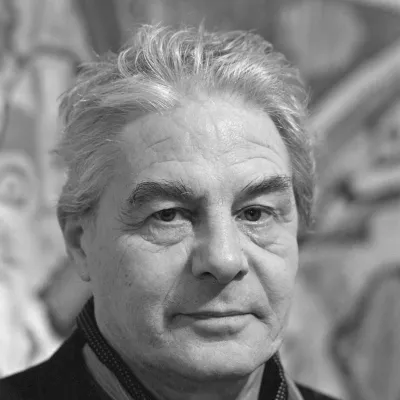
Lucebert
Human Design Chart
Biography
Lucebert was the son of the house painter and waiter Lubertus Jacobus Swaanswijk (28 May 1902) and Johanna Kalf (1891), a barmaid. They married 14 October 1914 in Amsterdam and got three sons. The marriage was unhappy: there were financial problems and quarrels and when Lucebert was only 2 years old, his mother left the family. They divorced officially on 31 December 1927 in Amsterdam. After four difficult years, his father remarried on 12 June 1930 the Catholic Hendrika Johanna Wilsens (18 April 1892, Vught), an early widowed house keeper without children.
Until age 13, Lucebert lived in the Jordaan area of Amsterdam, which had then a typical Labour neighbourhood with a mixed population, including poor immigrant Jews. He became at young age interested in alchemy. His father played on 24 November 1928 the role of Sint Nicolaas in Amsterdam, but there is little reason to believe that his youth was happy. He followed the ULO Trade school from 1936-39, where two teachers formed him: The teacher of German letters G.F.J.C. Bering stimulated his love for romantic poetry and letters. The other was the SDAP member and socialistic painter, lithographer and Concertgebouw clarinet player Johan van Hell (28 February 1889, A'dam – 31 Dec 1952, A'dam). Van Hell recognised his talent and gave him private lessons in painting.
After the ULO (summer 1939), Lucebert had to work in his fathers house painting company. His talent for painting was rediscovered by a passenger, when he just made some painting on a wall. With a grant he was allowed to study at the "Instituut voor Kunstnijverheidsonderwijs" (art school) in Amsterdam. The director, the Bauhaus architect and designer Mart Stam (5 August 1899, Purmerend – 23 February 1986, Goldach), made him aware of Dada and surrealisms, but after four months of art study, his father abruptly ended it, as he had to work for bread to sustain the poor family.
Lucebert as a Manifestor 6/2 in Human Design
Manifestor 6/2 — Design at a Glance
Lucebert's design established a foundational stance as a pioneer and visionary. He acted similarly to an emperor in ancient Rome: he had the great vision of a new future but did not lead the necessary wars himself; instead, he sent others to build his empire. This superior perspective inevitably led to misunderstandings and polarization. His grand dreams evoked love from some people who followed him, while the same visions caused rejection or hatred in others. The conflict between his foresight and the environment's reaction formed a central pain point in his existence. To find the right followers, it was crucial for him to inform others about his plans early and precisely. This strategy of informing served as a lever to minimize misunderstandings. If Lucebert lived according to this design and informed his surroundings, he was rewarded with an inner sense of peace. When he violated this strategy and acted without prior communication, he instead felt a persistent, deep anger. Thus, his Human-Design shows a clear mechanism: the quality of his emotional experience depended directly on whether he communicated his visions clearly or acted in silence.
Emotional Authority
Lucebert's decision-making was characterized by the necessity to let emotional impulses subside first. His design featured an emotional authority carried by the defined Solar Plexus Center. This mechanism meant that he was subject to a constant emotional wave, manifesting as a continuous up and down of his moods. The world appeared colored through his current state: something could inspire him one moment, only for him to see it negatively in the next.
This immediate emotional reaction was merely a temporary snapshot, not necessarily his deeper truth. Quick, spontaneous decisions based on this current mood often had negative consequences for him, as they were rooted in fleeting impulses. His inner strategy required patience and conscious delay. He needed to let decisions mature by sleeping over them multiple times and giving himself time to distance from the intense emotional waves.
Only when the emotional wave subsided and clarity and calmness set in could he recognize his true truth. This process of waiting was essential, especially for long-term decisions with significant influence on his life path. By allowing this period, he managed to move from superficial mood swings to deeper insight and take solid steps.
The 6/2 Profile — Role Model / Hermit
Lucebert's design laid out a two-phase life journey: an early time of experimentation followed by deep reflection. As a 6/2 profile (Role Model/Natural Talent), the trial and error dominated his youth. The 6-line initially acted like the 3-line; Lucebert sought meaning through personal experiences, often accompanied by uncertainty or feelings of futility — this aligned with the nature of the hexagram, which at the roof had the gift to distinguish sense from nonsense but was prone to complaints when clarity was lacking.
Around age 30, with Saturn's return, his dynamics fundamentally shifted. The actual 6-line became active, leading Lucebert into a phase of intense isolation. He metaphorically retreated into the “Cave” to gain distance and cleanse unclear emotions — a process marked by Line 2, characterized by discipline and the desire for inner purity. This period served as healing and deep self-knowledge, allowing him to soberly review the cyclical nature of his earlier experiences.
From this phase emerged Lucebert as a wise figure. His introspective ability matured into wisdom that others could recognize. He became someone from whom others could learn how to endure challenges and find meaning after overcoming initial futility through strict self-purification.
Split Definition — Defined & Open Centers
Lucebert's design inclined towards constant mental activity and emotional depth, embedded in a stable inner identity. The defined Head and Ajna centers generated an ongoing, unavoidable process of questioning, inspiration, and conceptual processing; this was not a choice but a mechanical constant. His mind was always at work, which made meditation difficult but also served as an inspirational source for others. Since the Head and Ajna are not connected to any motors, there was no energy available to directly implement these thoughts. The attempt to relieve mental pressure through immediate action led to frustration; the challenge lay in accepting the pressure without acting on it.
The defined G Center provided a firm, magnetic self-identity and a sense of direction. Lucebert knew who he was and could show others new perspectives without being dependent on them. At the same time, the defined Solar Plexus Center represented his emotional authority. Truth did not reveal itself in the moment but only through waiting for the emotional wave to pass. Impulsive decisions at the peaks or troughs of this wave created chaos; true clarity emerged only during calm phases when emotions had subsided.
The open centers – Heart, Sacral, Spleen, and Root – acted as antennas for conditioning environmental energies. The open Heart Center tended to absorb willful pressure and strive to prove worth through performance, which could lead into a cycle of promises and disappointments. The open Sacral Center was vulnerable to vital overexertion; Lucebert risked exhaustion by amplifying foreign energy rather than listening to his own limits. The open Spleen and Root Centers made him sensitive to existential fears and environmental adrenalin stress. Instead of acting spontaneously or running under pressure, it was necessary to recognize these external impulses as non-self. The defined Throat served as an expression organ that translated these internal processes into a consistent yet limited communication.
Channels for abstraction, logical leadership and emotional openness.
Lucebert's design inclined towards intense inner reflection: His mind filtered experiences through kaleidoscopic mental images to construct meaning and stories. This attitude was shaped by the Abstraction Channel 64-47, connecting the Head Center with the Ajna Center. Gate 47, 'Gate of Understanding', formed the absolute energy focus (~70%); it propelled the search for perspective and the narration of a story – about oneself or others. This experience-based mind was constantly active but could be confusing ('drunken monkey'), until suddenly clarity emerged. While this mental definition did not suit problem-solving, it was ideal for communicating inspiring perspectives from inward reflection.
Alongside this inner processing, the Alpha Animal Channel 7-31, connecting the G Center with the Throat Center, came into play. It described logical, collective leadership looking towards the future. Gate 7 provided the role of self, while Gate 31 acted as a collective leader; its voice had valuable influence. Lucebert appeared less as an autocrat here but rather someone seeking his own 'pack' and leading from an influential position. Success was tied to the majority recognizing and inviting this leadership, as collective leadership rested on shared patterns.
Emotionally, Lucebert operated through the Openness Channel 22-12 between Solar Plexus and Throat Centers. His articulation depended on the emotional wave; Gate 22 brought passion and drama, while Gate 12 (Cautious) regulated this openness and limited it to people with significant mutative potential. He communicated effectively only when his mood was right – otherwise, he could come across as abrupt or misunderstood.
Additionally, individual Gates were at work: Gate 11 promoted visual memories and collective ideas for situational assessment; Gate 4 developed logical formulas for future security; Gate 49 responded sensitively to principles of transformation in tribal contexts. Gate 20 anchored him in the here and now to live an authentic self, while Gate 30 demanded the recognition of feelings and acceptance of limitations as fate.
Collective Circuitry — Circuit Signature
Lucebert's design was characterized by a tension between emotional transformation and rational strategy, both converging in the Throat Center. As a Shared Definition, his chart consisted of separate energetic groups. The Knowledge Circuit connected Solar Plexus with Throat (Channel 12-22). This shaped a pulsating, emotional energy: individual identity and transformative insights were experienced in wave movements and had to be authentically expressed. Parallel to this, the Understanding Circuit linked Identity with Throat (Channel 31-7). Here focused rational logic and strategic future vision prevailed, free from emotional conditioning. These two forces – the emotional wave of knowledge and the cool ratio of understanding – existed side by side without direct energetic flow between them, requiring constant integration in expression. A third, separate area was the Meaning-Finding Circuit (Channel 64-47), connecting Head with Ajna Centers. This connection stood for cyclical reflection on the past and finding meaning in past experiences, also visually and shared. Since this group was isolated, it formed its own sphere of inner processing independent from the converging expression streams in Throat Center. Lucebert's challenge lay in unifying the pulsating emotion of Solar Plexus with the focused strategy of G Center as well as the abstract meaning-finding of Head and Ajna into a coherent whole.
Left Angle Cross of Informing 2
Lucebert's design established a foundational disposition geared towards clear and direct communication. He was someone who not only processed information but actively passed it on to create clarity. This tendency stemmed from the influence of the left cross of the Communicator 2 in his Human Design chart.
This cross connects specific energies aimed at making complex matters accessible. It's not just about talking, but rather precisely formulating thoughts so that others can understand and use them. The energy of this configuration fostered a style of expression that got straight to the point without unnecessary detours.
For Lucebert, this meant his natural inclination was to present connections in such a way that they became comprehensible for those around him. It was a structural ability to shape knowledge or impressions into forms that facilitated exchange and understanding. His design supported him as an intermediary between inner insights and the external world by refining these insights linguistically or conceptually. This mechanism shaped his way of interacting with his environment and sharing his perspective.
Saturn Return · Uranus Opposition · Chiron Return · 2nd Saturn Return — Life Cycles
Lucebert's professional development followed two prominent cyclical turning points that structured his realization. In 1964, at age 40, he participated in documenta III in Kassel. This corresponded to the Uranus Return, a time when slow inner maturation often translates into sudden external visibility or a break with previous structures. For his design, this was a moment of professional consolidation and public recognition.
Seven years later, in 1971, Lucebert published “Bühnescreens”. He was then 47 years old and experiencing the Chiron Return. This cycle marks not healing from injuries but a phase of fulfillment and bloom. Here it shows how one's incarnation cross – assuming the person lived according to their strategy and authority – increasingly becomes effective in daily life, making sense tangible. The publication thus stood for the concrete unfolding of his purpose. Both events underscore that Lucebert’s path was not linear but marked by planetary returns, each activating new levels of his professional identity. The Uranus Return brought necessary structure and visibility; the Chiron Return confirmed the inner correctness and meaning of his work. This sequence clarified how external milestones were synchronized with internal development cycles to strengthen and deepen his artistic position.
Manifestor · Emotional Authority — Synthesis
Lucebert was a Manifestor whose life was marked by an inner drive towards initiation and profound emotional depth. His defined G-Center in conjunction with the Throat Center points to a strong inner direction and the desire to express it – not as authority, but as logical leadership (Channel 7-31). This tendency was reinforced by constant mental activation (defined Head and Ajna Centers), driving him to recognize patterns and develop new perspectives. The openness of his centers – Sacral, Root, Spleen, and Heart – made him receptive to external influences yet also vulnerable to conditioning, which he transformed through his creative expression power (Channel 12-22).
A central paradox in Lucebert's design lies in the interplay between initiation and emotional reaction. As a Manifestor, he was destined to set things in motion, but his emotional center required a maturing phase to gain clarity before communicating his visions. This tension between the impulsive urge for change and the necessity of waiting out the emotional wave (Solar Plexus) likely led to an inner dynamic of creative energy and periodic withdrawal – a back-and-forth that shaped his artistic process and kept him in a constant flow between expression and reflection.
3 Defined Channels
Incarnation Cross - Left Angle Cross of Informing 2
Solar Return
The Solar Return shows the moment when the sun returns to its exact birth position - your personal solar year.
Life Cycles
Discover the life cycles with a detailed triple view (birth chart, cycle chart, composite).
Human Design Profile
- Type
- Manifestor
- Strategy
- To inform others before acting
- Authority
- Emotional Authority
- Profile
- 6/2 - Role Model / Hermit
- Definition
- Split Definition
- Incarnation Cross
- Left Angle Cross of Informing 2
- Date of Birth
- 15.09.1924 01:00
- Place of Birth
- Amsterdam, Netherlands
Frequently Asked Questions
What was Lucebert's Human Design type?
What profile did Lucebert have in Human Design?
What authority did Lucebert have?
What incarnation cross did Lucebert have?
When was Lucebert born?
Discover your own Human Design
Are you also a Manifestor? Find out in a personal reading how to use your initiation power peacefully and dissolve resistance.
More Personalities
Back to overviewChristian-Jaque
Kesha

Masaccio
Papus
Petrarch
Pupo