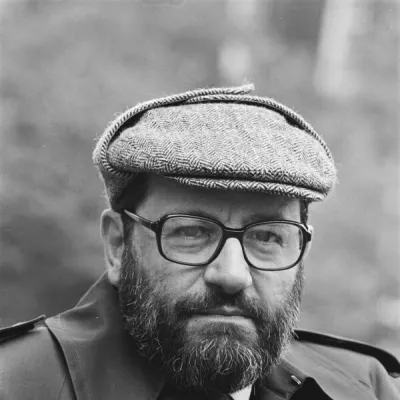
Umberto Eco
Human Design Chart
Biography
Eco wrote prolifically throughout his life, with his output including children's books, translations from French and English, in addition to a twice-monthly newspaper column "La Bustina di Minerva" (Minerva's Matchbook) in the magazine L'Espresso beginning in 1985, with his last column (a critical appraisal of the Romantic paintings of Francesco Hayez) appearing 27 January 2016. At the time of his death, he was an Emeritus professor at the University of Bologna, where he taught for much of his life. In the 21st century, he has continued to gain recognition for his 1995 essay "Ur-Fascism", where Eco lists fourteen general properties he believes comprise fascist ideologies.
What does Projector 5/2 mean for Umberto Eco?
Projector 5/2 — Design at a Glance
Umberto Eco's Human Design pointed towards an immediate system diagnosis tendency. As a projector, he had a dense, focused aura that behaved like a bright flashlight: it illuminated exactly those areas in the environment that were 'in the dark' or functionally impaired. Eco could thus instantly recognize where errors lay within a system.
However, this immediate perceptiveness carried a risk. Had he directly and abruptly addressed these flaws, his counterpart would often have reacted with rejection – comparable to shining a bright flashlight directly into someone's face. The mechanics of his design indicated that direct criticism was counterproductive. Instead, his most effective approach was to attract others through his own harmony. By being a functioning example himself, he became automatically attractive; people came to him on their own and sought his advice.
Therefore, Eco's central strategy was to wait for an honest, appreciative invitation. Only this permission allowed him to exercise his leadership role without provoking resistance. Furthermore, his undefined Sacral Center shaped his energy profile: there was no constant intrinsic life force. Instead, he experienced cycles of high activity and necessary rest phases. These pauses were essential to prevent burnout, as modern work often ignored these rhythmic needs. Living according to this pattern of patience and rhythm rewarded him with success; deviating from it sooner or later brought his non-self theme, bitterness, into play.
Splenic Authority
Umberto Eco demonstrated decision-making based on a fine, immediate inner signal: the authority of the Spleen. His design required that the Emotional and Sacral Centers remain open, typical for projectors or manifestors. The Spleen served as his health and alarm system, equipped with pronounced survival intelligence. This manifested not through prolonged thought but as spontaneous knowledge about whether a situation, environment, or society was right for him. His instinct and physical well-being served as reliable indicators.
Decisions had to be made in the moment; the first impulse was the truth and immediately served his protection. This allowed him to rigorously distance himself from harmful influences and take good care of himself. However, this Spleen impulse was very subtle and only appeared once at a moment, posing the risk of being drowned out by other voices. Therefore, Umberto Eco needed high vigilance not to miss this subtle call. A retreat could be helpful in decision-making.
Since what was right became clear only in each respective moment, plans often changed short-term. Long-term commitments were difficult; instead, he required much freedom and flexibility in his life to accommodate this spontaneous nature.
The 5/2 Profile — Heretic / Hermit
Umberto Eco's Human Design set a basic tension: the inner drive for recognition conflicted with the deep need for withdrawal. He was someone who initially hid his talents in the 'cave' – a typical characteristic of the Hero/Natural Talent (5/2) profile. While Line 5 stirred the desire to help others and be admired, Line 2 demanded isolation and time for himself. As long as the world did not 'discover' him, he worked hard on his development, using his alone-time to prepare for a potential hero role.
However, this configuration carried risks: waiting passively for discovery could lead to bitterness, as being a hero in the mode of the 'lonely wolf' hardly works. The challenge was to find courage for presence and put himself on the stage rather than just wait. Once he did so, his presence and clearly articulated insights were appreciated by others.
Line 5 brought an intuitive, isolated combat approach that proved particularly effective during crisis times – characterized by alienation and self-separation. At the same time, Line 2 provided clarity regarding appropriate values through intuition. These values primarily served survival or power security, not moral ideals. They required resolute determination to acknowledge and apply these intuitive insights without losing sight of necessary boundaries for his recovery.
Triple Split Definition — Defined & Open Centers
Umberto Eco's Human Design profile established a constant, autonomous presence: Six defined centers created a stable foundation for thinking, communication, identity, willpower, intuition, and stress management. His defined Ajna Center ensured consistent conceptual thinking; he processed data continuously and was mentally resistant to influence. The connection to the defined Throat allowed him to express these concepts directly – his voice reliably conveyed what his mind formed.
This intellectual foundation worked in conjunction with his defined Heart Center, which gave him clear willpower and a desire for self-determination. He preferred to control his own resources and kept promises, strengthening his self-esteem. His defined G Center provided a firm sense of identity; he knew his direction and could show others new paths without being dependent on them. The intuition of his defined Spleen Center delivered spontaneous judgments about health and well-being, while the defined Root Center supplied the necessary pressure to move forward materially and process stress.
However, three open centers marked areas of receptivity. His open Head Center lacked a constant source of inspiration; he tended to pick up mental pressure or questions from his environment and could get entangled in doubts that were not his own. The open Sacral Center meant a lack of consistent vital energy; he was prone to amplify the work energy of others and overburden himself without clear internal boundaries for 'enough'. Finally, his open Solar Plexus absorbed the emotional climate of his surroundings. He reflected moods and emotions of others, which could lead him to experience foreign emotions as his own or avoid confrontation out of fear of emotional overload. This openness required vigilance not to fall into conditioned patterns of energy absorption or emotional identification.
Channels for acceptance, pioneering spirit and persistent ambition.
Umberto Eco was a personality who penetrated complex systems to improve or overcome them. His design was characterized by three defined channels that created a specific dynamic: logical detail organization, competitive initiative pressure, and tribal-oriented transformation drive.
The Accepting Channel 17-62 connected the Head Center with the Throat Center. Through Gate 17, he visualized patterns, while Gate 62 translated these into precise language. This generated a permanent internal process of organizing information mentally and only understanding it when it logically fit his worldview. There was a strong pressure to verbally express these structured opinions, giving him the ability to clearly convey detailed visual concepts as theories or formulas.
Parallel to this, the Initiating Channel 51-25 worked in the Heart Center. It connected the competition-oriented shock of Gate 51 with the universal love and spirit of self from Gate 25. This configuration drove him to lead individualization through competition. He awakened competitive ability in others to initiate them and release their potential for expansion. However, this mystical process of initiation only occurred authentically when invited; it served to strengthen and mutate the collective through personal transformations.
The third pole was formed by the Transformation Channel 54-32 between Root and Spleen Centers. Driven by Gate 54 (ambition) and Gate 32 (continuity), he sought social advancement through tribal loyalty. His ambition arose from an awareness of the fragility of his tribe; he worked hard to improve his position and secure the prosperity of his community. This drive for recognition was guided by instincts that recognized when support was available, making transformations sustainable.
Together, these channels created a profile that established logical structures (17-62), further developed them through competitive initiatives (51-25), while always keeping social continuity and advancement in the collective in mind (54-32).
Individual Circuitry — Circuit Signature
Umberto Eco's design set a tendency towards inner stability and individual centering. His chart was marked by the Centering Circuit, which connected his Identity with the Heart Center. This configuration promoted solidified beliefs and strong self-esteem, but as an internal stance rather than an external statement. Since there was no connection to the Throat Center, this certainty remained inwardly directed, pulsating and melancholic, without direct verbal articulation. Parallel to this, Eco's Understanding Circuit connected his Ajna with the Throat Center through Channel 17-62. This allowed for sharing logical, rational insights free from emotional influence by the Solar Plexus Center. Here lay the ability to strategically and focusedly look into the future. A third aspect was the Ego Circuit, which linked Spleen and Root Centers (Channel 32-54). This stood for transformation and resource creation through cooperation but required pauses as no direct life force flowed from the Sacral Center. As a Triple Defined individual, Eco possessed three separate energetic groups: inner individuality (Heart/Identity), rational communication (Ajna/Throat) and resource-oriented transformation (Spleen/Root). These forces existed parallel without direct flow between them. His personality thus showed as a mix of strong internal affirmation, clear strategic expressiveness, and the need for supportive cooperation, each in their own domains.
Left Angle Cross of Individualism 2
Umberto Eco's Human Design profile established a structural orientation towards the left cross of Individuality Two. This configuration formed the archetypal framework for his energetic structure and shaped the fundamental dynamics of his being. The left cross of Individuality Two represents a specific path of self-realization that aims less at external recognition or collective adaptation, but rather at deep, often silent work on one's identity. It is a structure that focuses on developing an unmistakable inner core independent of environmental expectations.
For Umberto Eco, this meant that his life energy flowed into the creation and maintenance of an individual perspective. The mechanics of this cross support a process in which the individual learns not to define themselves through comparison with others but through the consistent expression of their own nature. It is a path of differentiation that requires patience to hear and articulate one's voice clearly in a noisy world. This energetic structure provided him with the framework to understand his uniqueness as a resource rather than a burden, fostering an attitude of inner stability that allowed him to stay on his path even during uncertain times without being distracted by external currents.
Saturn Return · Uranus Opposition · Chiron Return · 2nd Saturn Return — Life Cycles
Umberto Eco's professional development followed a clear rhythm marked by astrological cycles. In 1973, at the age of 41, he published 'Segno'. This coincided with an Uranus opposition. In Human Design mechanics, this configuration often signals a sudden break or new direction that dissolves old structures and enables innovation. For Eco, it manifested as a concrete career boost where his intellectual approaches were made public in a new form.
Later, in 1990 at the age of 58, an audiobook for 'The Foucault Pendulum' was released. This marked his second Saturn return. The Saturn cycle represents maturation, structuring, and condensing long-term work into sustainable results. While the first return often lays the groundwork, the second return confirms established positions and deepens the foundation. For Umberto Eco, this cycle worked as a confirmation of his authority; his work found a new acoustic dimension through the audiobook, which strengthened and anchored his existing reputation sustainably. These two events illustrate how cosmic cycles are not just abstract phases but concrete milestones in professional development: once as an impulsive innovation through Uranus, later as structural consolidation through Saturn.
Projector · Splenic Authority — Synthesis
Umberto Eco was a Projector whose life seemed to be marked by a profound drive to recognize patterns and organize them into understandable structures (Channel 17-62). He quickly saw where others pointed out errors in the system and had the ability to formulate complex ideas and support them with logical reasoning. This tendency towards analytical thinking, combined with the Projector trait of bringing light to darkness, indicates that he always strove to uncover hidden connections and make these accessible to others – a process enhanced by his defined mental component (Ajna Center).
At the same time, Eco carried an internal contradiction within him (Profile Leader/Natural Talent). Although he had the potential to be recognized and admired as an expert, he also needed space for withdrawal and self-reflection. This tension between the desire for recognition and the need for isolation shaped his work style, manifesting in phases of intense concentration and creative work followed by times of retreat.
3 Defined Channels
Incarnation Cross - Left Angle Cross of Individualism 2
Solar Return
The Solar Return shows the moment when the sun returns to its exact birth position - your personal solar year.
Life Cycles
Discover the life cycles with a detailed triple view (birth chart, cycle chart, composite).
Human Design Profile
- Type
- Projector
- Strategy
- Wait for the respectful invitation
- Authority
- Splenic Authority
- Profile
- 5/2 - Heretic / Hermit
- Definition
- Triple Split
- Incarnation Cross
- Left Angle Cross of Individualism 2
- Date of Birth
- 05.01.1932 18:30
- Place of Birth
- Alessandria, Italy
Frequently Asked Questions
What was Umberto Eco's Human Design type?
What Profile did Umberto Eco have in Human Design?
What Authority did Umberto Eco have?
What incarnation cross did Umberto Eco have?
When was Umberto Eco born?
Discover your own Human Design
Are you also a Projector? Find out in a personal reading how to unfold your leadership qualities and recognize the right invitations.
More Personalities
Back to overviewSissy Spacek

Alain-Fournier

Anémone

Angeli

Ann-Margret

Bourvil