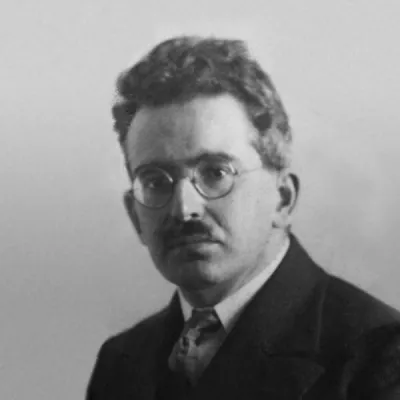
Walter Benjamin
Human Design Chart
Biography
Among Benjamin's major works as a literary critic are essays on Goethe's novel Elective Affinities; the work of Franz Kafka and Karl Kraus; translation theory; the stories of Nikolai Leskov; the work of Marcel Proust and perhaps most significantly, the poetry of Charles Baudelaire. He also made major translations into German of the "Tableaux Parisiens" section of Baudelaire's Les Fleurs du mal and parts of Proust's À la recherche du temps perdu.
His turn to Marxism in the 1930s was partly due to the influence of Bertolt Brecht, whose critical aesthetics developed epic theatre and its Verfremdungseffekt (defamiliarisation, alienation). An earlier influence was friend Gershom Scholem, founder of the academic study of the Kabbalah and of Jewish mysticism.
Influenced by the Swiss anthropologist Johann Jakob Bachofen(1815–1887), Benjamin coined the term "auratic perception", denoting the aesthetic faculty by means of which civilization may recover an appreciation of myth. Benjamin's work is often cited in academic and literary studies, especially the essays "The Task of the Translator" (1923) and "The Work of Art in the Age of Mechanical Reproduction" (1936).
On 26 September 1940 Benjamin committed suicide in Portbou at the French–Spanish border while attempting to escape from the Nazis.
Human Design Analysis: Walter Benjamin as Generator 4/6
Generator 4/6 — Design at a Glance
Walter Benjamin was a Generator. His design laid an enormous endurance comparable to that of a workhorse, which could only unleash its full power when it had energy for the task at hand. This life force came from the sacral center and required a specific approach: It wasn't initiating actions but responding to inner impulses.
His primary strategy was waiting for signals from life and then acting only when his sacral center gave a clear 'yes'. This gut reaction generated the necessary strength to materialize projects. When Walter Benjamin acted in harmony with this principle by responding to these internal drives, his design rewarded him with deep satisfaction and fulfillment.
At the same time, his central challenge was revealed through two stumbling blocks. If he did things that lacked inner resonance, he wasted energy and tended towards exhaustion. Being held back from his heart project despite strong internal drive led to frustration. Success and strength were thus exclusively tied to this reactive stance; perseverance at the right moment made him unshakable, while false initiative led to energy depletion.
Sacral Authority
Walter Benjamin showed himself as a Generator whose decision-making was marked by sacral authority. This inner instance did not react to abstract planning but to concrete external stimuli with immediate physical signals. His strategy was to respond – a process that became simpler through this specific authority when his emotional center was open.
His responses manifested as 'gut feelings' or physical energy surges. He learned to listen to sounds like grunts, hums, or an affirming 'mm-hm'. When this resonance occurred, he felt vital and alive. An almost inexhaustible flow of energy was available to him, enabling him to carry out his tasks with great enthusiasm. His life aimed at going through it joyfully without compulsive purpose.
Additionally, the spleen center acted as a supporting authority. This allowed Walter Benjamin particularly quick and spontaneous reactions. He had an immediate access to his physical well-being and instinctive perception. This combination of sacral reaction and spleen-induced speed enabled him to reliably guide himself by these inner impulses rather than falling into deliberate action. The distinction between reactive activation through the outside world and internal compulsion thus formed the foundation of his energetic alignment.
The 4/6 Profile — Opportunist / Role Model
Walter Benjamin was marked throughout his life by a tension between the heart's desire for intimacy and the head's drive towards wise distance. His design tended to experimentally act before the Saturn return in the first half of his life. In these early years, his sixth profile line acted like a third; he actively sought opportunities, especially in relationships and friendships, to orient himself.
This early behavior contrasted with later development. Once Line 6 became active, an internal conflict emerged: The desire for community (Line 4) clashed with the need to withdraw to ponder life's meaning. This heart-head conflict shaped his inner stance.
In his later years, there was an expectation of him as a wise role model through cooperation and sharing abstract experiences. However, the mechanics of his fourth line demanded caution; his large heart opened only partially to avoid being hurt by false people. He needed time for his internal process to organize details before expressing them. Meanwhile, his sixth line oversaw the entire process and reflected on who could complete this growth. The challenge was to allow others to partake in the benefits of this growth without slipping into self-alienation or aggression if that participation was denied. His development thus moved between ascetic withdrawal for detail order and the responsibility of passing on insights.
Split Definition — Defined & Open Centers
Walter Benjamin revealed himself as a person with constant mental activity and a clear inner direction. His defined Ajna Center ensured continuous conceptual thinking that was directly translated into language through his connection to the Throat Center; he spoke what he thought. However, this mental energy was not initiated but rather reactivated by his defined Sacral Center: He waited for an internal confirmation ("Yes" or "No") before acting to avoid frustration. His defined G Center gave him a firm sense of self and purpose in life, while the defined Spleen Center along with the Channel to Root ensured existential intuition and focus on material survival.
At the same time, he was vulnerable to external influences through three open centers. The open Head Center made him receptive to inspirations not originating from himself; he tended to get entangled in questions or seek answers that belonged to others instead of trusting his inner authority. His open Heart Center meant that he did not have a constant willpower and thus was not designed to give promises or prove his worth through performance; attempting this often led into cycles of self-doubt. Finally, his open Solar Plexus absorbed the emotions of his surroundings like a mirror. He could take in and amplify foreign moods, making him vulnerable to emotional conditioning; he had to learn not to personalize these feelings as his own but let them go to maintain his clarity. His challenge lay in avoiding mental initiation from the Head and instead waiting for the sacral response.
Channels for resources, logic, care and ambitious transformation.
Walter Benjamin revealed himself as someone whose deepest driving force was to express inner perceptions and visual patterns in words, making them understandable and structured. This was not just a tendency but a constant energy source: Gate 62 (Line 4, Sun) in Channel of Acceptance 17-62 carried most of his power. Here the ability to logically organize and name details combined with the Gate of Opinions (17). This created an ongoing internal pressure to mentally order information and express this order through language once receptivity was there. His gift lay in translating complex visual impressions into formulas or theories that could be tested for feasibility.
Parallel to this, Channel of Beat 14-2 worked. This channel connected the Gate skilled with handling power (14) with the Gate of Higher Knowledge (2). Walter Benjamin possessed the resources and mutative impulse to bring innovative new directions. He was able to sustain his creative efforts or encourage others in their direction through his example. This energy arose from a powerful connection between power competence and higher knowledge, generating fertile life force. It allowed him to face changing existential challenges while introducing critical new perspectives.
While Channel of Acceptance 17-62 kept his mind permanently occupied with integrating details into his mental system to gain understanding, Channel of Beat 14-2 provided the energetic basis for mutation and uniqueness. Walter Benjamin lived this mechanism by reacting to life and staying open. His strength lay in uniting both logical structuring of information and impulsive drive towards change. He found satisfaction in sharing his opinions in all details as long as the timing was right. Simultaneously, he used his sacral energy to offer others a new direction without actively forcing it upon them. This combination of analytical clarity and mutative power shaped his unique expression.
Tribal Circuitry — Circuit Signature
Walter Benjamin revealed himself as someone whose inner architecture was marked by two clearly separated energetic poles: on one side focused, rational intelligence, on the other pulsating individual creativity. This duality formed the foundation of his mode of expression. In the realm of mind, Channel "Accept" (17-62) connected Ajna Center with Throat Center. This allowed him to formulate and communicate logical and strategic insights free from emotional conditioning – a pure visual ratio aiming at clarity and structure. Parallel to this, in Knowledge Circuit, Channel "Beat" (2-14), which linked Sacral Center with Identity Center, generated an acoustic rhythmic energy carrying his unique individuality and pulsating creativity. Since these two circuits were not connected in Walter Benjamin, reason and emotional identity existed as separate systems; there was no integrated 'emotional logic', but a side-by-side of cool analysis and vibrant, personal radiance. Additionally, further defined areas shaped his design: Ego Circuit linked Spleen Center with Root Center via Channel of Transformation (32-54), signaling instinctive adaptability in social or resource-related contexts. Furthermore, in Protector Circuit, Channel of Preservation (27-50) connected Sacral and Spleen, activating primordial energies of protection, preservation, and care. This configuration underscored the separation between his intellectual work and deep, instinctual survival as well as identity mechanisms.
Right Angle Cross of Maya 2
Walter Benjamins Design enthielt die Konfiguration des „Rechten Kreuzes der Maya 2“. Da die spezifische mechanische Beschreibung dieser Struktur im vorliegenden Material nicht spezifiziert ist, lässt sich keine detaillierte Aussage über deren energetische Auswirkung oder charakterliche Prägung treffen. Human-Design-Kreuze beschreiben oft tiefgreifende Lebensmuster oder spirituelle Aufgaben; hier bleibt der Inhalt jedoch undefiniert. Es wurde keine Verbindung zu konkreten Verhaltensweisen, Strategien oder inneren Dynamiken hergestellt. Die Anwesenheit dieses Elements im Chart ist dokumentiert, seine Funktion bleibt in diesem Kontext unklar. Keine weiteren Interpretationen sind aus den gelieferten Daten ableitbar. Walter Benjamin trug diese Konfiguration, ohne dass ihr Einfluss auf sein Erleben oder Handeln durch die vorliegenden Fakten erläutert werden kann. Der Fokus liegt allein auf der Nennung des Elements selbst, da keine begleitende Erklärung vorliegt.
Saturn Return · Uranus Opposition — Life Cycles
Walter Benjamin showed a structure oriented towards fundamental maturation and radical breaks. His design indicated that his intellectual development did not proceed linearly but was marked by clear phase transitions where old structures broke down to make way for new content.
This process culminated in 1920 at the age of 28 with the publication of his dissertation “The Concept of Criticism in German Romanticism”. For his Human-Design, this moment marked his first Saturn Return. In this cycle, often seen as a phase of structural consolidation, years of groundwork condensed into a solid result. It was not a sudden impulse but rather the culmination of long inner work that now emerged in a stable form.
Yet this stability was only one phase. His design also contained the mechanics for abrupt breaks. In 1933 at the age of 41, an opposition to Uranus occurred. This aspect stands for unexpected changes and the end of established orders. Indeed, his publicist phase in the Weimar Republic came to a close with this event. What had previously served as a firm foundation was irrevocably destroyed by external circumstances. This break was not a random catastrophe but the result of a planetary configuration that dissolved old structures to make room for the unknown. Walter Benjamin’s path thus followed a pattern of building up and radical tearing down, driven by the specific dynamics of his Saturn and Uranus cycles.
Generator · Sacral Authority — Synthesis
Walter Benjamin lived a life profoundly marked by reactions to impulses from his environment (sacral authority). This responsiveness, combined with a defined Ajna Center and the Channel of Acceptance, led to constant intake and processing of information which he then communicated precisely. His profile as a networker/role model suggests that in his early years he gathered diverse experiences to later assume the role of a knower and mediator – a person who made connections and recognized patterns. The connection between G Center, Sacral Center, and the Beat Channel suggests that his energy and direction always sprang from a deep, instinctive source, driving him to explore new paths even if unconventional.
A central paradox in Walter Benjamin’s design lies in the interplay of defined Root and open Solar Plexus. The Root provided constant pressure to move forward and make things happen, while the open Solar Plexus made him especially receptive to other people's emotions. This likely led to an internal tension between his own drive and the ability to pick up collective moods, which both fueled his creativity and made him vulnerable to external influences.
4 Defined Channels
Incarnation Cross - Right Angle Cross of Maya 2
Solar Return
The Solar Return shows the moment when the sun returns to its exact birth position - your personal solar year.
Life Cycles
Discover the life cycles with a detailed triple view (birth chart, cycle chart, composite).
Human Design Profile
- Type
- Generator
- Strategy
- To respond - wait for something to respond to
- Authority
- Sacral Authority
- Profile
- 4/6 - Opportunist / Role Model
- Definition
- Split Definition
- Incarnation Cross
- Right Angle Cross of Maya 2
- Date of Birth
- 15.07.1892 22:30
- Place of Birth
- Berlin, Germany
Frequently Asked Questions
What was Walter Benjamin's Human Design type?
What profile did Walter Benjamin have in Human Design?
Which authority guided Walter Benjamin in Human Design?
What incarnation cross did Walter Benjamin have?
When was Walter Benjamin born?
Discover your own Human Design
Are you also a Generator? Find out in a personal reading how to use your sacral energy correctly and discover deep satisfaction.
More Personalities
Back to overviewAaliyah

Alexia

Angèle

Anne-Marie

Arcángel

Arno