
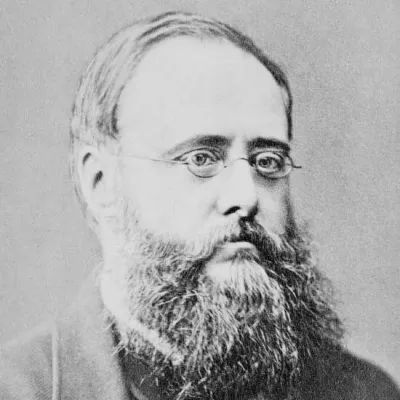
Wilkie Collins
Human Design Chart
Biography
Collins' father was the painter William Collins. He attended an academy and a private boarding school. He also traveled with his family to Italy and France, and learned the French and Italian languages. His first novel Iolani, or Tahiti as It Was; a Romance, was rejected by publishers in 1845. His next novel, Antonina, was published in 1850. In 1851 he met Charles Dickens, and the two became close friends. A number of Collins's works were first published in Dickens's journals All the Year Round and Household Words. The two collaborated on several dramatic and fictional works, and some of Collins's plays were performed by Dickens's acting company.
Collins published his best known works in the 1860s, achieving financial stability and an international reputation. During this time he began suffering from gout, and developed an addiction to opium, which he took (in the form of laudanum) for pain. He continued to publish novels and other works throughout the 1870s and 80s, but the quality of his writing declined along with his health. He died on 23 September 1889.
The Human Design of Wilkie Collins: Generator 3/5
Generator 3/5 — Design at a Glance
Wilkie Collins, as a Generator, possessed immense, sacral energy that enabled him to engage in sustained creative work. His design operated like that of a workhorse: strong and enduring, provided he received energy for his tasks. This power was not available to him through sheer will but primarily through reacting to external impulses. The motto of his system was “not to initiate but to react.” Successful action required him to wait for signals from life and only act when his Sacral Center gave a clear “yes.”
This mechanism held two central pitfalls. First, he burned his energy on tasks that did not resonate with him internally, leading to frustration and exhaustion. Second, he suffered when prevented from pursuing his heart project, even though his inner energy was still available. When Collins lived in harmony with this strategy – that is, through reactive responses to impulses – his design rewarded him with deep satisfaction and a sense of fulfillment. If he initiated independently against this inner logic, he encountered persistent frustration and a lack of energy. His strength lay not in driving forward but in skillfully utilizing the energy released through proper reactions.
Sacral Authority
Wilkie Collins was a Generator whose decision-making was marked by Sacral Authority. As the only type, he possessed an inner authority that was identical to his strategy, simplifying his process of choice. This mechanism only worked because his Emotional Center was open. His authority did not manifest in his Head but as a physical reaction to external stimuli: a gut feeling or a surge of energy. He learned to pay attention to these signals, which expressed themselves as grunts, hums, or a soft “mhm.” When his Sacral Motor engaged, he felt vital and alive. Then, he had almost inexhaustible energy at his disposal and tackled his work with great enthusiasm. He was born to walk through life with joy and satisfaction, fully immersed in his tasks without the need for purposefulness. Additionally, his Spleen Center was activated and possibly directly connected to the Sacral Center. This provided a supportive authority, enabling him to react particularly quickly and spontaneously and make decisions. He had immediate access to his physical well-being and instinctive perception, which he could rely on to guide him. This configuration shaped his way of reacting to the world: impulsively, grounded in the body, and driven by energy.
The 3/5 Profile — Martyr / Heretic
Wilkie Collins emerged as someone who gathered knowledge through his own, often risky experimentation to present it later as a solution to others. His design as a 3/5 Profile, the “Experimentor and Hero,” established this dynamic: The third line prompted him to initially make no assumptions but to test everything practically. From these experiments – and the associated failures – he gained a rich trove of life experience. The fifth line, the Hero Line, used this self-learned knowledge to solve others’ problems. This endowed him with a strong appeal; others wanted to learn from his experiences, flattering his role as a rescuer or storyteller but also making him vulnerable when public attempts failed.
Specifically, Gate 54 (Line 3) strengthened his ambition through secret interactions and circumventing official channels. Here, a persistent attraction overcame obstacles. Complementarily, Gate 57 (Line 5) introduced the further development of intuition in crisis times. Collins’ design foresaw individual mutations and new forms to enhance survival capability. These new approaches were made available to the collective to protect against threats. The combination of the experimental, often hidden learning of Line 3 and the public, rescuing presentation of Line 5 shaped his essence as someone who developed universally valid solutions from personal crises.
Triple Split Definition — Defined & Open Centers
Wilkie Collins was characterized by an unshakable inner structure. His defined G Center gave him a firm sense of self-identity and a clear direction in life, while the defined Heart Center provided him with the willpower to determine his own resources and keep promises. This combination created a person who knew who they were and what they wanted, without being dependent on others.
His mental work was equally constant. The defined Ajna Center ensured a steady, trustworthy form of conceptual thinking. Collins processed data and creativity in the same way, which made him an external authority for others. His thoughts were not influenced by the environment but followed his own mental preferences. These concepts flowed directly into his actions, as his Throat Center was also defined. It functioned as a reliable pivot point, transforming information from the mind into clear communication and manifestation. He spoke what he thought with a steady, though limited, form of expression.
The energy base of this system was the defined Sacral Center. As a generator, Collins had a vast source of vital energy that he had to channel through reactions to life. His strategy was not to initiate but to wait until he was asked to hear his sacral response – a clear yes or no. Only this way could he use his energy sustainably without encountering resistance.
In contrast, his open centers stood out. The undefined Head Center had no steady source of inspiration. Collins tended to take on the mental pressure of others or get entangled in questions that were not his. He had to learn not to internalize this pressure but to remain a detached observer. Similarly, his Solar Plexus Center was open. It absorbed the emotions of the environment, making him vulnerable to emotional conditioning. He tended to personalize other people's moods or avoid confrontations to avoid emotional waves. His health depended on not identifying the absorbed emotions as his own and regularly withdrawing to find emotional neutrality.
Channels for intuition, life purpose, pioneering spirit and logical clarity.
Wilkie Collins showed himself to be someone who organized information mentally to make it understandable. His design tended to visualize patterns and translate them into language. The Accepting Channel 17-62 connected the Ajna Center with the Throat Center. Gate 17 visualized patterns, while Gate 62 manifested them through words and named details. This created a continuous inner process: Only what logically integrated into his mental system was understood. A permanent pressure in the Throat Center drove him to explain his opinions and what he understood in detail. However, successful communication required that he be invited to speak to avoid resistance.
Alongside this analytical clarity, Wilkie Collins possessed a deep judgment. The Judgment Channel 58-18 connected the Root Center with the Spleen Center. Gate 58 drove the urge for vitality and constancy, while Gate 18, the Correcting Gate, checked what was healthy or balanced. This channel functioned like a sentry, reviewing patterns to see if they were satisfactory for the collective. It sought out errors to correct and strive for perfection. If he criticized without being asked, this could be felt as an unbroken stream of data about what was wrong. However, if he was asked for advice, he could offer effective solutions that saved relationships and restored peace.
His energy was also shaped by the Initiation Channel 51-25, which ran through the Heart Center. Gate 51 brought competitive ego energy, always wanting to be first, while Gate 25 saw universal love and the beauty of the living and the non-living. This connection allowed him to recognize the potential for individuation in others and, if invited, to provide the necessary shock to strengthen them. This promoted the expansion of creative boundaries and the development of a deeper consciousness.
Additionally, the Life Struggle Channel 38-28, connecting the Root Center with the Spleen Center, was at work. Gate 38, the Fighter, urged the preservation of individual integrity against external distractions. Gate 28, the Player Gate, recognized which struggles had value and made fighting worthwhile. This gave him a stubborn determination to follow his own path and find meaning in the difficulties of his life. His struggles served as role models that drove others to realize their own individuation process.
Finally, he possessed the Power Channel 34-57, connecting the Sacral Center with the Spleen Center. Gate 34 gave the power to engage in activities, while Gate 57, the Gate of Intuitive Insight, constantly checked the environment for threats. This combination created an archetype of individualized survival. He reacted spontaneously and intuitively to vibrations in his environment, free from mental or emotional delays. This defensive intelligence kept him alert and enabled him to safely navigate each moment by relying on his physical perception.
Individual Circuitry — Circuit Signature
Wilkie Collins was marked by a Triple Definition, where three separate energetic blocks existed in parallel without directly flowing into each other. One block connected the Ajna with the Throat Center via the Understanding Circuit. Here, channels of Accepting and Judgment projected logical structures and rational insights into the world without emotional coloring. This created a clear, strategic expressiveness.
A second, isolated block included Spleen and Root Center in the Knowledge Circuit. The Life Struggle Channel connected intuitive perception with survival energy, promoting a pulsating, acoustic quality of individuality. However, this energy did not directly exchange with the other areas.
The third block linked Identity and Heart Center through the Centering Circuit. The Initiation Channel strengthened self-esteem and fortified brave, individual convictions. Since there was no connection to the Throat Center, these deep inner certainties often remained unspoken.
Additionally, the Integration Circuit, connecting Sacral and Spleen Center, was at work. The Power Channel channeled energy from reactions to life through intuitive knowledge into the present. This configuration created a highly individual, present-focused energy, but it remained fragmented due to the missing bridges between the three main groups. Each of these spheres – rational communication, intuitive survival, and inner identity – operated as independent forces, dividing Wilkie Collins’ experiential world into discrete, non-connected areas.
Right Angle Cross of Penetration 4
Wilkie Collins carried the right cross of the Intersection 4. This configuration in his design combined the ability to penetrate deeply into matter with a clear, focused orientation. He was someone who not only recognized complex interconnections but also pursued them with a certain intensity and forcefulness. The mechanics of this cross describe an energy that unites both analytical depth and a direct, often unsentimental approach. It was a structure that tended to reduce things to their core and develop a certain hardness or inflexibility when it came to perceiving reality. Wilkie Collins lived with this inner logic, which allowed him to penetrate obstacles and focus on the essential, without being easily diverted by external distractions. This trait shaped his way of evaluating and acting on situations: directly, penetratingly, and with a focus on what was felt to be true and substantial. The right cross of the Intersection 4 thus created a foundation for a personality that valued clarity and substantial results, often at the cost of superficial harmony or diplomatic detours.
Saturn Return · Uranus Opposition · Chiron Return · 2nd Saturn Return — Life Cycles
Wilkie Collins’ design presented itself through clear, cyclical structuring moments where long-term developments condensed. This was evident in 1852, at the age of 28, with the publication of "Basil." This marked his first Saturn return. In Human Design mechanics, this cycle is a moment of maturation and consolidation, where years of groundwork and inner development often crystallize into a solid, external result. For Collins, this was a career-defining step built on the foundation of his inner authority and strategy.
This structural clarity repeated in later phases of his life. In 1875, at the age of 51, "The Law and the Lady" was published. This fell during his Chiron return, a fulfillment cycle in which one's incarnation cross—provided it is lived according to strategy and authority—unfolds increasingly, making the meaning of life tangible. This was not a healing but a blooming period of one's purpose. Three years later, in 1878 at the age of 54, "The Mystery of Edwin Drood" followed his second Saturn return. This second cycle deepened the already established structure and confirmed the lasting impact of his work. Collins’ design thus followed a pattern where external milestones directly corresponded with inner maturation processes and the unfolding of his specific purpose.
Generator · Sacral Authority — Synthesis
Wilkie Collins lived primarily through his sacral Generator type (Design) and the energy that was activated by external stimuli (Authority). This reaction, an inner "springing up" (Authority), nourished a life characterized by a love of experimentation (Profile 3/5) and a drive to collect experiences and translate them into stories. The defined Ajna Channel (Centers) amplified his ability to organize information and manifest it through speech (Channel 17/62), which was evident in the development of concepts and storytelling techniques. The repeated Career events (Cycles) underscored that the realization of these inner impulses into concrete works was a central life content.
A central paradox in his Design lay in the combination of a need for constant stimulation and the inner logic of the Knowledge Circuit. While the Generator sought new experiences and absorbed them through experimentation (Profile), the defined Ajna Channel filtered and organized this information to transform it into coherent narratives. This led to a tension between the impulsive exploration and the necessity to mentally structure and communicate this exploration, which was evident in the continuous production of works.
5 Defined Channels
Incarnation Cross - Right Angle Cross of Penetration 4
Solar Return
The Solar Return shows the moment when the sun returns to its exact birth position - your personal solar year.
Life Cycles
Discover the life cycles with a detailed triple view (birth chart, cycle chart, composite).
Human Design Profile
- Type
- Generator
- Strategy
- To respond - wait for something to respond to
- Authority
- Sacral Authority
- Profile
- 3/5 - Martyr / Heretic
- Definition
- Triple Split
- Incarnation Cross
- Right Angle Cross of Penetration 4
- Date of Birth
- 08.01.1824 19:45
- Place of Birth
- Westminster, United Kingdom
Frequently Asked Questions
What is Wilkie Collins' Human Design type?
What Profile did Wilkie Collins have in Human Design?
Which Authority guided Wilkie Collins?
What incarnation cross characterized Wilkie Collins?
When was Wilkie Collins born?
Discover your own Human Design
Are you also a Generator? Find out in a personal reading how to use your sacral energy correctly and discover deep satisfaction.
More Personalities
Back to overviewAaliyah

Alain-Fournier

Alexia

Angèle

Angeli

Anne-Marie
