
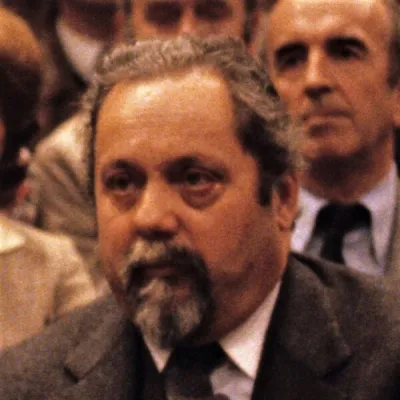
Alain Bombard
Human Design Chart
Biography
On 19 October 1952 Bombard began his solitary trip across the Atlantic for the West Indies. He sailed in a Zodiac inflatable boat called l'Hérétique, which was only 4.5 metres (15 ft) long, taking only a sextant and almost no provisions. Bombard reports he survived by fishing (and using fish as source of both fresh water and food) with a self-made harpoon and hooks and harvesting the surface plankton with a small net. He also drank a limited amount of seawater for a long period on his trip. Bombard reached Barbados on 23 December 1952 after 4,400 km of travel. He had lost 25 kg and was briefly hospitalized. He published a book about his trip entitled "Naufragé Volontaire" in 1953.
Bombard died in the southern French town of Toulon on 19 July 2005 at age 80.
The Human Design of Alain Bombard: Generator 2/4
Generator 2/4 — Design at a Glance
Alain Bombard revealed himself as someone with tremendous endurance, whose strength, however, depended on a specific condition: the reaction to external impulses. His design as a Generator had a lot of sacral energy, making him an extremely strong "workhorse" – provided he had energy for his task. This power did not ignite through his own initiatives but only became effective when life sent a signal and his inner self responded with a clear "Yes! Let's get started!"
The central mechanics of his design consisted in not initiating but reacting. Alain Bombard could materialize things in his life by waiting for signals from the environment and then acting upon them. This fundamentally differed from other types; his energy was primarily freed through this reactive approach.
If he followed this strategy, his design rewarded him with deep satisfaction and a sense of fulfillment. However, if he did not live according to this pattern – for example, by continuously initiating things himself or doing tasks that he had no desire to do – he would eventually encounter persistent frustration or energy deficiency. Two stumbling blocks shaped his potential: on the one hand, the risk of burnout through wasting energy on unwanted tasks, and on the other hand, blocking his heart project when prevented from pursuing it despite having full power. His strength lay in his ability to respond instinctively to what was offered to him.
Emotional Authority
Alain Bombard's Human Design profile sets a tendency towards emotional depth and cyclical perception. His inner authority is Emotional Authority, carried by his defined Emotional Center. This configuration fundamentally determines his decision-making strategy: he is subject to a constant wave motion of feelings, an up-and-down cycle that continually colors his view of the world. In moments of intense enthusiasm or deep disappointment, he sees the same circumstances filtered differently through his current mood.
This mechanism does not mean that his immediate feeling is wrong, but rather that it only represents a snapshot—a first impression that may not yet correspond to his deepest truth. Quick, spontaneous reactions from such an emotional peak could therefore be misleading and lead to negative consequences. Alain Bombard's strategy was to give this wave time. He needed patience to let decisions mature, often by sleeping on them multiple times or waiting until the intense feelings subsided.
Only when he gained this emotional distance and clarity and calmness set in had he completed the process. Then he could access his true inner truth. This ability for temporal distancing is particularly crucial for long-term life decisions, as it ensures that his choice does not stem from a passing mood but arises from a stable, well-considered insight.
The 2/4 Profile — Hermit / Opportunist
Alain Bombard's Human Design profile sets up a fundamental tension between the deep desire for withdrawal and the urge to connect with others. As a 2/4 Profile ("Natural Talent / Networker"), he constantly oscillates between Line 2, which demands solitude and inner reflection, and Line 4, which seeks time with familiar people. This dynamic required clear communication of his needs: He had to make it explicit when he wanted company and when he needed to be left alone. Only in this way could he use his "Me-Time" to process the knowledge from his network and develop new insights.
This structure was influenced by the dominant Sun at Gate 28, which made up about 70% of his energy. This gate represents an unwavering drive for victory, risk-taking, and intuition as the core of personal purpose. For Alain Bombard, life without playing to win was meaningless; he accepted risks and even unpleasant alliances to achieve his goals. Success wasn't guaranteed but heavily depended on how others perceived him. Criticism was part of the process and should not be taken personally, since it is a component of the development line "The Success." Through this configuration, a person emerged who acted intuitively, took risks, and whose motivation was significantly influenced by external recognition or rejection.
Single Definition — Defined & Open Centers
Alain Bombard's Human Design profile established a tendency towards a strong, constant energy base that was modulated by high receptivity to external influences. His defined Sacral Center generated an enormous daily power source, experienced as vital energy or restlessness. This energy was only available in response to external requests; the immediate yes-or-no answer of the Sacral determined whether full force stood behind a decision or not. Initiation without prior questioning led to this connection being interrupted and exhaustion setting in.
Additionally, his defined Solar Plexus Center acted as an inner authority that provided emotional depth and passion. Truth revealed itself here only over time through waiting out the emotional wave. Impulsive decisions at the peaks or troughs of this wave were characteristic of the non-self mode; clarity required patience, often sleeping on a decision. His defined Root Center also delivered a steady, adrenalized pressure that propelled him forward in the material world and nourished existential awareness.
In contrast, Head, Ajna, Throat, G, Heart, and Spleen were open. The open Head and Ajna Centers made Alain Bombard susceptible to mental stress, confusion, and adopting foreign ideas he could not interpret as his own truth. He tended to question whether he needed to find inspiring answers, which could distract from the correct decision-making process. The open G Center meant a lack of fixed identity; he adapted to his environment and often sought direction or love through others rather than initiating it himself. The open Heart Center led him to not have a consistent ego and try to prove his worth through promises or competition, ending in a cycle of self-disapproval if he failed. Finally, the open Spleen Center made him sensitive to health and survival fears; spontaneous decisions here were risky as they often stemmed from conditioned fears rather than genuine intuition. This configuration required placing one's own authority (Sacral/Solar Plexus) over the mental and identity-forming pressure of the open centers.
Channels for focus, details and emotional waves.
Alain Bombard's design established a tendency towards strong inner concentration, paired with a provocative presence. The Channel of Concentration 52-9 connected the Root Center to the Sacral Center through the Gate of Non-action (52) and the Gate of Focusing (9). This generated a permanent background process of detail evaluation and logical correction. Alain Bombard was someone who held still – like in a yoga pose – to keep distractions at bay and apply his energy precisely. This channel carried the qualities of the Understanding Circuit; it challenged him to correct and perfect patterns. Without an object of focus that confirmed his inner authority, restlessness could arise. The logic worked step-by-step, required time for confirmation or refutation of formulas, and served to maintain collective influence through precise attention.
Simultaneously, the juxtaposition of the Channel of Emotion Release 39-55 acted as an external provocateur. This channel connected the Root Center with the Solar Plexus Center through the Gate of Provocation (39) and the Gate of Mind (55). It did not represent its own activity but radiated a mercurial energy that stimulated the minds of others. The emotional wave – a continuum between joy and melancholy – served to strengthen perception and trigger mutation processes. Alain Bombard could through this mechanism tease out the nature of other people's minds; the effect depended on his current mood. This combination shaped his essence: a calm, focused inner side that challenged and tested outwardly through emotional wave movements without these being active actions.
Individual Circuitry — Circuit Signature
Alain Bombard's design was characterized by a tension between emotional transformation and rational structure. He possessed a simple, coherent definition that connected the Sacral, Root, and Solar Plexus Centers. This unity allowed for a direct energetic flow without internal fractures.
The Knowledge Circuit worked through him via the Channel 'Emotion Release', which linked the Solar Plexus to the Root Center. This generated a pulsating, acoustic energy aimed at expressing one's identity through emotional waves and initiating change. Simultaneously, energies of the Understanding Circuit shaped his actions. The Channel 'Concentration' here connected the Sacral with the Root Center. This promoted focused, logical analysis and strategic thinking, free from emotional influence, to share rational insights and shape the future.
The integration of these two circuits showed in the ability to connect emotional intuition (Solar Plexus) with rational endurance (Sacral/Root). While one aspect aimed at individual creativity and expressing the primal self, the other served logical structuring and sharing knowledge. Both streams converged in the Root Center, indicating that both emotional impulses and rational strategies were put into action through endurance and energy. His design thus established a tendency to unite unique identity with clear, future-oriented logic, focusing on authentic communication of these dual forces.
Right Angle Cross of the Unexpected 3
Alain Bombard's design was marked by the right cross of the Unexpected. This configuration set a foundational stance that embraced spontaneous and often unforeseen turns in life rather than planning or controlling them. In Human Design, this cross describes a dynamic where the individual learns to cope with surprises and accept them as natural parts of the flow of life. It wasn't about predicting events but reacting flexibly to what unfolded.
For Alain Bombard, this meant that his path was determined by unexpected developments he could not foresee or calculate in advance. The mechanics of this cross show how people with such configurations often find themselves in situations challenging them to let go of expectations and embrace the present moment. It was a life task to develop trust in the process even when the next step seemed uncertain.
This structure shaped his experiential world: instead of seeking fixed patterns, he had to learn to integrate unpredictability as part of his identity. The right cross of the Unexpected challenged him not to fight against the current but to go with it, enabling him to remain internally stable even in chaotic moments. His energy was directed towards using the unexpected as an opportunity for further development without needing to evaluate or analyze it.
Saturn Return · Uranus Opposition · Chiron Return · 2nd Saturn Return — Life Cycles
Alain Bombard's design featured phases of structural anchoring that corresponded with Saturn return cycles. These cycles mark stages of maturation and identity consolidation in Human Design mechanics. The first cycle, typically occurring around age 28, establishes the fundamental life structure. For Alain Bombard, this was evident in 1952: at age 28, he sailed from Monaco to Gran Canaria across the Atlantic without drinking water or food supplies. This event illustrated the consolidation of his basic identity through an extreme and independent feat.
The second Saturn return, beginning around age 57, deepens this structure on a higher level and is often associated with authority or institutional responsibility. Alain Bombard experienced this turning point in 1981: at age 57, he served as Secretary of State for the Ministry of Environment for one month. This assumption of political responsibility reflected the mechanics of the second cycle, where the previously established base was expanded to a position of societal integration and leadership. Both events demonstrate how Saturn cycles not only marked time periods but shaped concrete life phases: first through individual proof under extreme conditions, later by acquiring formal authority in public space. The structure of his design thus promoted development from personal capability to institutional anchoring.
Generator · Emotional Authority — Synthesis
Alain Bombard was a Generator whose life was deeply influenced by sacral energy. His ability to react to impulses and shape reality through action formed the foundation of his behavior. However, this reactivity coupled with emotional authority required patience and waiting for an internal wave before decisions could be made. The profile as a natural talent and networker revealed an interaction between the need for solitude for reflection and the desire for community, a rhythm that fueled his energy and gave him the opportunity to integrate knowledge and develop new ideas. A focus on details (Gate 28) and releasing emotions (Channel 39-55) pointed towards a capacity to delve deeply into topics and initiate transformation through authentic expression.
Bombard lived in a paradox between the drive for activity and the necessity of waiting for his inner truth. As a Generator, he was meant to react, not initiate, yet his emotional center challenged him to make decisions only after careful consideration. This tension manifested as an ongoing interplay between the need to release sacral energy and the emotional clarity achieved by waiting for the wave – a dynamic balance that shaped his lifestyle and enabled him to face challenges with persistence.
2 Defined Channels
Incarnation Cross - Right Angle Cross of the Unexpected 3
Solar Return
The Solar Return shows the moment when the sun returns to its exact birth position - your personal solar year.
Life Cycles
Discover the life cycles with a detailed triple view (birth chart, cycle chart, composite).
Human Design Profile
- Type
- Generator
- Strategy
- To respond - wait for something to respond to
- Authority
- Emotional Authority
- Profile
- 2/4 - Hermit / Opportunist
- Definition
- Single Definition
- Incarnation Cross
- Right Angle Cross of the Unexpected 3
- Date of Birth
- 27.10.1924 09:30
- Place of Birth
- Paris, France
Frequently Asked Questions
What is Alain Bombard's Human Design type?
What Profile did Alain Bombard have?
Which authority guided Alain Bombard?
What incarnation cross did Alain Bombard have?
When was Alain Bombard born?
Discover your own Human Design
Are you also a Generator? Find out in a personal reading how to use your sacral energy correctly and discover deep satisfaction.
More Personalities
Back to overviewAaliyah

Alexia

Angèle

Anne-Marie

Arcángel

Arno
