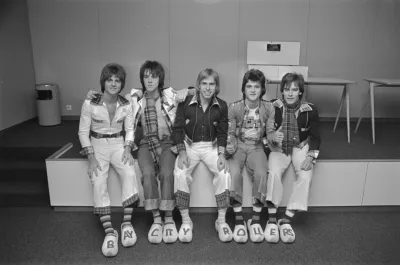
Photo: Wikimedia Commons
Alan Longmuir
Human Design Chart
Biography
Alan suffered with depression, a drinking problem and a marriage that struggled from 1985 to 1990. In 1995 he suffered a heart attack and on 1 February 1997, he had a stroke brought on by a blood clot in the brain.
Longmuir died on 2 July 2018, aged 70, in Forth Valley Royal Hospital in Larbert, Scotland, after contracting an illness while on holiday in Mexico.
Alan Longmuir — Reflector with Profile 2/4
Reflector 2/4 — Design at a Glance
Alan Longmuir's design lacked defined centers, which did not endow him with constant, inherent energies. Instead, he acted as a mirror of his environment, intensively absorbing the energies of other people and nature. This configuration marked him as someone who was strongly influenced by external influences and cyclical changes such as seasons or astronomical constellations.
For Alan Longmuir, it was essential to live in harmony with these natural rhythms. His strategy involved waiting for at least a month, a complete lunar cycle, before making important decisions. This pause allowed him to observe and integrate the changing energies before taking action. By following this strategy, he naturally found environments and people that suited him.
This path led him to observe the world free from attachment and identification. As a reward for this attitude, he experienced a feeling of joyful surprise. Conversely, if he lived against this design, it manifested as a deep, lasting disappointment, directed both at himself and the state of the world. His Human Design thus described a lifestyle based on perception, patience, and reflection of the environment, rather than internal, constant stability.
No Inner Authority
Alan Longmuir's design lacked an internal, physical authority. This configuration was rare and marked him as a Mental Projector. His chart showed no defined centers below the Throat Center. This openness fundamentally shaped his decision-making process. He did not orient himself based on internal impulses but sought exchanges with other people. Through these dialogues, energetic interactions in his open centers activated latent potentials, providing him with specific information and enabling him to view issues from multiple perspectives. The high resonance capability in his openness helped him identify the right environment and suitable conversation partners.
Evaluating these diverse impressions was a complex process that required time and solitude. Only in silence could he discern the thread and distinguish what made sense and what belonged to him. Through this filtering, he developed his specific intelligence: extracting the essential from a mass of information, meaningfully organizing and structuring it. This formed his capital as a projector. A key element in his life was choosing an environment where he felt comfortable. There, he met people with whom he could exchange confidently. This confident dialogue deepened his sense of what was right for him over time. His strength did not lie in quick intuition but in the careful synthesis of external inputs through targeted exchange and subsequent internal processing.
The 2/4 Profile — Hermit / Opportunist
Alan Longmuir's design was characterized by a fundamental tension: the simultaneous strong desire for deep solitude and the urge for close community. As a person with Profile 2/4, he constantly oscillated between these poles. Line 2, the Hermit Line, demanded withdrawal to gain clarity in internal processes and find peace. Without this 'me-time,' he could not regenerate. At the same time, Line 4, the Community Line, irresistibly drew him to his favorite people. His design required him to create a safe, loving environment where he could clearly communicate when he sought company and when he needed solitude.
This dynamic was not a weakness but a source of brilliant ideas. In solitude, he reflected and evaluated the knowledge he had gathered in his network. Line 4 enabled him to take a social influence through his contagious nature and as a 'spiritual warrior,' to preserve his innocence in a fixed perspective. Line 2 brought humility and the correct action in his often perceived as extreme or bizarre rhythm from the outside. Alan Longmuir used this range to delve deeply into himself and interact effectively with others, as long as he maintained the balance between cave and network.
No Definition — Defined & Open Centers
Alan Longmuir's design was characterized by the complete openness of all nine centers, making him a so-called Open Gate or Blank Slate. His chart contained no defined energy centers, meaning he did not have a constant, personal energy source for thinking, feeling, wanting, or acting. Instead, he functioned as a pure mirror medium, absorbing and reflecting the energies of his environment.
This configuration fundamentally shaped his lifestyle. His open Head Center made him vulnerable to mental confusion and the pressure to find answers to others' questions without having them himself. The open Ajna Center allowed him to think flexibly and adopt ideas but tended to misinterpret concepts as his own truth. His open G Center meant he had no fixed identity or life direction; he often sought a 'right place' or relationship to anchor himself rather than generating this from within himself.
The open Heart Center made him sensitive to the pressure to prove his worth, while the open Sacral Center led him to amplify the vital energy of others without producing it consistently, which could lead to exhaustion. His open Solar Plexus absorbed the emotions of the environment, making him a sensitive barometer for the emotional climate but also vulnerable to others' moods. The open Spleen Center made him take on intuitive fears that were not his own, and the open Root Center amplified the stress and adrenal impact of his environment without generating it himself. Finally, his open Throat Center meant he could not communicate consistently but had to wait for the right invitation and timing to raise his voice.
This total openness required Alan Longmuir to not identify with the absorbed energies. His mechanics lay in acting as a neutral observer, reflecting the wisdom and mistakes of those around him without personalizing them. He was designed to go through life and learn through interactions with others rather than embodying a fixed, unchanging structure.
Channels & Gates
Alan Longmuir's design was characterized by a deep rooting in the collective and an intense, body-focused dedication. His essence was marked by the ability to adapt to natural rhythms, supported by Gate 15, the Gate of collective behavior and humility. This logical gate helped him establish the flow within groups and understand himself as part of a larger whole without losing his individual profile.
At the same time, a strong individual component was present, steered by Gate 10 in the G Center. As one of the most complex gates, it allowed him to integrate through genetically predetermined behaviors and strengthen his own convictions. This combination of adaptability and inner structure created a balance between what was expected from the outside and what he internally deemed right.
Spiritual innocence and the search for unconditional love were further central aspects of his design, expressed through Gate 25. This gate promoted a mystical attitude, enabling him to focus on the essential and meet himself and others with a kind of centeredness that went beyond the purely intellectual. It was a gate of individuation, helping him locate his own identity in a spiritual context.
Finally, Alan Longmuir showed a deep connection to his physical body, marked by Gate 46. This gate emphasized the importance of engagement and dedication in the here and now. It taught him to care for the body as a temple and find happiness and discovery through full participation in life. This physical presence and willingness to give oneself to the process of life were crucial for his well-being and ability to succeed in various situations.
Circuit Signature
Alan Longmuir's design was revealed as an open, unstructured energy configuration that did not show any fixed internal connections. His chart was marked by 'No Definition,' meaning none of his energy centers were linked by channels. There were no stable, recurring patterns or automatic responses stemming from an internal logic. Instead, he was completely open to the influence of his environment and the people he interacted with.
This configuration described a person not defined by their own rigid beliefs or fixed roles. Alan Longmuir lived in a state of constant adaptation and absorption. Since no centers were defined, there were no 'blind spots' in the sense of unconscious but active patterns he could not question. At the same time, he lacked the internal stability that arises from connected centers. He was a mirror for others, reflecting the energies and themes of his environment without owning or internalizing them.
His life was marked by this flexibility and the absence of a fixed internal structure. He could immerse himself in various roles and situations since he had no dominant energetic streams pulling him in a specific direction. This openness allowed him to start anew and change without being bound by past patterns. Alan Longmuir was an example of the human ability to exist without a fixed internal framework and yet take shape through interaction with the world. His experience was one of learning through life itself, not through the enactment of predefined energetic scripts.
Right Angle Cross of the Vessel of Love 2
Alan Longmuir's design carried the signature of the right cross of the Love Vessel 2. This configuration described a specific energetic alignment that manifested in the way he engaged and understood emotional connections. It was not about superficial feelings but a deep-seated structure that shaped his interpersonal dynamics.
In Human Design mechanics, this cross represents a particular quality of love and emotional intelligence. It points to the ability to grasp the essence of relationships and live them with a certain intensity and authenticity. Alan Longmuir, through this mechanism, was someone capable of generating and receiving deep emotional resonances. His design suggested that he understood relationships not just as social interactions but as transformative experiences that filled and shaped his inner vessel.
The specific expression of this cross influenced his entire life approach. It created a foundation on which he could harmonize his emotional needs with those of his environment. This led to a kind of presence that attracted others, as it spoke of a genuine, unpretentious emotional depth. Alan Longmuir's chart thus revealed a person whose life was strongly determined by the quality of her emotional bonds, which formed a central pillar of her personal development and work.
Saturn Return · Uranus Opposition · Chiron Return · 2nd Saturn Return — Life Cycles
Alan Longmuir's life followed a rhythmic pattern of structural condensation and necessary change. His design foresaw that he would go through phases of consolidation at regular intervals, followed by times of deep transformation. The first Saturn return marked the transition from experimental youth to a phase of responsibility, where he laid the groundwork for his future work. This period served to stabilize and build solid structures.
Following this was the Uranus opposition, a cycle that challenged established patterns. Here, an inner drive for freedom and reorientation was evident, pushing him to break old ties and forge new paths. This conflict between security and change significantly shaped his middle life phase.
The Chiron return around the age of 50 marked the peak of his personal unfolding. During this period, understood as a phase of bloom, his individual life purpose became tangible. If he had followed his inner strategy, he experienced an increasing sense of purpose and fulfillment of his path. This was not about healing in a medical sense, but about the realization of his incarnation purpose.
The second Saturn return rounded off this cycle. In this late phase, it was about integrating all previous experiences. Alan Longmuir faced the task of organizing his legacy and internalizing the wisdom of age. This cycle brought peace and closure by transforming the previously gathered insights into a coherent life balance.
Reflector · No Inner Authority — Synthesis
Alan Longmuir lived as a Reflector, whose essence lay in reflecting the energy of the environment and aligning with its cycles. He did not have constant, internal energies but perceived the world as a mirror, which made him an observer without a fixed identity. This openness, combined with an undefined Head Center, led to a constant fluctuation of mental impulses and a tendency to get lost in foreign thoughts. The search for clarity he found not within himself, but in exchange with others to gain understanding through their perspectives. His profile as a natural talent and networker reinforced the oscillation between the need for withdrawal and the desire for community, where he found clarity in isolation to reconnect with others.
A central paradox in Alan Longmuir's design lay in the tension between his complete openness and his ability, through Gate 15, to naturally perceive rhythms and collective behavior in his environment. Although he had no fixed internal energies, he could still recognize patterns and flows in his surroundings and adapt to them. This ability to reflect the world and simultaneously perceive a logical flow within it created a dynamic balance between adaptation and observation, which shaped his life.
Incarnation Cross - Right Angle Cross of the Vessel of Love 2
Solar Return
The Solar Return shows the moment when the sun returns to its exact birth position - your personal solar year.
Life Cycles
Discover the life cycles with a detailed triple view (birth chart, cycle chart, composite).
Human Design Profile
- Type
- Reflector
- Strategy
- Wait a lunar cycle (approx. 28 days)
- Authority
- No inner authority - learn more
- Profile
- 2/4 - Hermit / Opportunist
- Definition
- No Definition
- Incarnation Cross
- Right Angle Cross of the Vessel of Love 2
- Date of Birth
- 20.06.1948 23:35
- Place of Birth
- Edinburgh, United Kingdom
Frequently Asked Questions
What was Alan Longmuir's Human Design type?
What profile did Alan Longmuir have?
What authority did Alan Longmuir have?
What incarnation cross did Alan Longmuir have?
When was Alan Longmuir born?
Discover your own Human Design
Are you also a Reflector? Find out in a personal reading how to find the right environment and understand your unique mirror effect.
More Personalities
Back to overviewAaliyah

Alexia

Alizée

Angèle

Anne-Marie

Arcángel