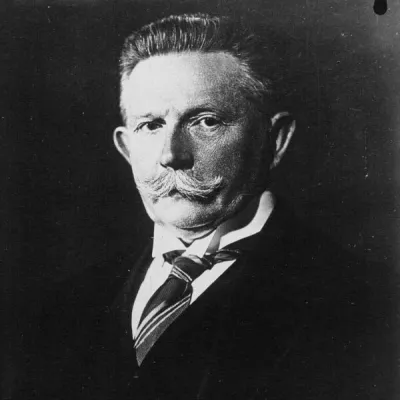
Alfred Hugenberg
Human Design Chart
Biography
Hugenberg's fundamental political and philosophical principles can be traced back to his youth. His university studies and early work organizing agricultural societies led him to view the independent farmer or small businessman as the ideal German. He believed in social Darwinism, despised communism, socialism and trade unions, and was in general skeptical of big business and finance. He thought that Germany needed an authoritarian government – ideally a monarchy – and strongly supported nationalism and imperialism in the belief that Germany could be secure only as a great power.
What does Reflector 1/3 mean for Alfred Hugenberg?
Reflector 1/3 — Design at a Glance
Alfred Hugenberg revealed himself as someone whose inner compass did not consist of firmly anchored personal convictions, but rather acted like a mirror reflecting his surroundings. His design lacked defined centers, meaning he didn't possess constant, personal energies. Instead, he absorbed the currents of his environment – whether human interactions or natural cycles such as seasons and planetary constellations – with extreme intensity. This configuration predisposed him to reflect the energy of the world rather than generate it independently. For this way of life, living in harmony with natural rhythms was crucial; when faced with important decisions, waiting for at least one lunar cycle was key to gaining clarity. By letting go of attachments and observing the world without personal projection, he could experience moments of joyful surprise. However, if he lived against his design by trying to take firm positions or make decisions without this waiting period, it led to deep, lasting disappointment with himself and the state of the world. His role was not to proclaim an unchanging truth but rather to serve as a sensitive indicator for the current time, where his satisfaction directly depended on his ability to reflect without personal identification.
No Inner Authority
Alfred Hugenberg did not possess inner physical authority – a rare trait that marked him as a mental projector. His design showed no center activation below the Throat Center, which meant he relied on an alternative path to decision-making: exchanging ideas with many different people. Through these dialogues, dormant potentials in his open centers were activated, allowing him to view and express issues from numerous perspectives. This high resonance ability helped him find the right environment and conversation partners for this intense exchange.
The analysis of the gathered information was a complex process that required time and especially solitude. Only in retreat could Alfred Hugenberg discern the thread, distinguish what made sense and truly belonged to him. Thus, he developed his specific intelligence: filtering out the essential from a mass of data, organizing it meaningfully, and structuring it. This formed his central capital for success as a projector. A key element in his life was being in an environment that brought him well-being. There, he was surrounded by trustworthy people with whom he could discuss decision-making processes. Over time, this trusting exchange deepened his sense of what was right for him and which paths to take.
The 1/3 Profile — Investigator / Martyr
Alfred Hugenberg showed himself as someone who not only collected knowledge theoretically but also tested it through hard practice. His design as a researcher and experimenter (Profile 1/3) set a tendency to understand the world through trial and error. For him, self-acquired experience was the highest good; any judgment of his always rested on double testing: theoretical planning and practical trial runs.
This mechanism arose from the tension between his Line 1, which demanded conscientiousness and the pursuit of harmonious order, and his Line 3 in Gate 25. This line drove him to sensitivity for the individual and the 'here and now'. Success was not a primary goal for Hugenberg but rather a byproduct of authentic action. Yet, Line 3 also brought with it the necessity to endure shocks and failures. The realization that innocent or purely planned actions do not guarantee success shaped his path. When Hugenberg believed something was right, he had previously tested this matter both conceptually and in reality thoroughly. His design challenged him to overcome fear of insufficient knowledge to follow the urge for practical implementation. Only through this active testing could he find his deeper truth and offer a trustworthy judgment to others.
No Definition — Defined & Open Centers
Alfred Hugenberg revealed himself as someone who operated without internal, stable energy sources. His design showed no defined centers – all nine areas were open. This meant that he did not have his own stable identity or willpower but instead absorbed and reflected these qualities from his environment.
His open Head Center and Ajna Center made him vulnerable to mental pressure. He tended to lose himself in other people's thoughts and sought inspiration externally rather than generating his own answers. At the same time, his open Solar Plexus absorbed the emotions of his surroundings. Instead of having stable feelings of his own, he mirrored moods, making him susceptible to emotional conditioning.
The open Heart Center led him to often seek validation for his worth from outside sources. He tried to keep promises and prove himself in order to gain recognition, even though he lacked the consistent energy needed to do so. His open G Center also meant that his direction and love were determined by others; he found his place only in correct environments that initiated him.
His open Sacral and Root Centers contributed to this dynamic as well. He took on foreign vitality and stress, which could lead to overload since he did not know when enough was enough. His open Throat Center attracted attention only when he waited; active speaking for self-assertion often had unpredictable results. Finally, his open Spleen reflected the health of others rather than possessing his own intuition. Alfred Hugenberg thus lived in constant interaction with the field around him, characterized by absorption and reflection.
Channels & Gates
Alfred Hugenberg revealed himself as someone deeply rooted in the collective flow, embodying a paradoxical mix of individual mysticism and strict adaptation to societal rhythms. His design inclined towards a centered, almost priestly stance that did not appear isolated but manifested through full immersion in the present moment – or more precisely: showed up as a present force within the group.
This dynamic drew from Gate 15, the logical gate of collective behavior. It established the flow within societies and fostered humility born out of adapting to natural rhythm patterns. Alfred Hugenberg thus held a magnetic monopoly on understanding how groups organize; he was part of the collective fabric, not merely an observer of it.
Simultaneously, Gate 10, the most complex gate in the emotional center, shaped his life through genetically predetermined behaviors and served as one of the gates of love. It supported the integration process and helped him form personal convictions – often in conjunction with Gate 34 to secure survival through appropriate behavior at the right time. This dominance of Profile Gates lent a certain inevitability and depth to his reactions.
Gate 25 added the spiritual dimension: the stance of innocence and individualization. It allowed access to unconditional love via a mystical channel, where an inner "shaman" tested this innocence in the process. Together with Gate 10, it aimed at centering the individual even within complex social structures.
Finally, Gate 46 shaped his way of participation. It stood for determination and immersion in the collective. Success for Alfred Hugenberg did not come from passive waiting for luck but through active engagement and nurturing the physical body as a temple. His happiness resulted from this effort and the ability to always be present at the right place and time – a serendipity that rested on full commitment.
Circuit Signature
Alfred Hugenberg revealed himself as someone whose energetic landscape was defined by a complete absence of clearly delineated internal connections. His design contained no centers connected by channels; all nine energy centers remained undefined and isolated from one another. This "No Definition" meant that there was no automatic, innate flow of energy between different aspects of his personality. There was no inherent bridge linking, for example, his intuition directly with his will or emotional waves. Instead, he lived in a state of maximal openness and receptivity to external influences. Since there were no internal structures prescribed, Alfred Hugenberg could act like a mirror: He absorbed the energies, moods, and demands of his environment and reacted to them without an inner compass needle guiding or filtering these reactions. This created immense flexibility but also constant dependence on context. His actions and attitudes were not determined by a stable inner core but arose situationally from interactions with other people and events. Without defined groups, there were no separate, parallel-running energy blocks; instead, there was a blank canvas upon which different patterns could emerge depending on the situation. This configuration allowed him to slip into various roles and meet others' expectations since his design did not present rigid internal resistances or set priorities that would have hindered such adaptations.
Right Angle Cross of the Vessel of Love 2
Alfred Hugenberg exhibited a fundamental disposition deeply marked by a profound, almost fateful attachment to his own emotional essence. His design carried the 'Right Cross of the Vessel of Love', a configuration that did not describe superficial romance but rather an intense, often passionate commitment to what he felt was fundamentally right and valuable. This structure acted like an inner compass urging him not only to live his deepest feelings and convictions privately but also to make them the foundation of his entire existence. It was an energy capable of both creation and destruction depending on whether this inner truth was acknowledged or fought against. Alfred Hugenberg lived in a constant tension between the desire for absolute authenticity and the external demands of his environment. His decisions were less driven by rational calculations but rather by this deep, almost mystical connection to his innermost core. This created a personality that either worked with great intensity and conviction or retreated inward when this inner truth was not respected. The mechanics of this cross demanded unconditional loyalty to his vessel of love, which significantly shaped Alfred Hugenbergs path through life and motivated his actions in ways often difficult to grasp purely by logical standards.
Saturn Return · Uranus Opposition · Chiron Return · 2nd Saturn Return — Life Cycles
Alfred Hugenberg showed himself as someone who radically realigned his professional orientation at cyclic turning points. In 1908, at the age of 43, he left public service and joined the board of the Frankfurt Berg- und Metallbank. This step marked the Uranus Opposition, a phase where old structures often prove too confining and abrupt changes become necessary. Hugenberg used this pressure not for destruction but to reorient towards greater autonomy in the financial sector.
His design required continuous adaptation to external circumstances, which became evident in subsequent years. In 1914 at age 49, he reached his Chiron Return. During this fulfillment cycle where one's life purpose increasingly crystallizes, he stepped down from management and instead founded Auslands GmbH. This was not a retreat but a focus on his true calling: the creation of new independent structures reflecting his inner compass.
The second Saturn Return in 1922 at age 57 crowned this development. The founding of Mutuum Darlehen Aktiengesellschaft showed a mature integration of earlier experiences. Here, years of groundwork condensed into a stable, viable result. Hugenberg did not follow rigid plans but reacted to the specific demands of each cycle: Uranus demanded rupture, Chiron meaning-making and Saturn consolidation. His career was thus not a linear rise but a sequential response to cosmic impulses leading him from administration towards self-responsible business founding.
Reflector · No Inner Authority — Synthesis
He was a mirror of his time, marked by openness to external influences and constant striving for knowledge. As a Reflector without defined centers, he intensely perceived the energy of his environment (Design View) and reflected this in his actions. This pattern manifested repeatedly through professional new beginnings – exiting established structures followed by founding new enterprises (Cycles) – an expression of adaptability to the respective environment and its associated cycles. The Line 1/3 in Profile amplified this process through systematic testing and experimentation with new possibilities, always searching for valid knowledge and practical application (Profile Role).
A central paradox lay in the lack of inner authority (Authority) alongside a pronounced ability to integrate complex information (Gate 10). While other types rely on their inner voice, he depended on grasping the energy of others and gaining insights through dialogue. This likely led to constant tension between the need for independent evaluation and the necessity to engage with external impulses – a dynamic interaction making him an observer and mediator but also vulnerable to confusion by countless thoughts (Centers).
Incarnation Cross - Right Angle Cross of the Vessel of Love 2
Solar Return
The Solar Return shows the moment when the sun returns to its exact birth position - your personal solar year.
Life Cycles
Discover the life cycles with a detailed triple view (birth chart, cycle chart, composite).
Human Design Profile
- Type
- Reflector
- Strategy
- Wait a lunar cycle (approx. 28 days)
- Authority
- No inner authority - learn more
- Profile
- 1/3 - Investigator / Martyr
- Definition
- No Definition
- Incarnation Cross
- Right Angle Cross of the Vessel of Love 2
- Date of Birth
- 19.06.1865 23:45
- Place of Birth
- Hanover, Germany
Frequently Asked Questions
What was Alfred Hugenberg's Human Design type?
Which Profile did Alfred Hugenberg have?
What Authority did Alfred Hugenberg have?
What incarnation cross did Alfred Hugenberg have?
When was Alfred Hugenberg born?
Discover your own Human Design
Are you also a Reflector? Find out in a personal reading how to find the right environment and understand your unique mirror effect.
More Personalities
Back to overviewBaekhyun

Christian-Jaque
Jihyo

Marilyn

Pelé
Squeezie