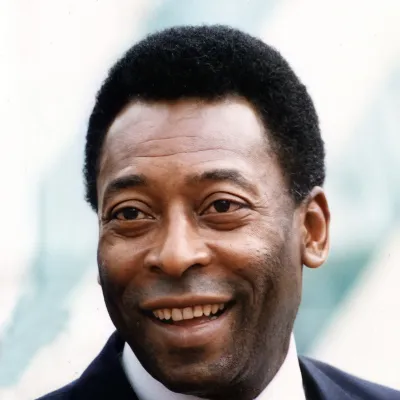
Pelé
Human Design Chart
Biography
During his career, he became known as "The Black Pearl" (A Pérola Negra), "The King of Football" (O Rei do Futebol), "The King Pelé" (O Rei Pelé) or simply "The King" (O Rei).
Pelé came from a poor family in the impoverished town of Tres Coracoes, Brazil. His family called him "Dico" but his young soccer friends nicknamed him "Pelé." As a kid, he shined shoes. At 11, he was discovered by Waldemar de Brito, the country's best soccer player.
In 1956, he began his professional career with Santos FC. The club won nine championships between 1958 and 1969. Pelé quickly became the top scorer in the soccer league. He became not only a legend in his own country but all around the world. In 1967, Nigeria called a 48-hour cease fire so the athlete could play an exhibition match in the capitol of Lagos. Most soccer players careers lasts around five years. Pelé played - at his peak - for 18 years.
In 1970, Pelé played his last World Cup game final. He retired from the Santos Football Club after the 1974 season. In 1975, when he discovered the extent of his financial debts he returned to soccer and played for the New York Cosmos from 1975 to 1977. In 1994, Pelé was named Brazil's Minister of Sports.
By 1990, he was the representative of Warner as well as the owner of a restaurant under his nickname of "Pelé."
Pelé married three times and had seven children.
Pelé — Manifesting Generator with Profile 2/4
Manifesting Generator 2/4 — Design at a Glance
Pelé's Design featured a tendency for rapid implementation based on a hybrid energy source: the combination of Manifestor speed with the constant power of the sacral center. This configuration allowed him to skip steps and draw quick results into his life. However, this speed also carried risks. Without first responding to external impulses, there was a danger of missing important stages or starting multiple projects simultaneously, which could quickly lead to frustration – the specific non-self theme for this type.
The mechanics of the Manifesting Generator therefore do not require initiation but rather response. Pelé was most effective when he waited until life spoke to him and then checked if his sacral center confirmed with a clear "Yes! I love it!" Only this inner validation ensured that his creative power did not end in exhaustion.
Deep satisfaction arose for him through variety and a playful approach to his tasks. The pressure to complete one thing before starting another contradicted his nature. Instead, his energy flourished when he fell into a "play mode" and pursued various impulses sequentially or simultaneously – provided each step was secured by this inner approval. Thus, potential frustration transformed into sustainable satisfaction.
Sacral Authority
Pelé's Design inclined him to make decisions not in his Head Center but from his body. He showed himself as someone who reacted to external stimuli with immediate physical signals – an inner "gut feeling" that often manifested in sounds like grunting or a palpable surge of strength. This mechanism is determined by his defined Sacral Authority. As a Generator, Pelé was the only type whose strategy and internal authority were identical: waiting for the impulse. This greatly simplified his decision-making process as he wasn't torn between two instances.
The prerequisite for this clear leadership was his open Emotional Center. When Pelé's sacral motor engaged with something, a state of vibrant aliveness ensued. He possessed inexhaustible energy and tackled his tasks with great enthusiasm. His Design helped him to go through life with joy and satisfaction, fully immersed in his duties – without any sense of obligation. The authenticity of this physical reaction was the measure for his enjoyment of action. Instead of intellectual deliberations, he trusted this direct connection to his own energy flow, which allowed him to act spontaneously and powerfully when the inner resonance felt right.
The 2/4 Profile — Hermit / Opportunist
Pelé's Design revealed a tendency towards tension between the desire for withdrawal and the wish for community. He was someone who constantly oscillated between two poles: the urge to be alone to gain clarity, and the desire to spend time with his favorite people. This dynamic of Profile 2/4, "Natural Talent / Networker," requires a safe environment where availability can be clearly communicated – when company is desired and when silence is needed.
During his solitary times, Pelé immersed himself in internal processes to find peace. When this phase satisfied the need of Line 2, he emerged from "his cave" to reconnect with his network. This shift allowed him to reflect on the knowledge of his network during solitude and develop brilliant ideas from it. The second line brought determination and intelligence but could encounter resistance if values were not yet established; here friends helped overcome this resistance. Simultaneously, the fourth line worked through clever calculation and the role of storyteller to convey messages and seize appropriate opportunities. Thus, the synthesis of hermitage and community need became a powerful source for innovation and connection.
Split Definition — Defined & Open Centers
Pelé's design established a massive, constant inner energy infrastructure: Sacral (Engine), Heart (Willpower/Ego), Throat (Manifestation) and Root (Stress/Pressure) were defined. This created a reliable source of vital energy, the ability to fulfill promises as well as a consistent expression in the world driven by the pressure from the Root Center. In contrast, Head, Ajna, G-Center, Solar Plexus and Spleen remained open. Pelé showed himself to be someone with enormous inner strength and endurance, yet without a fixed internal identity or emotional independence. His challenge lay in not initiating the immense defined energy through the pressure of the open centers but rather waiting for stimuli.
An open G-Center meant that he did not have a consistent direction and tended to ask where he could find love or his place instead of generating it himself. The open Solar Plexus Center made him vulnerable to absorbing and amplifying emotions from the environment, which could lead to inner unrest if he identified these as his own. Also, the open Spleen Center carried fears about survival security, making spontaneous decisions risky and often based on conditioning rather than true intuition.
The mechanics describe that Pelé had to learn to use his willpower and manifestation power only after reacting correctly, instead of initiating from a need for identity or emotional validation. His defined centers offered the strength, but the open G- and Solar Plexus Centers required patience: He had to wait until the environment initiated him to use his energy correctly rather than acting out of uncertainty or emotional waves. Thus, his strength was effective when he waited for stimuli instead of acting from the open field.
Channel 3-60: Mutation — Channels & Gates
Pelé's design set a tendency towards evolutionary change that did not proceed linearly but pulsatingly. This dynamic manifested through Channel 60-3 (Mutation), connecting Root Center with Sacral Center. This channel brings unpredictable energy oscillating between chaos and order. Gate 60 (Limitation) requires accepting limits as a pivot for new possibilities, while Gate 3 (Ordering) tries to realize these novel impulses. The associated melancholy is not a deficit but a sign of inner processing; the change often occurs unexpectedly in pauses between active pulses. Patience and waiting time for internal reactions were crucial here to channel this mutative force constructively.
Parallelly, Line 21-45 (Money) shaped his relationship with the material world. This channel connects Heart Center with Throat Center through Gate 21 (Hunter) and Gate 45 (Collector). It demands material mastery through will expression and control over resources. The challenge lay in the tension between hard work and not overloading the heart. Independence was key: Pelé worked best when he exercised his own leadership and followed his natural rhythm rather than submitting to foreign structures. The ability to take responsibility for the material plane – 'I have or I don't' – served to protect and provide for his surroundings. Both channels together created a profile seeking innovation through inner discipline and material security through self-determined will.
Individual Circuitry — Circuit Signature
Pelé's design set a tendency towards pulsating, innovative energy that manifested in two clearly separated systems. Through his Split Definition, there were no continuous internal connections between these areas; they acted as parallel, independent forces.
In the Knowledge Circuit, Channel 3-60 (Mutation) connected Sacral with Root Center. This connection generated an acoustic, now-oriented energy aimed at following one's unique path and transforming new knowledge. The mutation as deviation from the known strengthened the expression of a unique identity.
Completely differently presented itself the Ego Circuit. Here Channel 21-45 (The Money Line) connected Heart with Throat Center. This timeless, conservative energy served cooperation and joint creation of resources within the tribe. Since this circuit lacks connection to Sacral Center, there was no constant life force; instead, pauses were necessary to generate resources for the tribe and balance the give-take relationship.
Pelé thus showed himself as someone driven by innovative impulses towards change on one hand, yet acting in a traditional, resource-oriented framework that required pauses. These two systems – one pulsating and transformative, the other timeless and cooperative – existed alongside each other without directly flowing energy between them.
Right Angle Cross of Laws 3
Pelé's Design established a deeper archetypal imprint that goes beyond the individual mechanics of Gates and Channels. He was someone whose identity was structured by the "Right Cross of Law 3" – a specific energetic signature that significantly determined his life path. This configuration represents not a random pattern but an inherent destiny pattern that worked as a fundamental level of his existence.
In Human Design, such a cross defines the essence of who a person is at their core, independent of external circumstances or conscious decisions. It's an archetypal assignment that shapes the foundational identity level. For Pelé, this meant that his nature was formed by this Law 3 configuration, which gave him a specific inner logic and orientation. This structure is not learnable or changeable; it is the foundation upon which all other energetic aspects of his design rest.
Since no concrete events are listed in the raw content, the focus remains on this abstract assignment. It's about the pure essence of this pattern: an unshakable basis of identity and destiny. Pelé’s Design carried this signature as a constant background that influenced his life path and self-understanding at a deeper level without necessarily being visible in specific historical data. The emphasis is thus on the archetypal significance of this cross-configuration as a defining factor of his inner structure.
Saturn Return · Uranus Opposition · Chiron Return · 2nd Saturn Return — Life Cycles
Pelé's Design established a tendency towards cyclical structuring, where life phases condensed around clear milestones. His first Saturn return around the age of 30 often marked the transition from training to established authority. This was concretely evident in 1970 when he played his last World Cup final match – a moment when years of athletic groundwork matured into a solid, conclusive result and cemented his position in this domain.
The following phase led to his Chiron return between the ages of 49 and 51. This cycle is not a traditional healing process but an achievement cycle where one's incarnation cross unfolds and personal meaning becomes tangible. Pelé used this time for realignment: In 1990, he became a representative for Warner and owner of a restaurant. Here, his inner bloom manifested outwardly as he transferred his identity into new business structures and anchored his life purpose in another sphere.
His second Saturn return around the age of 58 (here slightly earlier) served to integrate these experiences finally. In 1994, he was appointed Brazilian Minister of Sport. This appointment was no coincidence but rather the logical consequence of a design that had matured through previous cycles. It anchored his long-standing presence in an official, structural role and completed the arc from individual achievement to institutional responsibility.
Manifesting Generator · Sacral Authority — Synthesis
Pelé's Design reveals a central theme of the dynamic interplay between inner energy and external expression. As a manifesting generator with Sacral Authority, he responds to life, but his connection to the Throat Center gives him an accelerated ability to set things in motion. This combination of reaction and initiation, reinforced by the Channel of Mutation (Gate 60/3), shapes a character deeply rooted in the present moment yet constantly seeking new possibilities – a player whose energy unfolds in rapid bursts. The openness of his centers for emotions and identity suggests that he absorbs and transforms the energies of others, enhancing his ability to be an influential force shaped by and shaping its environment.
A central paradox in Pelé's Design lies in the tension between the need for alone time (Line 2) and the desire for community (Line 4). This Profile reflects an inner dynamic requiring constant oscillation between retreating for reflection and seeking connection with others. Simultaneously, this tension is amplified by his defined Heart Center – a strong need for control and self-determination – which contrasts with the open centers that make him receptive to external influences. This apparent contradiction drives him both to seek his own inner truth and engage in community.
2 Defined Channels
Incarnation Cross - Right Angle Cross of Laws 3
Solar Return
The Solar Return shows the moment when the sun returns to its exact birth position - your personal solar year.
Life Cycles
Discover the life cycles with a detailed triple view (birth chart, cycle chart, composite).
Human Design Profile
- Strategy
- To respond - wait for something to respond to
- Authority
- Sacral Authority
- Profile
- 2/4 - Hermit / Opportunist
- Definition
- Split Definition
- Incarnation Cross
- Right Angle Cross of Laws 3
- Date of Birth
- 21.10.1940 03:00
- Place of Birth
- Três Corações (Minas Gerais), BRAS
Frequently Asked Questions
What is Pelé's Human Design type?
What profile does Pelé have?
What authority does Pelé have?
What incarnation cross is assigned to Pelé?
When was Pelé born?
Discover your own Human Design
Are you also a Manifesting Generator? Find out in a personal reading how to unfold your multi-talents and direct your energy wisely.
More Personalities
Back to overviewAldair

Alizée

Angeli

Arletty

Artus

Balthus