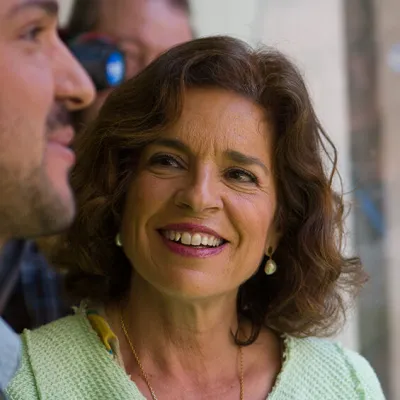
Ana Botella
Human Design Chart
Biography
Botella and former Spanish prime minister José María Aznar have been married since 1977 and have three children: José María, Ana, and Alonso.
Ana Botella — Reflector with Profile 6/2
Reflector 6/2 — Design at a Glance
Ana Botella's design showed a tendency towards extreme receptivity. She acted as a mirror of her environment without possessing constant energies of her own. As a Reflector, she had no defined centers in her chart. This meant that she perceived the energy of her surroundings and nature particularly strongly. She not only reflected other people but also natural rhythms such as seasons or planetary constellations.
This structure required a lifestyle in harmony with natural cycles. For important decisions, it was crucial for her design to wait at least one moon cycle. This strategy of patience allowed her to grasp the full spectrum of her environment before taking action.
If Ana Botella followed this path, she naturally found people and environments that suited her well. She could observe the world free from attachment. Her design rewarded this attitude with a feeling of joyful surprise. If she lived against this pattern, deep, lasting disappointment set in. This feeling was directed both at herself and at the state of the world. Therefore, her strength did not lie in constant activity but in clear perception of what was happening around her and trust in the temporal flow of natural processes.
No Inner Authority
Ana Botella's design tended to find decision-making certainty not through isolated intuition or pure logic, but in dialogic exchange. As a mental projector, she lacked inner authority – a rare state where no center activation below the Throat Center occurs. Her open centers functioned as resonance bodies: In contact with others, dormant potentials were activated, allowing her to view issues from multiple perspectives and express them differently. This high resonance capability helped her identify the right environment and conversation partners for this exchange.
The key mechanism of her strategy was however post-processing. After intense input from dialogue, she needed time in solitude to recognize the 'red thread'. Urgency or haste destroyed this process; only in peace could she filter out the essentials and develop her specific intelligence – the ability to meaningfully organize and structure a mass of information. This formed her capital as a projector. A crucial key lay in staying in an environment where she felt comfortable and could exchange with trust. Over time, this secure framework deepened her sense for what was right for her by recognizing which information made sense and belonged to her.
The 6/2 Profile — Role Model / Hermit
Ana Botella's design is characterized by a clear two-phase life path. In her younger years, before the age of 30, the dynamics of trial and error dominated. She intensely experimented with various life paths, gathered direct experiences, and withdrew after setbacks to learn. This phase was marked by the need to try much, where failures served as necessary lessons.
After turning 30, the mechanics of line 6 in profile 6/2 activate. Ana Botella then showed a tendency towards withdrawal into a metaphorical 'cave on the mountain'. In this phase, she distanced herself from external experiments to look back at her past experiences with great distance. This time served intensive reflection, healing, and deep self-knowledge. She learned to handle her expectations gently and recognized that life often unfolds differently than planned.
From this introspective phase emerged her role as a role model. Ana Botella later appeared as a wise mentor whose profound introspection attracted others. People sought her out to partake in her life wisdoms and learn the ability of self-reflection. Her aura radiated caring and strength, even if she sometimes did not fully recognize this power herself. She became a source of wisdom for those who wanted to make their own developmental steps.
No Definition — Defined & Open Centers
Ana Botella's design is characterized by the complete openness of all nine centers, making her a pure mirror and absorber of her environment. She has no consistent personal energy in areas such as thinking (Head/Ajna), communication (Throat), identity (G Center), willpower (Heart), vitality (Sacral), emotions (Solar Plexus), intuition (Spleen) or stress (Root). Instead, she tended to strongly absorb external conditioning and interpret it as her own truth.
This state makes her extremely sensitive to mental pressure from others. With open Head and Ajna centers, she may have sought inspiration externally to resolve confusion rather than using her inner authority. The open G Center led to identity and direction often being defined by relationships or places; she adapted instead of having a fixed personality. In the emotional realm, her undefined Solar Plexus center absorbed the moods of the environment, which could lead to fluctuations between happiness and depression without these emotions being truly hers.
This openness was also evident in the area of vitality: The open Sacral Center had no constant energy flow, making her vulnerable to running on borrowed energy from others and overextending herself. The open Heart Center pushed her to prove her worth through promises or performance, which could lead into a cycle of self-doubt if these were not kept. Additionally, the undefined Root Center absorbed external stress, often misinterpreted as internal pressure leading to hyperactivity in an attempt to escape this unpleasant feeling.
The challenge lay in the deconditioning process: She had to learn not to react to mental demands, emotional waves or a desire for attention. Her strength was reflecting and understanding various perspectives without becoming attached to them. By recognizing the differences between her own needs and those of the environment, she could develop wisdom – as a neutral observer who learns when it is correct to rely on inner authority rather than being guided by external influences.
Channels & Gates
Ana Botella's design tends towards abstracting mental processes into figurative narratives. This energy served as motivation to translate complex thoughts into collective stories that resonate with others and inspire them. The voice of this configuration described a process from start to finish, which was crucial for understanding shared narratives.
This ability for mental stimulation and reflection was complemented by genetic care. The energy of preservation ensured activities were not only intellectual but also carried a warm, altruistic quality. It was about nurturing the tribe and one's own children, giving actions a deep, almost magical resonance.
At the same time, an adventurous readiness to make decisions in the here-and-now characterized her approach. Willingness to take risks or consciously avoid them was based on intense listening in the present moment. This required persistence in listening and acceptance that everyone must find their personal meaning to counteract feelings of value loss.
In the background, an energy of transformation under pressure influenced her design. Acceptance of limitations served as a prerequisite for further development. Melancholy here was not seen merely as weakness but as a bodily experience that could be overcome through creative power. Genetic information and mutations played a central role in this process, showing how pressure can lead to inner transformation.
Together, these elements formed a profile that combined mental clarity with emotional depth. The narrative became the tool for reflection while care and risk-readiness directed actions in daily life. Transformation under pressure rounded off this picture by demonstrating how boundaries could be overcome to gain new perspectives.
Circuit Signature
Ana Botella's design tends towards situational flexibility, free from a continuous strategic orientation or collective role. She was someone who made decisions individually and in the moment without having to fit into predefined system roles. This configuration results from the absence of defined circuits in her Human Design chart. While defined circuits often describe a specific life task or a fixed energetic flow within a group, her 'No Definition' means the opposite: There is no set systemic logic that structures her actions. Instead, this absence underscores the necessity of personal responsibility in every situation. Ana Botella did not act from a rigid collective expectation but kept herself free to respond to the circumstances of the moment. This openness allowed her not to be limited by a single dominant strategic line. The energy did not flow through a fixed channel between certain centers but remained unbound and adaptable. This does not mean she was aimless, but that her direction was determined situationally. Every action arose from direct engagement with the current context, not from a predetermined systemic role. This structure promoted high adaptability and the ability to navigate various environments without being bound to a fixed pattern. Decision-making power always lay with herself in the here-and-now, independent of external systems or group pressures.
Left Angle Cross of Distraction 1
Ana Botella's design is characterized by the presence of the left cross of Avoidance. This configuration implies a specific energetic structure that remains undefined in the available data without further mechanical details. There are no descriptions of behavior, energy patterns, or psychological traits derived from this cross. Therefore, no specific emphasis can be inferred. The focus lies on merely naming the cross without providing substantive content. The left cross of Avoidance is mentioned here as a structural feature only, not explained in terms of its effect or manifestation. It remains unclear what concrete tendencies or challenges might arise for Ana Botella from this configuration. The mechanics of this cross are not further elaborated upon in the raw data. Thus, the characterization of Ana Botella regarding this aspect of her design remains open and unassessed. No assumptions about her actions, motivations, or life paths are made due to a lack of facts. The mention of the cross is purely informative without interpretation or contextualization within a larger framework. Therefore, Ana Botella is not described as a person with specific traits but merely as a carrier of this particular design configuration whose significance is not unfolded here.
Saturn Return · Uranus Opposition · Chiron Return · 2nd Saturn Return — Life Cycles
Ana Botella's design indicated a tendency towards structured life phases marked by clear cyclical turning points. Her rhythm followed the four classical astrological cycles: the first and second Saturn return, Uranus opposition, and Chiron Return. These phases did not mark arbitrary events but archetypal structural points of her maturation.
The first Saturn return often established a foundation for long-term commitments and identity. The subsequent Uranus opposition challenged her to break free from outdated patterns to gain individual autonomy. The Chiron Return, as the fulfillment cycle in late forties to early fifties, brought her incarnation cross into bloom. Here, the purpose of the design became experiential if strategy and authority were observed – not as a healing of wounds but as an unfolding of purpose. The second Saturn return concluded this arc by transferring the attained wisdom into a new, more stable life order.
For Ana Botella, this meant that her life was not a linear progression but structured through these four major transformations. Each cycle offered the chance to carry inner mechanisms outward and thus physically and psychologically embody the archetypal structure of her maturation. These cycles define profound transformation phases independent of individual expression where the design manifested concretely in daily life.
Reflector · No Inner Authority — Synthesis
Ana Botella appears to be marked by a deep openness that runs through her entire design. As a Reflector without defined centers, she perceives the energies of her environment intensely and reflects them back. This resonance ability, enhanced by her open centers (Head, Ajna, Throat, G Center, Sacral, Solar Plexus, Root), makes her a true mirror of the world – sensitive to subtle changes but also vulnerable to conditioning. Her profile as an exemplar suggests that she learns through experience and later passes on wisdom, while the prioritization of Gates 56, 60, 27, and 28 points towards a dynamic engagement with stimulation, acceptance, care, and the here-and-now.
A central paradox in Ana Botella's design lies in the tension between her ability for deep resonance and the lack of inner, defined energy. She is a sensitive instrument that mirrors the world but without a firm foundation. This leads to an ongoing search for orientation externally while simultaneously requiring her to distance herself from external influences and trust in her (slow) inner authority to avoid conditioning.
Incarnation Cross - Left Angle Cross of Distraction 1
Solar Return
The Solar Return shows the moment when the sun returns to its exact birth position - your personal solar year.
Life Cycles
Discover the life cycles with a detailed triple view (birth chart, cycle chart, composite).
Human Design Profile
- Type
- Reflector
- Strategy
- Wait a lunar cycle (approx. 28 days)
- Authority
- No inner authority - learn more
- Profile
- 6/2 - Role Model / Hermit
- Definition
- No Definition
- Incarnation Cross
- Left Angle Cross of Distraction 1
- Date of Birth
- 24.07.1953 11:00
- Place of Birth
- Madrid, Spain
Frequently Asked Questions
What is Ana Botella's Human Design type?
What Profile does Ana Botella have?
What authority does Ana Botella have?
Which incarnation cross is active for Ana Botella?
When was Ana Botella born?
Discover your own Human Design
Are you also a Reflector? Find out in a personal reading how to find the right environment and understand your unique mirror effect.
More Personalities
Back to overviewBaekhyun

Jihyo

Laurent-Eynac
Starhawk
Jan Simon van der Aa
Rune Aanderaa