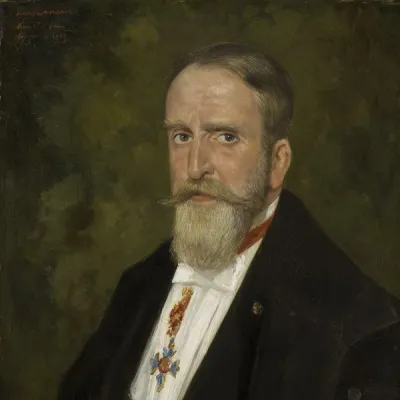
Jan Simon van der Aa
Human Design Chart
Biography
Van der Aa received his doctorate in 1890 from the University of Amsterdam under the supervision of Gerard Anton van Hamel with his dissertation "De Rijksopvoedingsgestichten in Nederland" (The State Educational Institutions in the Netherlands). In 1906, he was appointed professor of philosophy of law, criminal law, and criminal procedure at the University of Groningen. The title of his inaugural address, delivered on 20 October 1906, was "De arbeid als element van de gevangensstraf" (Labour as an element of imprisonment). In 1912, the teaching of philosophy of law was transferred to Isaac Bennie Cohen. Van der Aa delivered his farewell address on 16 October 1926.
Jan Simon van der Aa died on 24 February 1944 at age 77 in Lausanne, Switzerland. The study association for criminal law and criminology at the University of Groningen is named after him.
Human Design Analysis: Jan Simon van der Aa as Generator 1/3
Generator 1/3 — Design at a Glance
Jan Simon van der Aa had a high, enduring sacral energy. His design did not function through initiative but rather by reacting to impulses from the environment. As a Generator, he possessed the potential to generate a lot of energy and work extremely hard and sustainably—provided his energy flowed into tasks that resonated with him internally.
His central life strategy was Reacting. When Jan Simon van der Aa responded to signals from life and his inner self, his sacral center gave a clear "yes," he experienced deep satisfaction and fulfillment. Acting against this internal impulse or initiating independently without an external trigger led to frustration and energy loss.
Two main pitfalls shaped his energetic profile: First, wasting energy on things that did not interest him, which over time could lead to burnout. Second, holding back from his heart's project even though he still wanted to continue working with full power. His path to materialization therefore lay not in actively starting but rather in waiting and then responding intuitively to an invitation or opportunity. If he lived by this principle, nothing could stop him; deviating from it led to persistent frustration and a lack of energy.
Sacral Authority
Jan Simon van der Aa did not base his decisions on cognitive analysis but rather on an immediate physical resonance. His design as a Generator allowed for this direct approach: the strategy of waiting for the impulse and relying on inner authority aligned here, simplifying the decision-making process. Central to this was his defined Sacral Center, which he used as a reliable compass by tuning into its signals. This "gut feeling" manifested in physical sounds like grunting or humming, along with feelings of vital energy and enthusiasm whenever an external stimulus activated his sacral motor. Jan Simon van der Aa responded to such impulses with inexhaustible vitality and immersed himself fully in his tasks, driven by joy rather than duty. Additionally, since the Spleen Center was active and likely connected to the Sacral Center, he had a supportive authority. This gave him the ability for particularly quick and spontaneous reactions as well as an immediate access to his instinctive perception of physical wellbeing. He relied reliably on these deeply rooted impulses that allowed him to take the right path without hesitant deliberation. This configuration shaped his way of living: a spontaneous and joyful exercise of his duties, guided by the direct feedback mechanism of his body in response to the world around him.
The 1/3 Profile — Investigator / Martyr
Jan Simon van der Aas's Human Design profile marks him as a researcher and experimenter whose life path was a cyclical process of theoretical study followed by practical application. His Profile 1/3 combined the drive for logical reasoning with learning through trial and error. Line 1 in the Throat Center, represented by Gate 31, pushed him to build knowledge and seek rational leadership. However, this could lead to hesitation as he felt he did not know enough before taking action. At the same time, Line 3, embodied by Gate 27, urged immediate experimentation and adaptation. This tension between wanting to plan everything in advance and being impelled to dive into experimentation shaped his development.
His characteristic trait was the ability to only accept complex information as trustworthy once he had tested it both theoretically and practically on a personal level. His judgment was considered absolutely reliable only after this double validation occurred. He was a scientist-adventurer type who needed to know secret information in order to care for others appropriately. The quality of his leadership depended on an interplay with subsequent individuals.
Light and darkness in his design were mutually dependent: the light brought form, while the darkness led into spirituality. Through this process of constant testing and adapting, he developed insights that served as a solid foundation for him.
Single Definition — Defined & Open Centers
Jan Simon van der Aa was a Generator whose design relied on a constant vital energy source: his defined Sacral Center. This inner power drove him but required the strategy of waiting and responding. His ability to act did not unfold through initiated action, but rather by waiting for requests that his body answered with a clear yes or no tone. Only upon receiving an affirming response was he fully committed; ignoring this sacral voice in favor of mental deliberation led to resistance and frustration.
His decision-making process did not occur through rational analysis or emotional waves but via the defined Spleen Center as personal authority. This conveyed him intuitive intelligence in the present moment – an immediate instinct for health, safety, and well-being. Jan Simon van der Aa had to learn to trust this subtle, non-verbal signal in the now rather than overriding it with subsequent rationalization.
Simultaneously, his design was marked by seven open centers: Head, Ajna, G, Heart, Solar Plexus, and Root as well as Throat Center. This openness made him receptive to external impulses that he could not identify as his own enduring traits. In the mental realm (open Head and Ajna Centers), he tended to engage with others' doubts or questions rather than seeking his own clarity. His open G Center meant identity and life direction were situational, shaped by the environment; he did not actively seek a fixed 'who', but was initiated when at the right place.
The open Heart Center led him often to feel pressured to prove his worth or make promises for recognition – a mechanism that ultimately weakened him over time. Additionally, his open Solar Plexus absorbed emotions from his surroundings, making him vulnerable to emotional waves not of his own making. Finally, his open Root Center took on external stress which he could misinterpret as his own drive towards hyperactivity. The wisdom of his design lay in using these open fields as mirrors of the environment without being led by them and instead listening to the trustworthy response of his Sacral and the intuition of his Spleen.
Channels for caring preservation and traditional values.
Jan Simon van der Aa exhibited an aura that automatically created trust, making him a natural caregiver for his surroundings. His design was oriented towards preserving clan, values, and infrastructure while balancing care with the defense of traditional order. This dynamic was primarily shaped by Channel 27-50. This connection linked the selfless love of Gate 27 with the conservative impulse of Gate 50, which protected established laws and values. Through this combination, Jan Simon van der Aa could not only support individuals but also ensure structural stability by ensuring that the foundations for his community's survival and well-being remained intact.
However, his inner compass demanded strict discipline: the practice of 'enlightened selflessness'. Jan Simon van der Aa instinctively understood that true care could only arise from a state of personal health and strength. Only those who properly nourished and cared for themselves had the capacity to carry others. Without this foundation, there was a risk of overloading as his open willingness to help could easily be exploited. Therefore, it was crucial that he did not automatically take on responsibility but only when explicitly asked and his inner response – his Sacral authority – clearly signaled 'yes'. This selective commitment ensured him the necessary energy to remain effective long-term without sacrificing himself.
Additionally, further energetic currents influenced his system. Gate 31 brought a capacity for identity transmission and collective power, while Gate 28 encouraged evaluating risks in the here and now. In contrast, Gate 41 viewed evolutionary changes and crises as growth opportunities. On a personality level, he reflected through Gate 32 the desire for material continuity and protection from instability. Gate 42 challenged him to complete processes to take on new commitments, while Gate 29 emphasized persistence in the face of life challenges. Finally, Gate 3 contributed to adaptability by helping create new orders out of confusion. Together, these elements formed a complex pattern of consistent care and adaptive strength.
Tribal Circuitry — Circuit Signature
Jan Simon van der Aa exhibited an ancient fundamental stance, marked by a deep need to protect family and genetics. His design connected the Sacral Center with the Spleen Center via the Protector Circuit. This connection created a direct flow between his life force and instinct.
The active Channel 27-50, 'Conservation', was crucial here. It linked the powerful production of the Sacral with the intuitive perception of the Spleen. This allowed him a natural ability for care, preservation, and nourishing his kin. It was timeless energy of 'mother and father' that did not react to short-term impulses but aimed at the long-term survival of his genetics.
As Jan Simon van der Aa had a simple definition, these two centers formed a cohesive, stable core. His protective instincts were not separate impulses but flowed seamlessly from his life energy. This shaped his actions through strong engagement for safety and care in private settings. The mechanics of this circuit emphasized themes like defending the self and constant provision for family. Thus, his energy primarily served to preserve what was close to him, driven by an instinctive certainty about what was necessary to safeguard his genetics.
Right Angle Cross of the Unexpected 2
Jan Simon van der Aas' Human Design profile established a foundational structure where the unexpected was not seen as a disruptive element, but rather as a central impulse for personal development. The archetypal imprint of the right cross of Unexpected 2 defined his deeper existential framework. This involved navigating and integrating surprises and unforeseen turns as a defining life motif.
This configuration described a pattern of adapting to sudden changes. What would appear to others as disturbance or chaos served him as an essential trigger for realignment. The mechanics focused on the response to the unexpected: unpredicted events were not rejected but understood as necessary components of the growth process. This shaped an attitude of flexibility, where abrupt turns were utilized to break old patterns and forge new paths. The energy of this cross promoted the ability to remain dynamic in moments of uncertainty rather than becoming rigid, thus fostering a proactive integration of surprises as driving forces for evolutionary steps in life.
Saturn Return · Uranus Opposition · Chiron Return · 2nd Saturn Return — Life Cycles
Jan Simon van der Aas' professional career followed a clear rhythmic structure aligned with his planetary cycles. His first Saturn Return marked the transition from education to established expertise: In 1890, at age 25, he was awarded a doctorate by the University of Amsterdam. This cycle condensed years of academic groundwork into a solid conclusion and laid the foundation for his later authority in law.
Further development showed a phase characterized by expansion and institutional anchoring, coinciding with his Uranus Opposition. In 1906, at age 41, he was appointed Professor of Legal Philosophy, Criminal Law, and Criminal Procedure. This appointment was not a random career step but reflected the pressure of this configuration to break through or redefine existing structures. It signaled the move from individual qualification to public responsibility and teaching duties.
The sequence of these events underscores how his professional identity did not remain static but evolved in defined intervals. First, consolidation of knowledge through promotion, later expansion of influence with the professorship title. This mechanism illustrates that his life was governed by an inner order where external recognition was synchronized temporally with profound internal transformation processes of his Human Design cycles.
Generator · Sacral Authority — Synthesis
Jan Simon van der Aas lived a life profoundly marked by his sacral energy – a constant source of endurance and strength, which however only became activated through external impulses. This responsiveness, combined with open Head and G Centers, points to someone who did not become entrenched in rigid identities or prescribed paths but rather embraced the world around them and learned from this interaction. The ability, through the Spleen Center, to instinctively recognize what is nourishing and worthy of protection further enhanced this openness by establishing an immediate connection to life energy. He was thus a true seeker – always on the lookout for new experiences and insights gained through experimentation and testing information.
Despite this dynamic adaptability, a central paradox seemed to manifest in Jan Simon van der Aas' life: The necessity to react to external stimuli (sacral center) stood in tension with his ability to unfilteredly absorb and amplify these impulses due to open centers. This potentially led to an ongoing search for validation and direction while enjoying the freedom of not being confined, posing the challenge of recognizing and acting upon one's own inner truth amidst this flood of information and influence.
1 Defined Channel
Incarnation Cross - Right Angle Cross of the Unexpected 2
Solar Return
The Solar Return shows the moment when the sun returns to its exact birth position - your personal solar year.
Life Cycles
Discover the life cycles with a detailed triple view (birth chart, cycle chart, composite).
Human Design Profile
- Type
- Generator
- Strategy
- To respond - wait for something to respond to
- Authority
- Sacral Authority
- Profile
- 1/3 - Investigator / Martyr
- Definition
- Single Definition
- Incarnation Cross
- Right Angle Cross of the Unexpected 2
- Date of Birth
- 25.07.1865 00:30
- Place of Birth
- Hornhuizen, Netherlands
Frequently Asked Questions
What was Jan Simon van der Aa's Human Design type?
What Profile did Jan Simon van der Aa have?
Which Authority guided Jan Simon van der Aa?
What incarnation cross did Jan Simon van der Aa have?
When was Jan Simon van der Aa born?
Discover your own Human Design
Are you also a Generator? Find out in a personal reading how to use your sacral energy correctly and discover deep satisfaction.
More Personalities
Back to overviewAaliyah

Alexia
Angèle

Anne-Marie

Arcángel

Arno