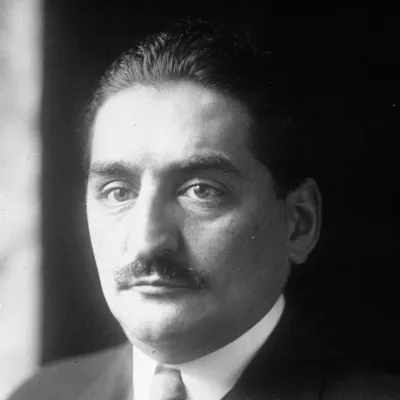
Laurent-Eynac
Human Design Chart
Biography
In 1940, Eynac was appointed Minister of the Air in the government of Paul Reynaud. In this role he served as part of the War Committee put together early in the Second World War.
He died on 16 December 1970.
What does Manifesting Generator 2/4 mean for Laurent-Eynac?
Manifesting Generator 2/4 — Design at a Glance
Laurent-Eynacs design inclined towards extreme speed and parallel action. As an Manifesting Generator, he had constant sacral energy that pushed him to wait for external impulses rather than initiate himself, waiting for his inner 'yes'. This hybrid configuration combined the endurance of a generator with the direct impact of a manifestor.
This mechanism allowed him to skip steps and draw rapid results into his life. However, this speed carried risks: if he skipped important stages or started too many projects at once without his inner authority's consent, it quickly led to frustration. His design demanded that he regularly check whether the work in progress still resonated with him.
When Laurent-Eynac did so by reacting rather than initiating and letting himself be carried by the playful variety of his parallel activities, he experienced deep satisfaction. For him, the advice to do one thing at a time was often counterproductive; instead, his creative power flourished in 'play mode', where multitasking became a source of fulfillment when correctly resonant, rather than overwhelming.
Emotional Authority
Laurent-Eynacs design inclined towards emotional cyclicity: he showed himself as someone who did not make decisions based on initial impulse reactions but needed time for their maturation. This attitude stemmed from his inner authority located in the defined Emotional Center. In Human Design mechanics, this authority always takes precedence over all other defined centers regardless of further configurations. It was subject to a permanent wave of ups and downs, coloring his perception through the current mood. What appeared inspiring at one moment could turn negative in the next. His immediate feeling was only a snapshot, not an ultimate truth. Quick spontaneous reactions to these transient states could lead to misjudgments. Instead, his system required patience: he had to sleep on decisions and gain emotional distance. Through delaying and pausing multiple times, intense feelings subsided. Only then, when the emotional wave had died down, did clarity and calmness set in. This process of distancing was crucial for long-term realignments as it allowed him to recognize deeper connections rather than reacting to superficial mood swings. His strategy involved letting the full cycle of emotions run its course before acting.
The 2/4 Profile — Hermit / Opportunist
Laurent-Eynacs design inclined towards a pronounced tension between deep withdrawal and social engagement. He showed himself as someone who felt the need for isolation at times to condense internal processes before re-entering his familiar network. This dynamic of Profile 2/4, Natural Talent and Networker, describes a life task: Line 2 demands solitude for reflection and idea development while line 4 seeks connection with the community.
For Laurent-Eynac it was crucial to communicate this polarity clearly. His design required the ability to make clear when he sought company and when he needed to be left alone. In his withdrawal phases, he immersed in internal processes, creating calmness and clarity. Only after satisfying line 2's need did he return from his 'cave' to spend time with his favorite people.
The depth of this hermit phase was shaped by aspects like the theme of degeneration and an external perspective. Without experimental openness, this depth could not fully unfold. Simultaneously, his configuration emphasized careful judgment before action, coupled with a certain fixity in character. Laurent-Eynac used solitude to evaluate the knowledge of his network and develop brilliant ideas that he then authentically brought into the community. His success depended on consciously steering this rhythm of withdrawal and re-emergence and making it transparent outwardly.
Split Definition — Defined & Open Centers
Laurent-Eynacs design structured him with immense inner resources, marked by defined centers for communication (Throat), identity (G Center), willpower (Heart), vital energy (Sacral) and emotion (Solar Plexus). This shaped him as someone who had a consistent form of expression. His voice was not a random product of the mind but a reliable channel for his inner truth, driven by a massive sacral energy source. This configuration required the strategy of waiting for reaction: Laurent-Eynac acted most effectively when he did not initiate but reacted to questions or invitations to ensure that his energy was truly available.
His defined Heart Center gave him accessible willpower and the ability to keep promises as well as self-determined control over resources. Parallel to this, his defined Solar Plexus worked as emotional authority; he had to wait out waves of feelings to gain clarity rather than impulsively reacting to highs or lows. His open Spleen provided intuitive protective mechanisms in the present moment.
Simultaneously, his design revealed areas of receptivity: Head, Ajna and Root were open. The open Head Center made him vulnerable to mental pressure and the temptation to answer questions that weren't his own. He tended to be swayed by others' doubts rather than trusting his inner authority. His open Ajna Center allowed a flexible mind that absorbed concepts from the environment without identifying them as personal truths. However, the open Root Center also absorbed external stress and adrenaline. Laurent-Eynac was confronted with distinguishing between healthy engagement of this pressure and attempts to rid himself of unbearable environmental stress through hyperactivity – a cycle that could lead to exhaustion if his mechanics were ignored. His strength lay in using these open spaces not as deficits but as mirrors for the environment while relying on his defined, stable power sources.
Channels for intuitive presence, focus, determination and connection.
Laurent-Eynac showed a deeply rooted intuition for the immediate now, shaping his actions and presence. This attitude stemmed from the Awakening Channel 10-20, connecting G Center with Throat Center. Through Gate 10 (Presence) and Gate 20 (Now), he transformed individual knowledge into correct action in here and now. His behavior was guided by a code of self-love and trust; simply being authentic inspired others unconsciously to be themselves too. This radiant clarity created an atmosphere of acceptance that defused resistance and invited genuine invitations.
This spontaneous wisdom was reinforced by the Brainwave Channel 57-20, linking intuitive insight from Gate 57 (Spleen Center) with expression in the present moment of Gate 20. Laurent-Eynac possessed the ability to communicate penetrating self-awareness directly: 'I know that I am living now.' His verbal outbursts were often pure intuition finding the core faster than reflective analysis, helping him and his surroundings let go of future fears and focus on immediate survival.
Additionally, the Channel of Completion 57-10 linked intuitive insight (Gate 57) with self-presentation (Gate 10), giving him an aesthetics of survival: he acted spontaneously and appropriately based on deep awareness for physical well-being and environment. His behavior was marked by a quiet dignity that did not seek recognition but arose from living his own truth.
The Channel of Discovery 29-46 added persistence. Through Gate 29 (Saying Yes in Sacral Center) and Gate 46 (Self's Determination in G Center), he fully immersed in experiences without expectations, only through this deep commitment could he make discoveries that made sense at the end.
The Channel of Community 37-40 showed his ability to build bridges between individuals and groups. He sought his place within the whole (Gate 37) and understood the necessity of clear agreements and pauses (Gate 40) for sustainable relationships.
Individual Gates like Gate 48 (Pattern Recognition) or Gate 21 (Control over material things) complemented this picture with logical depth and a desire for respect in the community, while Gates like 39 (Provocation/Analysis) and 38 (Boundaries/Fight for Integrity) showed where he held pressure or fought against harmful forces to preserve his identity. Gate 14 provided skilled handling of power and direction.
Individual Circuitry — Circuit Signature
Laurent-Eynacs design inclined towards impulsive identity flashes that, however, moved in separate energetic fields. Through his Split Definition, two independent power centers existed: A combination of G-, Throat- and Spleen Centers alongside a separate block of Heart and Solar Plexus. Between these groups there was no direct flow; they worked parallel beside each other.
In the first field, the Knowledge Circuit over Channel 20-57 connected Throat Center with Spleen. This generated acoustic, pulsating mental flashes for new identity in the present moment. Parallel to this, integration through Channels 20-10 and 10-57 ensured survival: intuitive knowledge (Spleen) was translated into correct behavior (identity) in the current situation (Throat), fostering self-reassurance in the moment.
The second field encompassed Heart and Solar Plexus, connected by the Ego Circuit (Channel 37-40). Here it was about cooperative resource building and the relationship of giving and taking. As no connection to Sacral Center existed, this dynamic required mandatory pauses for regeneration of energy.
A third aspect was the Sense-Making Circuit (Channel 46-29), linking identity with Sacral Center. This channel allowed visual, cyclical reflections on the past to find emotional significance and share these insights with the collective. Laurent-Eynac thus moved between impulsive now-orientation in the first field and emotional sense-making as well as cooperative resource utilization in the second, always considering the need for pauses.
Right Angle Cross of Tension 3
Laurent-Eynacs design structured him through the right cross of tension 3. This configuration formed an archetypal framework of his life energy and significantly determined his inner dynamics. Rather than submitting to external compulsion, he followed an internal logic of building up and releasing tension.
The right cross of tension 3 describes a specific Human Design mechanics. It is a constellation of defined gates that work together to produce a certain type of energy flow. This structure demands continuous engagement with internal pressure and the search for an exit or solution. The energy of this cross is not static; it moves in cycles of tension and relief. For Laurent-Eynac, this meant his life was often marked by this rhythmic movement. He sought no peace in stillness but found his alignment through dealing with tensions. This archetypal dynamic acted as a fundamental life structure shaping his reactions to challenges and determining how he brought energy into the world. It was not a conscious choice but a biological-energetic given of his design. Tension 3 demanded movement and progress through engagement with resistance. Laurent-Eynac lived this mechanics by surrendering himself to the internal dynamics of this cross. His identity was closely tied to this specific energetic quality. The design offered him no path of least resistance but a way of active confrontation with his own energy, shaping his entire existence as someone defined by tension and its resolution.
Saturn Return · Uranus Opposition · Chiron Return · 2nd Saturn Return — Life Cycles
Laurent-Eynacs design showed a clear structuring through recurring astrological cycles marking structural turning points and consolidation phases. This mechanics did not work as an abstract theory but shaped his concrete career development. The first Saturn Return around age 28 condensed years of groundwork into a viable result: in 1914, he was elected to the National Assembly, establishing his political base.
The Uranus Opposition at about age 42 demanded fundamental realignment and breaking with previous structures. This showed in 1928 when he was appointed France's first Minister of Aviation, a role requiring innovation and new political focus. The Chiron Return around age 49 marked not a healing process but a fulfillment cycle where his inner purpose unfolded: in 1935, Laurent-Eynac was elected to the Senate, marking the realization of this internal plan.
The second Saturn Return around age 54 brought a phase of maturity and responsibility. In 1940, he followed as Minister of Aviation into Reynaud's cabinet. Each of these cycles – Saturn, Uranus, Chiron – functioned in Laurent-Eynacs design as concrete triggers for career-relevant decisions structuring and advancing his political career. The mechanics determined the timing of consolidation or breaking with the old.
Manifesting Generator · Emotional Authority — Synthesis
Laurent-Eynac lived a life marked by profound inner clarity and a strong drive towards self-realization. His defined G Center and associated emotional authority pointed to someone who derived their direction from careful engagement with feelings. This internal guidance, coupled with his defined Throat Center, allowed him authentic communication of beliefs and values. The Awakening Channel (10/20) underscored his ability to be present in the moment and express this clarity, manifesting in his commitment to political tasks – a life guided by inner truth and expressed through external actions. The connection between Sacral and G Centers (Channel 29/46) indicated deep persistence in pursuing goals, reinforced by his capacity for self-affirmation.
A central paradox in Laurent-Eynacs design lies in the tension between his emotional center and the need for decision-making. While he needed time to gain clarity (emotional authority), the defined Throat Center pointed towards a tendency to express thoughts and feelings. This dynamic carried the risk of acting impulsively before the emotional wave had fully run its course or getting lost in analysis. The connection from G to Heart Centers also indicated a strong need for recognition, which could clash with his inner drive for self-realization.
5 Defined Channels
Incarnation Cross - Right Angle Cross of Tension 3
Solar Return
The Solar Return shows the moment when the sun returns to its exact birth position - your personal solar year.
Life Cycles
Discover the life cycles with a detailed triple view (birth chart, cycle chart, composite).
Human Design Profile
- Strategy
- To respond - wait for something to respond to
- Authority
- Emotional Authority
- Profile
- 2/4 - Hermit / Opportunist
- Definition
- Split Definition
- Incarnation Cross
- Right Angle Cross of Tension 3
- Date of Birth
- 04.10.1886 05:00
- Place of Birth
- Le Monastier, France
Frequently Asked Questions
What Human Design Type was Laurent-Eynac?
What Profile did Laurent-Eynac have?
What Authority did Laurent-Eynac possess?
What Incarnation Cross did Laurent-Eynac have?
When was Laurent-Eynac born?
Discover your own Human Design
Are you also a Manifesting Generator? Find out in a personal reading how to unfold your multi-talents and direct your energy wisely.
More Personalities
Back to overviewAldair
Alizée

Angeli
Arletty
Artus

Balthus