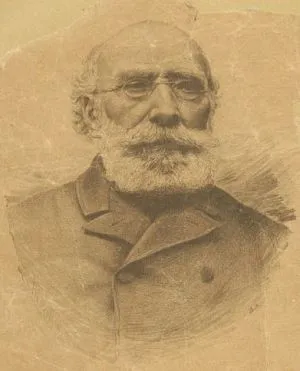
Antoine Béchamp
Human Design Chart
Biography
Béchamp developed the Béchamp reduction, an inexpensive method to produce aniline dye, permitting William Henry Perkin to launch the synthetic-dye industry. Béchamp also synthesized the first organic arsenical drug, arsanilic acid, from which Paul Ehrlich later synthesized salvarsan, the first chemotherapeutic drug.
Béchamp's rivalry with Pasteur was initially for priority in attributing fermentation to microorganisms, later for attributing the silkworm disease pebrine to microorganisms, and eventually over the validity of germ theory.
Béchamp claimed to have discovered that the "molecular granulations" in biological fluids were actually the elementary units of life. He named them microzymas—that is, "tiny enzymes"—and credited them with producing both enzymes and cells while "evolving" amid favorable conditions into multicellular organisms. Béchamp also denied that bacteria could invade a healthy animal and cause disease, claiming instead that unfavorable host and environmental conditions destabilize the host's native microzymas and decompose host tissue by producing pathogenic bacteria.
While cell theory and germ theory gained widespread acceptance, granular theories have been rejected by science. Béchamp's version, microzymian theory, has been retained by small groups, especially in alternative medicine.
He died 15 April 1908 in Paris.
The Human Design of Antoine Béchamp: Manifesting Generator 2/4
Manifesting Generator 2/4 — Design at a Glance
Antoine Béchamps Design established a tendency towards hybrid energy: He had the constant power of a Generator but also possessed the ability for lightning-fast action. His life task was to not initiate himself but to react to inner impulses. This sacral energy required an external response before it could become effective.
At the same time, Antoine Béchamp could skip steps and quickly draw things into his life. However, this speed carried risks. Often he was too quick and skipped important stages, which led him to return later to fill in gaps. This created frustration, the central non-self theme of his type. Additionally, he tended to pursue multiple projects simultaneously, driven by various impulses. When his inner consent was missing, his creative enthusiasm quickly turned into exhaustion.
To use this dynamic constructively, the same strategy applied to Generators: Reacting to life and only acting when the sacral center signaled a clear "yes" was key. Regular checks to see if his internal authorities still supported his current path were crucial. With correct application, Antoine Béchamp drew deep satisfaction from his work. Parallel work then became no obstacle but rather a source of variety and fun for him. He found his true creative power in the play mode, where diversity and quick implementation harmonized instead of overwhelming him.
Emotional Authority
Antoine Béchamps decision-making did not follow a linear path of immediate clarity but rather a rhythmic process of emotional waves. His defined Solar Plexus Center determined his inner authority, meaning he did not make decisions based on the first impulse but only after experiencing emotional movements. For Antoine Béchamp, every emotional reaction was merely a snapshot colored by the current mood – sometimes euphorically excited, other times deeply skeptical. These fluctuations were not mistakes but rather the necessary mechanism of his perception.
Immediate reactions in his system were considered unreliable as they often reflected only the first, still immature impression. True clarity set in only when he allowed time and practiced patience. The principle of "sleeping on it" was central to him: by letting decisions rest, intense feelings subsided, and emotional distance emerged. Only from this distance to the initial mood storm could Antoine Béchamp recognize his deeper truth. This approach protected him from misjudgments arising from transient emotions. Especially for long-term choices, his design required this conscious delay to gain calmness and comprehensive insight. Emotional authority had precedence over all other defined centers in his chart; it was the sole compass for his essential life decisions.
The 2/4 Profile — Hermit / Opportunist
Antoine Béchamps Design presented a clear tension between the deep desire for withdrawal and the simultaneous longing for community. As a person with Profile 2/4, he constantly oscillated between these two poles: Line 2, which promotes solitude and asceticism, and Line 4, which seeks contact with the network. For him, it was crucial to create a safe environment where he could clearly communicate when he sought company and when he needed to be undisturbed.
This structure meant that during his alone time, Antoine Béchamp clarified internal processes and found peace. Line 4 required harmony and simplicity but needed time to organize details before expressing them. If pulled out of this phase too early, frustration or corrections would arise. Only after satisfying the need of Line 2 did he emerge from his "cave" to connect with his favorite people.
This dynamic allowed him to reflect on the knowledge of his network in isolation and develop precise insights. Controlling his availability was not a lack of openness but a necessary strategy to ensure the quality of his contributions. By respecting these boundaries, he could use the tension between projection (Line 2) and relationship (Line 4), rather than being overwhelmed by it. His path involved consciously steering this rhythm: withdrawal for condensation, then targeted emergence in the social field.
Triple Split Definition — Defined & Open Centers
Antoine Béchamps Human Design shows a tendency towards constant inner strength and clear expression ability. His defined Throat Center ensures a reliable voice that carries messages from his inner self into the world. This communication power is fueled by his defined Heart Center, which gives him willpower and the desire for self-determination; he often acts out of the impulse to want and control.
His motor was the defined Sacral Center, a source of immense vitality. Antoine Béchamp reacted to life offers with a physical response that showed him where energy was available. This persistence was supported by his defined Root Center, which provided constant pressure to move forward and master existential challenges. At the same time, he had a defined Spleen Center, giving him spontaneous intuition and an awareness of health in each moment. However, his decisions were not made impulsively but filtered through his defined Solar Plexus Center; he waited patiently until his emotional wave clarified before acting.
In contrast, Head, Ajna, and G Centers are open. Antoine Béchamp tended to absorb mental inspirations from the environment rather than generating them himself. He could reflect in various roles due to his open G Center not having a fixed identity but finding it through relationships and places. Instead of seeking eternal truth in the Head, he used his open mind as a mirror for others' ideas while his defined centers provided him with stable energy to process and express these impressions.
Channels for focus, devotion, emotional truth and growth.
Antoine Béchamp showed himself to be someone who not only analytically penetrated complex biological patterns but also instinctively brought this knowledge into the Stamm. His design united logical depth with entrepreneurial marketing power. The Channel of Concentration 52-9 connects the Root Center with the Sacral Center via Gate of Non-Doing (52) and Gate of Focusing (9). This generates a permanent, calm tension for detailed analysis and logical perfectionism. Antoine Béchamp needed silence to keep distractions at bay and direct energy precisely towards facts; he corrected patterns step by step until they matched the truth. Simultaneously, the Channel of Devotion 44-26 worked as an instinctive entrepreneur connecting the Spleen Center with the Heart Center via Gate of Awareness (44) and Gate of Egoists (26). He had a keen sense for market needs and the willpower to actively sell or enforce solutions. This dynamic allowed him to package and promote scientific truths in ways that the collective would accept. Using his intuitive nose, he recognized what needed improvement and used his ego strength to present these improvements as necessary. The synthesis of the ability to focus on details for hours and the drive to convincingly present results shaped his approach: He did not just analyze for himself but created products or theories that he could successfully bring into the Stamm.
Collective Circuitry — Circuit Signature
Antoine Béchamps design presented three separate, parallel energetic streams. The Understanding Circuit connected his Sacral with Root Center through the Concentration Channel (9-52). This promoted a future-oriented logical structuring and focused attention free from emotional influence.
Simultaneously, the Meaning Finding Circuit existed as an independent unit. It included two groups: Throat was linked to Solar Plexus (Transience 35-36), and Sacral with Root Center (Maturation 42-53). This configuration generated a wave-like emotional dynamic for processing past experiences. Important: The connection between Throat/Solar Plexus and Sacral/Root was not direct; they formed two separate segments within this circuit, both serving the goal of drawing meaning from the past and sharing it.
The third stream, the Ego Circuit, connected Heart with Spleen Center through the Devotion Channel (26-44). This supported cooperative resource creation and mutual support in the 'Stamm'. Since this circuit did not have a direct connection to the Sacral Center, constant life force was lacking. Antoine Béchamp therefore needed strategic rest periods to regenerate energy for these cooperative efforts.
Overall, there was a tension between the cool, rational future orientation of the Understanding Circuit and the emotional, past-oriented wave dynamic of the Meaning Finding Circuit. The Ego Circuit complemented this through the need for cooperation but required regular recovery due to its isolation from Sacral energy. These three definitions coexisted without direct energetic flow between the groups.
Right Angle Cross of Maya 3
Antoine Béchamps Human-Design profile included the structure of the right Maya 3 cross. This archetypal configuration shaped his inner orientation, even though it did not prescribe specific behaviors or concrete action patterns. In Human Design, such crosses function as deep, often unconscious patterns that frame a person's essence without directly steering their daily actions. For Antoine Béchamp, this structure worked as a silent backdrop that influenced the course of his life without manifesting in clear, observable actions. Since no further mechanical details or specific channels of this cross were described in the raw content, its expression remained general and not tied to particular themes. It was a fundamental energetic signature that accompanied his existence but could not be translated into concrete, analyzable behavioral strategies. This ambiguity was part of his individual constellation: an archetypal framework that was there but did not provide a detailed itinerary. Antoine Béchamp lived with this structure that distinguished him as an individual without it resolving into specific life events or character traits beyond merely naming the cross.
Saturn Return · Uranus Opposition · Chiron Return · 2nd Saturn Return — Life Cycles
Antoine Béchamps design set a tendency towards recurring phases of structural consolidation and authority assumption. These cycles shaped his life path as a rhythmic sequence of building up, testing, and affirming his position. In 1843, at age 27, he founded a pharmacy in Strasbourg – a typical moment of the first Saturn return when years of groundwork often condense into a solid result. This step marked the beginning of a phase of professional anchoring.
The structure of his design foresaw that such consolidation phases would be complemented by periods of expansion and new responsibility. In 1856, at age 40, he became Professor for clinical chemistry and pharmacy at the University of Montpellier. This corresponded to the influence of the Uranus opposition, which often brings unexpected opportunities for assuming higher authority.
The peak of this development was shown in his Chiron return, a fulfillment cycle between ages 49 and 51 when one's incarnation cross increasingly makes sense. In 1867, at age 51, Béchamp claimed priority for the infectious disease Pébrine in a letter to the Academy of Sciences. Here his life purpose became concrete: asserting his scientific identity and capability.
The final confirmation came in 1876, at age 60, when he was appointed Dean at the Free Medical School of Lille. This corresponded to the second Saturn return, which often leads to definitive institutional anchoring. His path thus clearly followed the cycles of his structure: building up, expanding, fulfilling and final authority.
Manifesting Generator · Emotional Authority — Synthesis
Antoine Béchamp lived a life deeply marked by an inner dynamic: the constant interplay between the drive to initiate things and manifest them (as a Manifestor Generator) and the need to take time for emotional maturation of decisions. This combination of quick reaction and deep emotional processing created a person who was both innovative and steadfast – a cycle of swift action followed by careful reflection, which ran through his career and quest for knowledge. His defined sacral energy provided the power for this continuous work, while the Heart Center gave him the willpower to pursue his goals and realize himself in his work. Through the connection of Throat, Heart, and Root Centers, he was always ready to do something or manifest it, with a focus on building a stable foundation (Gate 32).
A central paradox in Antoine Béchamps design lies in the tension between his ability for quick reaction and his need for emotional clarity. He was destined to act impulsively, yet simultaneously his emotional authority required careful consideration and experiencing the entire wave of emotions before he could make decisions. This discrepancy may have led to internal conflicts as he oscillated between a desire for immediate implementation and the necessity of thorough emotional processing – a dynamic that forced him to consciously apply his energy and recognize the limits of his own reactivity.
4 Defined Channels
Incarnation Cross - Right Angle Cross of Maya 3
Solar Return
The Solar Return shows the moment when the sun returns to its exact birth position - your personal solar year.
Life Cycles
Discover the life cycles with a detailed triple view (birth chart, cycle chart, composite).
Human Design Profile
- Strategy
- To respond - wait for something to respond to
- Authority
- Emotional Authority
- Profile
- 2/4 - Hermit / Opportunist
- Definition
- Triple Split
- Incarnation Cross
- Right Angle Cross of Maya 3
- Date of Birth
- 15.10.1816 07:00
- Place of Birth
- Bassing, France
Frequently Asked Questions
What is Antoine Béchamp's Human Design type?
What profile did Antoine Béchamp have?
What authority did Antoine Béchamp have?
Which incarnation cross was active for Antoine Béchamp?
When was Antoine Béchamp born?
Discover your own Human Design
Are you also a Manifesting Generator? Find out in a personal reading how to unfold your multi-talents and direct your energy wisely.
More Personalities
Back to overviewAldair

Alizée

Angeli

Arletty

Artus

Balthus