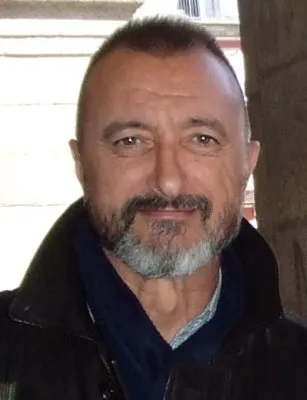
Arturo Pérez-Reverte
Human Design Chart
Biography
Human Design Analysis: Arturo Pérez-Reverte as Manifesting Generator 3/5
Manifesting Generator 3/5 — Design at a Glance
Arturo Pérez-Reverte was someone who worked with hybrid energy: the constant power of a Generator paired with the lightning-fast assertiveness of a Manifestor. His design inclined towards great speed, allowing him to skip steps and quickly pull things into his life. However, this ability carries the risk of overlooking important stages, forcing him to backtrack later and do catch-up work – a process that can lead to frustration if inner consent is lacking.
Characteristic of his approach was also the tendency to push multiple projects forward simultaneously. By reacting to various impulses, he could put himself into a 'play mode' that brought him deep satisfaction. This required, however, not initiating on his own but responding to life and ensuring that his Sacral Center – his energy source – affirmed each endeavor with a clear 'yes'. Only when this inner authority concurred did potential overloading from multitasking turn into productive creative power. Without this reaction to real impulses, his speed could overwhelm him; with it, it became the tool of a dynamic, varied life design.
Emotional Authority
Arturo Pérez-Reverte's design inclined towards emotional fluctuation: His perception of the world was always colored by his current mood. In one moment he could be enthusiastic about something, in the next view the same situation entirely negatively. This configuration describes Emotional Authority, which is present whenever the Emotional Center is defined – regardless of which other Centers are active in the chart.
For Arturo Pérez-Reverte, feeling in the moment was just a snapshot, a first impression that did not necessarily represent his truth. Quick, spontaneous decisions made from such an emotional state could therefore have negative consequences. Instead, his system required patience: He had to take time for decisions to mature. This meant hesitating and being asked multiple times. Over time, intense feelings subsided, he gained emotional distance, clarity and calmness set in. Only then was he through the process. This mechanism was particularly important for long-term decisions that could have a significant impact on his life course. By waiting and sleeping over options, he could see deeper and more comprehensively what truly served him.
The 3/5 Profile — Martyr / Heretic
Arturo Pérez-Reverte revealed himself through his Human Design Profile 3/5 as someone who gained knowledge not from books but through direct, often risky experimentation. This 'Experimentor' initially believed nothing and had to experience everything firsthand to distill practical wisdom. This attitude shaped him into a heroic storyteller: He amassed a rich trove of experiences – including inevitable failures – and presented them to others with almost magnetic attraction.
The Line 3 of his profile emphasized the process of trial and error as a path to awareness and authenticity. Power unfolded here not through dogma but by surviving one's own experiments. Simultaneously, the Line 5, that of the Hero and Saviour, influenced him. It gave him an alluring aura, especially in crisis times. Others projected their hopes onto him because he possessed the knowledge to solve problems through his own practice. This role as a cool storyteller flattered his design deeply but also carried the risk of public failure – a price for the transparency of his learning. Thus, Arturo Pérez-Reverte became living proof that true authority stems from lived experience and the ability to convey this attractively to others.
Split Definition — Defined & Open Centers
Arturo Pérez-Reverte revealed himself as someone whose expression and actions were driven by a deep inner vitality. His design indicated a tendency towards constant, clear communication that flowed directly from his sacral energy source. With defined Throat and Sacral Centers, he had a reliable motor for work and expression; he did not act impulsively but responded to life with full energetic support. His voice was more than just an intellectual act; it was a transmuter of his generative power into the world.
This physical presence was reinforced by defined Heart and Root Centers. He possessed natural willpower and the drive to move forward materially and existentially. It was important for him to fulfill promises and establish his own authority in the world without overburdening others. The connection between Root pressure and Sacral energy created a robust foundation for endurance and success in daily life.
At the same time, his design revealed sensitive points of conditioning. With open Head, Ajna, and G Centers, he was prone to getting lost in mental confusion or searching for a fixed identity. He was susceptible to adopting others' opinions as his own truth or questioning who he really was and where his life was headed. These open centers acted like mirrors: they absorbed intellectual concepts and directions from the environment rather than generating them themselves. The challenge lay in not interpreting this mental noise as his own truth but relying on the clear response of the Sacral Center and the emotional clarity of the defined Solar Plexus. His open G Center also meant that his identity stabilized only in correct environments; at the wrong place, he felt lost, while at the right place, he flourished, carried by the support of others.
Channels for charismatic power, intuition, community and emotion.
Arturo Pérez-Reverte revealed himself as someone whose ability to act was based on a deep, instinctive reaction that left little room for hesitant thinking. This dynamic was shaped by Channel Charisma 34-20: The raw physiological energy of the Sacral Center (Gate 34) met directly with the Throat Center (Gate 20), creating an urge to act so quickly it bypassed conscious thought. This created a tendency towards constant engagement and charismatic presence, which remained stable only when guided by inner leadership.
This guidance occurred through Channel Power 34-57, connecting the Sacral Center with the Spleen. Here, an archaic survival intelligence operated: Gate 57 (intuitive insight) continuously scanned the environment for dangers or opportunities and directed these warning signals directly into the generative power of Gate 34. The result was rapid defensive alertness and the ability to make decisions in fractions of a second – not through logical analysis but through auditory attention and bodily sensation.
Additionally, intuitive truth flowed through Channel Brainwave 57-20 straight to the voice. When Gate 57 had an insight, it was expressed without filters in the present moment. This gave his utterances a piercing sharpness and authenticity that often surprised or challenged others because they were not constructed but spontaneous from the subconscious.
In interpersonal relationships, Channel Community 37-40 and Channel Feelings Release 39-55 shaped his relationship with the environment. He sought clear, fair agreements (Gate 37/40) and was willing to contribute when he felt valued. Simultaneously, his emotional state followed a natural wave of highs and lows (Gate 39/55). This moodiness was not a flaw but a mutative force: in moments of melancholy or passion, he could reveal deep truths while retreating during phases of uncertainty to conserve energy. His strength lay in accepting this emotional alchemy without rationalizing it, making him appear as an individual with his own unshakable aura.
Individual Circuitry — Circuit Signature
Arturo Pérez-Reverte was marked by a divided energetic structure that formed two parallel, non-directly connected power fields. One field linked the Throat, Sacral, and Spleen Centers; the other the Solar Plexus, Heart, and Root Centers. This separation meant his creative impulses and emotional drive existed as separate streams without forming a single cohesive flow.
In the Knowledge Circuit, Channels Lightning Strike (Throat-Spleen) and Feelings Release (Solar Plexus-Root) were active in him. This created two isolated segments: on one hand, innovative, present-moment acoustic intuition; on the other, emotional waves running through the body. This configuration promoted the emergence of new knowledge and its expression but without direct linkage between cognitive inspiration and emotional processing.
The Ego Circuit featured Channel Community (Heart-Solar Plexus). Here it was about cooperation and resource exchange within the tribe. Without a connection to the Sacral Center, pauses for regeneration were essential to maintain energy for mutual support.
Lastly, the Integration Circuit operated with Channels Charisma and Power, connecting Throat, Sacral, and Spleen Centers. This enabled drawing strength from reacting to life, guiding it through intuitive knowledge, and making an impact in the present moment. Overall, these divided circuits shaped a profile that oscillated between individual creativity, tribe-oriented cooperation, and self-reinforcing integration, each level possessing its own dynamics.
Right Angle Cross of the Sleeping Phoenix 4
Arturo Pérez-Reverte's Human Design suggests a tendency towards a deep, often unspoken inner order. This configuration, the right cross of the sleeping phoenix, describes not external activity but a quiet, fundamental structure in character. It acts like an invisible compass guiding decisions and stances from a very personal, barely visible center.
In Human Design mechanics, this cross represents a specific kind of integrity. It is not about what is outwardly visible or expected by others, but rather an inner truth that often remains dormant for long periods before manifesting in clear actions. The phoenix symbolizes not a dramatic rebirth in the public sphere, but a quiet renewal of one's values and principles.
For Arturo Pérez-Reverte, this means his most important impulses come from this deep, private source. His energy is not geared towards constant proof or persuasion but adhering to this inner structure. When external circumstances challenge this inner order, there is a remarkable constancy. It is a design that requires patience and depth because the power does not lie in the speed of action but in the clarity of inner alignment. This quiet presence shapes his way of dealing with challenges: not through loud protest but through an unshakable stance that arises from this specific cross configuration.
Saturn Return · Uranus Opposition · Chiron Return · 2nd Saturn Return — Life Cycles
Arturo Pérez-Reverte showed a development line manifesting as increasing institutional anchoring and recognition of his life's work. His design carried the impulse to solidify one's creation within established structures, often only fully unfolding later in life. This process typically culminated during the Chiron Return cycle between the ages of 49 and 51 – a period where the inner essence and incarnation cross experience fulfillment and meaning when aligned with strategy and authority. It is not a phase of psychological healing but a blooming time reflecting one's core. For Arturo Pérez-Reverte, this qualitative change occurred in 2003 when he was admitted to the Royal Spanish Academy at age 52. This event marks not only a career peak but exemplifies the mechanics of Chiron Return: long-term dedication and commitment to one's essence lead to official confirmation and integration into high cultural institutions. His entry into this academy was the visible expression that his design now fully and officially fulfilled its intended role in the world.
Manifesting Generator · Emotional Authority — Synthesis
A central red thread runs through the design: the dynamics between the drive for quick, direct manifestation (Channel Charisma) and the need for emotional maturity (emotional authority). This tension manifests as a constant interplay of impulsive action and the need to filter decisions through an emotional wave. The line 3/5 of the profile strengthens this by connecting the urge to experiment with learning from experiences and sharing them – a process requiring time and emotional processing. The defined Throat Center indicates strong expressive power, yet influenced by the quality of underlying energy (Sakra or emotions).
The central paradox lies in the combination of quick reactivity and emotional depth. While the Sacral center provides immediate responses and fuels the desire for rapid progress, emotional authority demands a delay, sleeping on decisions to gain clarity. This apparent contradiction creates an inner tension between the need to act in the moment (Gate 20) and the necessity to weigh consequences emotionally – a tension driving the creative process of the knowledge circuit.
5 Defined Channels
Incarnation Cross - Right Angle Cross of the Sleeping Phoenix 4
Solar Return
The Solar Return shows the moment when the sun returns to its exact birth position - your personal solar year.
Life Cycles
Discover the life cycles with a detailed triple view (birth chart, cycle chart, composite).
Human Design Profile
- Strategy
- To respond - wait for something to respond to
- Authority
- Emotional Authority
- Profile
- 3/5 - Martyr / Heretic
- Definition
- Split Definition
- Incarnation Cross
- Right Angle Cross of the Sleeping Phoenix 4
- Date of Birth
- 25.11.1951 07:00
- Place of Birth
- Cartagena, Spain
Frequently Asked Questions
What is Arturo Perez-Reverte's Human Design type?
What Profile does Arturo Pérez-Reverte have in Human Design?
What Authority determines Arturo Pérez-Reverte?
Which incarnation cross is active for Arturo Perez-Reverte?
When was Arturo Pérez-Reverte born?
Discover your own Human Design
Are you also a Manifesting Generator? Find out in a personal reading how to unfold your multi-talents and direct your energy wisely.
More Personalities
Back to overviewAlain-Fournier

Aldair

Alizée

Angeli

Arletty
Artus