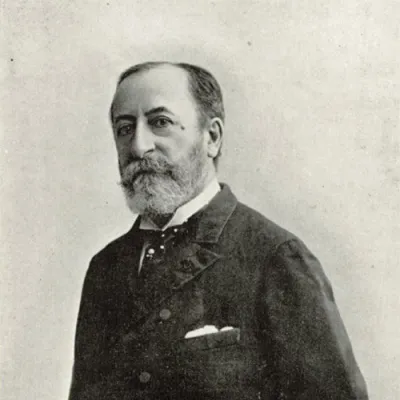
Photo: Wikimedia Commons
Camille Saint-Saëns
Human Design Chart
Biography
Writing came easily to him; his works included the opera "Samson And Delilah," and symphonic poems such as "Danse Macabre," "Carneval Des Animaux" and "Third Symphony." Among his numerous honors he had a membership in the Institut de France, 1881, and Grand Cross of the Legion d'Honneur in 1913. Saint-Saens composed five piano concertos and three violin concertos, developing a brilliant technique.
He died on 16 December 1921, Algiers.
Human Design Analysis: Camille Saint-Saëns as Generator 1/3
Generator 1/3 — Design at a Glance
Camille Saint-Saëns possessed remarkable endurance that allowed him to pursue tasks with great consistency. As a Generator, he had abundant sacral energy, comparable to a strong workhorse that generates power as long as it burns for its task. However, this energy was not released through independent initiation but by responding to signals from his environment. His strategy involved waiting until an inner 'yes' emerged before taking action.
This mechanism protected him from two typical pitfalls: Firstly, the wastage of energy on things without internal resonance, leading to exhaustion. Secondly, holding back projects that he still wanted to pursue with full power. When Camille Saint-Saëns responded to impulses from life and acted accordingly, nothing could stop him. Living in harmony with this design rewarded him with a deep sense of fulfillment. If he initiated independently without inner confirmation, however, he encountered frustration and energy shortages. His success thus depended on reacting from the gut rather than anticipating.
Emotional Authority
Camille Saint-Saëns was someone who never made decisions immediately but allowed them to mature consciously. His design featured Emotional Authority, as the emotional center was defined and therefore always took precedence over all other defined centers. This meant he was subject to a constant wave of rising and falling emotions: The world appeared colored by his current mood; a moment of enthusiasm could turn into deep skepticism in the next instant. Since this immediate feeling was only a fleeting snapshot, spontaneous actions risked errors as the first impression did not yet reflect the truth. His strategy involved taking time to think through decisions multiple times or even sleep on them. Only when intense feelings subsided and emotional distance had been gained did clarity set in for him. This process of patience allowed him to recognize deeper connections and find calm, which was especially crucial for long-term life decisions.
The 1/3 Profile — Investigator / Martyr
Camille Saint-Saëns showed himself as someone whose judgments were based on a double check: theoretical knowledge and practical experience. His Human Design Profile 1/3, that of the Researcher and Experimenter, established this fundamental approach. The Line 1 drove him to learn first and cultivate intuition; confusion did not serve as an obstacle but rather as a foundation for extraordinary clarity. Once he moved into implementation, however, the energy of Line 3 took over. Here, the principle of trial and error applied: mistakes were not defeats but essential steps in development.
This combination meant that Camille Saint-Saëns only considered something truly good if it had been thoroughly thought through in his mind as well as rigorously tested in practice. His judgment was therefore trustworthy because it did not rest on mere theory or blind activism, but rather on this synthesis of research and experience. Conflicts were often unconsciously provoked to force development while the search for harmony remained in the background. The Spleen Center supported this process through intuitive survival energy that operated independently of physical strength. Thus, a specific learning path emerged for him: active experimentation followed by reflective review of results, thereby solidifying his insights.
Split Definition — Defined & Open Centers
Camille Saint-Saëns revealed himself through a firm inner identity and a clear sense of direction in life. His defined G Center gave him a reliable self-image that allowed him to love others without becoming dependent. This stability contrasted with the attraction of his open Head and Ajna Centers, where he was vulnerable to mental confusion. Instead of constantly seeking intellectual confirmation, he tended to observe mental pressure as a transient phenomenon without being led by doubts.
His energy source lay in his defined Sacral Center, which provided him with constant vital power. This energy became effective when he reacted to external stimuli rather than initiating himself. Through this reaction, he found deep satisfaction and avoided the exhaustion that would result from making mental decisions without sacral approval. Parallel to this, his defined Solar Plexus served as an emotional authority. He learned to trust the waves of his feelings and make decisions only after waiting for emotional clarity, which helped him avoid impulsive actions and gain deep insights.
The defined Spleen Center provided spontaneous intuition in the present moment, while the defined Root Center supplied the necessary pressure to remain existentially present. This combination of instinct and endurance formed the foundation of his ability to act. In contrast, his open Heart Center revealed a vulnerability to wanting to prove one's worth through promises or competition. By recognizing this trap of willpower and not falling into the cycle of self-proof, he could maintain his natural dignity. His design thus promoted a life based on inner security, emotional patience, and intuitive reaction, free from the need to constantly justify himself intellectually or willed.
Channels for rhythm, emotional clarity and ambitious transformation.
Camille Saint-Saëns revealed himself as someone who created innovative directions through his generative energy. This occurred via Channel Beat 14-2, connecting Gate of Competence (14) with Gate of Higher Knowledge (2). This configuration gave him the ability to use material resources to drive mutations and forge new paths by trusting his inner reaction.
Simultaneously, he was driven by an intense desire for new experiences, mediated through Channel Recognition 41-30. Here, restlessness from the Root Center (Gate 41) connected with emotional intensity in the Solar Plexus (Gate 30). This generated a longing to deeply feel life and gather experiences, though patience was needed to gain clarity within the emotional wave.
Furthermore, he was shaped by ambitions supported by Channel Transformation 54-32. Ambition (Gate 54) was guided by awareness of continuity and talent (Gate 32), motivating him to rise through constancy and service to the collective.
Additionally, isolated Gates like Gate 51 with its strong willpower and adaptability as well as Gate 53, which fosters new cycles and a pioneer spirit, influenced him. Gate 57 provided intuitive clarity in the here and now, while Gate 44 brought alertness to interactions. The ability for detail work (Gate 9) and orientation towards collective rhythms (Gate 15) rounded out his design, as well as readiness for risks (Gate 28), provocation as a means of analysis (Gate 39), and acceptance of limitations for transcendence (Gate 60). These mechanisms collectively shaped his unique expression.
Individual Circuitry — Circuit Signature
Camille Saint-Saëns revealed himself through a design with split definition, forming two independent energetic blocks. One block connected Identity and Sacral Centers; the other included Solar Plexus, Root, and Spleen Centers. This separation meant that the forces did not flow into each other but existed parallel.
The Knowledge Circuit was active via Channel 'Beat' between Identity and Sacrum. This gave him a pulsing rhythm and emphasized his unique individuality. He had an acoustic quality that promoted new paths and mutations.
In the Perception Circuit, Channel 'Recognition' between Solar Plexus and Root Center worked. This area was cyclical and visually marked, with a downward emotional wave. It served to reflect past experiences, find their meaning, and share these insights with the collective.
The Ego Circuit utilized Channel 'Transformation' between Spleen and Root Centers. Although it belongs to the Stem Group, there was no direct connection to the Sacral Center here. Instead, this area focused on timeless values, tactile and olfactory senses, as well as traditional structures. The energy worked like a ratchet, necessitating pauses for resource building.
Together, these three circuits formed a complex pattern: A pulsing, individual expression stood alongside cyclical processing of the past and a traditional, resource-oriented approach in social contexts. Since there was no connection between the two main groups, Camille Saint-Saëns had to learn to integrate these different energetic realities as separate but equally valued aspects of his personality without artificially merging them.
Right Angle Cross of Penetration 3
Camille Saint-Saëns was characterized by a profound inclination to penetrate complex interconnections and convey these insights with a clear, almost surgical precision. His design was marked by the energy of the right penetration cross 3. This configuration combined the intuitive ability to grasp hidden patterns instantly with the drive to communicate these truths unfiltered and directly. It wasn't about gentle mediation but rather an intellectual cutting through illusions or ambiguities.
It was typical for him that he didn't just see things, but reduced them to their essence and presented this reduction to others. This mechanism fostered a stance of intellectual honesty and directness. He tended to unravel complexity and expose the underlying structure, often with a certain ruthlessness towards superficiality. His way of looking at the world was analytically sharp; he penetrated facade and form to hit the core. This shaped his interactions and expression: clear, focused, and to the point, without unnecessary detours or softening. The energy of this cross propelled him not only to recognize the truth but also to make it visible and tangible for his environment.
Saturn Return · Uranus Opposition · Chiron Return · 2nd Saturn Return — Life Cycles
Camille Saint-Saëns’ design inclined towards structured milestones that combined inner maturity with external recognition. This development unfolded in clearly defined phases marked by planetary cycles, which refined his life direction.
The first Saturn return around age 26 served as a test of responsibility and discipline. During this phase, years of groundwork condensed into a solid foundation. In 1861, he took the position of piano teacher at École Niedermeyer de Paris – a step that institutionalized his professional competence and established a stable career base.
Around age 40, the Uranus opposition occurred, a cycle often associated with a need for freedom or realignment in interpersonal bonds. Here, the design sought balance between individual autonomy and partnership. This was evident in 1875 when he married Marie-Laure Truffot – a decision that solidified his private life structure.
The Chiron return around ages 46 to 51 marked the phase of bloom where the incarnation cross unfolds, making purpose tangible. It wasn't about healing but about realizing inner intent through external validation. This peak occurred in 1881 when he was elected into the Academy of Fine Arts. This honor confirmed his artistic authority and anchored his life path sustainably in public recognition.
Generator · Emotional Authority — Synthesis
Camille Saint-Saëns lived a life driven by a deep internal force to generate energy and channel it into creative work (Generator type with defined Sacral Center). However, this ability for endurance and creation was always modulated by an emotional depth (Emotional Authority) that compelled him not to rush decisions but let them ripen in the wave of his feelings. The profile as a researcher and experimenter (1/3) underscored this process: he sought new insights and tested these both theoretically and practically before passing judgment – a verdict one could trust. The Channel of Beats (14-2) suggests that he was ready to move into new directions guided by this inner direction.
A central paradox marked Saint-Saëns’ design: the tension between the necessity to maintain his energy through work on heart projects (Generator Pitfall), and the influence of the knowledge circuit, which urged him constantly to discover and transform. He seemed always in search for innovation and uniqueness while wanting to preserve the reliability of his own identity (defined G Center). This was evident in events where career successes and personal commitments were intertwined with phases of intense scrutiny and realignment.
3 Defined Channels
Incarnation Cross - Right Angle Cross of Penetration 3
Solar Return
The Solar Return shows the moment when the sun returns to its exact birth position - your personal solar year.
Life Cycles
Discover the life cycles with a detailed triple view (birth chart, cycle chart, composite).
Human Design Profile
- Type
- Generator
- Strategy
- To respond - wait for something to respond to
- Authority
- Emotional Authority
- Profile
- 1/3 - Investigator / Martyr
- Definition
- Split Definition
- Incarnation Cross
- Right Angle Cross of Penetration 3
- Date of Birth
- 09.10.1835 07:00
- Place of Birth
- Paris, France
Frequently Asked Questions
What was Camille Saint-Saëns' Human Design type?
What Profile did Camille Saint-Saëns have in Human Design?
What Authority did Camille Saint-Saëns have?
What incarnation cross did Camille Saint-Saens have?
When was Camille Saint-Saens born?
Discover your own Human Design
Are you also a Generator? Find out in a personal reading how to use your sacral energy correctly and discover deep satisfaction.
More Personalities
Back to overviewAaliyah

Alexia

Alizée

Angèle

Anne-Marie

Arcángel